Different Types of Wood Saws: A Professional Selection Framework
Master the CMP framework to choose among different types of wood saws for framing, engineered timber, and finish carpentry with exact blade specs.

Selecting the correct saw for dimensional lumber, engineered timber, or finish millwork directly impacts material yield, joint integrity, and jobsite safety. The different types of wood saws available to modern framers and finish carpenters range from traditional Japanese pull saws to 12-inch sliding compound miter saws. Rather than relying on generic buying guides, professional builders must apply a rigid selection methodology to match tool mechanics to specific wood densities and cut geometries.
The CMP Selection Framework for Wood Saws
To systematically evaluate different types of wood saws, apply the Cut-Material-Precision (CMP) framework:
1. Cut Geometry: Is the primary task ripping (with the grain), crosscutting (across the grain), or compound mitering?
2. Material Density & Thickness: Are you cutting softwood SPF (Spruce-Pine-Fir), dense hardwoods, or resin-heavy engineered LVLs?
3. Precision Tolerance: Does the application require framing tolerances (1/16-inch) or finish millwork tolerances (1/64-inch)?
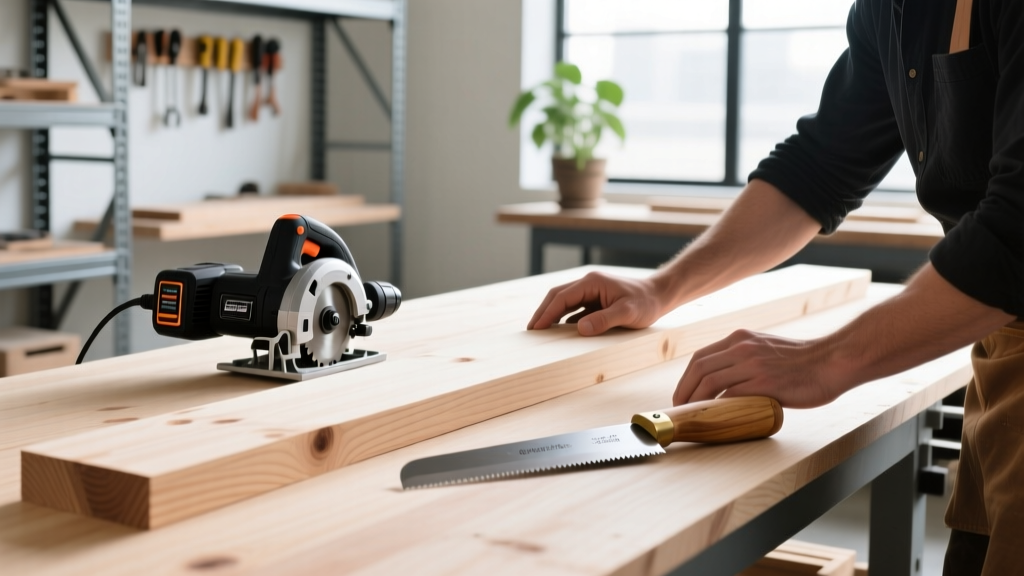
Categorizing Different Types of Wood Saws by Mechanics
Portable Power Saws: Circular and Track
Portable circular saws are the backbone of rough framing. When selecting a circular saw, the drivetrain dictates the tool's optimal use case. Worm-drive saws, such as the Skilsaw SPT77WML, position the motor parallel to the blade, delivering higher torque at lower RPMs (approx. 5,300 RPM). This makes them ideal for ripping dense, wet pressure-treated lumber or cutting thick LVL headers. Sidewinder (direct-drive) saws, like the DeWalt DCS570B, spin faster (approx. 5,200 RPM to 5,800 RPM) and are lighter, making them superior for overhead crosscutting and rapid sheathing work.
For cabinet-grade plywood and veneered panels, track saws (e.g., Festool TS 55 REQ) replace the traditional circular saw. The guide rail eliminates blade deflection, and the riving knife prevents kerf pinching, yielding splinter-free edges on both sides of the melamine or hardwood veneer.
Stationary Saws: Miter, Table, and Band
Stationary saws provide the stability required for repetitive, high-precision cuts.
- Sliding Compound Miter Saws: A 12-inch sliding miter saw (e.g., DeWalt DWS779) handles crosscuts up to 14 inches wide. However, the sliding mechanism introduces slight lateral deflection. For critical finish carpentry, a 10-inch non-sliding miter saw offers superior rigidity and tighter miter tolerances.
- Table Saws: The table saw is the only safe and accurate tool for ripping long stock. For jobsites cutting engineered I-joists, a table saw with a 3HP motor and a zero-clearance throat plate prevents the fragile OSB web from tearing out during the rip.
- Band Saws: Often overlooked in framing, portable deep-throat band saws are essential for cutting curved brackets, scarf joints, or resawing thick timber into thinner veneers without wasting material to a wide kerf.
Hand Saws: Western Push vs. Japanese Pull
While power tools dominate, hand saws remain critical for flush cuts and delicate finish work. Western saws cut on the push stroke, requiring a thicker blade to prevent buckling. Japanese saws (Nokogiri) cut on the pull stroke, allowing for ultra-thin blades. The Gyokucho Ryoba #611 features a dual-edge 240mm blade (crosscut on one side, rip on the other) with a kerf of just 0.02 inches. This leaves a glass-smooth finish on hardwood trim without the need for sanding or planing.
Decision Matrix: Matching Saw to Lumber Application
| Saw Type | Primary Cut | Max Typical Thickness | Precision Tolerance | Ideal Lumber Target |
|---|---|---|---|---|
| Worm-Drive Circular | Ripping / Beveling | 2.5 inches (at 45°) | ±1/16 inch | Wet PT Lumber, LVL Headers |
| Track Saw | Ripping / Plunging | 2.125 inches | ±1/64 inch | Cabinet Plywood, Melamine |
| 12" Sliding Miter | Crosscut / Compound | 6.75 inches (vertical) | ±1/32 inch | Dimensional Framing, Decking |
| Jobsite Table Saw | Ripping / Dadoing | 3.125 inches | ±1/64 inch | I-Joists, Hardwood Flooring |
| Ryoba Pull Saw | Flush / Detail | 4 inches | ±1/128 inch | Dowel Pins, Finish Trim |
Blade Geometry: TPI, Kerf, and Hook Angles
The saw itself is only half the equation; blade geometry dictates the actual cut quality and feed rate. When navigating the different types of wood saws, you must pair the tool with the correct blade specifications.
- Teeth Per Inch (TPI): Framing and ripping require low TPI (4 to 7) for aggressive chip removal. Crosscutting dimensional lumber requires 10 to 14 TPI to sever wood fibers cleanly. Finish carpentry demands 40 to 80 TPI.
- Hook Angle: The hook angle determines how aggressively the tooth bites into the wood. A positive hook angle (15° to 20°) pulls the wood into the blade, ideal for ripping framing lumber. A negative hook angle (-2° to -5°) prevents the blade from climbing the material, which is mandatory for cutting aluminum, plastics, or using a sliding miter saw to prevent dangerous kickback.
Special Considerations for Engineered Structural Timber
Cutting engineered wood products like Laminated Veneer Lumber (LVL), Parallel Strand Lumber (PSL), and Glulam presents unique challenges. According to guidelines from APA - The Engineered Wood Association, the structural adhesives and resins used in these products are highly abrasive and generate significant heat during cutting.
Standard high-speed steel (HSS) or uncoated carbide blades will dull rapidly and cause the resins to melt, gumming up the blade and causing dangerous kickback. When cutting LVLs or Glulams, you must use carbide-tipped blades with an anti-stick PTFE coating (such as Freud's Perma-Shield). Furthermore, the USDA Forest Products Laboratory Wood Handbook notes that engineered timbers have uniform density without natural defects, meaning the cutting resistance remains constant, allowing for faster, continuous feed rates compared to natural knotty timber.
Jobsite Safety and OSHA Compliance
Operating different types of wood saws requires strict adherence to safety protocols. OSHA Standard 1926.304 mandates specific guarding requirements for woodworking machinery. For portable circular saws, the lower blade guard must automatically retract and cover the blade when not in the cut. Bypassing or pinning back the lower guard is a citable offense and the leading cause of severe lacerations on framing jobsites.
Summary Checklist for Jobsite Procurement
- Audit the Cut List: Determine the ratio of ripping to crosscutting to decide between investing in a high-torque worm-drive vs. a high-RPM sidewinder.
- Verify Material Abrasiveness: If cutting LVL, PSL, or pressure-treated lumber, allocate budget for PTFE-coated carbide blades to prevent resin buildup.
- Match Tolerance to Tool: Reserve sliding miter saws for framing and decking; deploy non-sliding miter saws or track saws for finish millwork and cabinetry.
- Check Power Ecosystem: For cordless portable saws, standardize on a single battery platform (e.g., Makita 18V LXT or DeWalt 20V MAX) to maximize battery rotation across the framing crew.
Written by
David NakamuraDavid Nakamura is a licensed architect (AIA) and construction technology writer focused on sustainable building methods, mass timber engineering, and high-performance building envelopes. He holds a Master of Architecture from the University of Washington and is a certified Passive House Consultant (CPHC). David spent eight years at the Seattle firm Mithun, where he led the design of three LEED Platinum projects, before founding his own practice specializing in net-zero residential design. He serves on the editorial advisory board of GreenBuilder Magazine and has authored peer-reviewed papers on cross-laminated timber (CLT) connections for the Journal of Structural Engineering. In his spare time, David teaches woodworking at Pratt Fine Arts Center and kayaks the Puget Sound.
More from David Nakamura
View all
Construction Cost
Labor Cost to Build a Deck Per Sq Ft: 2026 Installation Guide
Discover the exact labor cost to build a deck per sq ft in 2026. This installation guide breaks down contractor rates, complexity factors, and hidden fees.
Aug 4, 2026

Construction Cost
How Much Does It Cost to Build a 3 Bedroom House? Financing Guide
Learn exactly how much it costs to build a 3 bedroom house and explore 2026 financing options, construction loan types, and budget frameworks for your build.
Aug 4, 2026

Construction Cost
Cost to Build a Tennis Court: 2026 Guide
How much does it cost to build a tennis court in 2026? Breakdowns for asphalt, concrete, and synthetic surfaces plus fencing and lighting.
Jul 30, 2026