A Species Guide to the Different Type of Joints in Wood
Discover how wood species density, grain, and movement dictate the different type of joints in wood for structural and furniture applications.

The Intersection of Wood Species and Joinery
Selecting the correct joinery method is never a one-size-fits-all decision. When evaluating the different type of joints in wood, the specific species you are working with dictates the mechanical limits, adhesive compatibility, and long-term dimensional stability of the connection. A joint that holds a white oak dining table together for a century will catastrophically fail if applied to eastern white pine without modification.
The USDA Forest Products Laboratory Wood Handbook emphasizes that wood is an anisotropic material, meaning its physical properties change depending on the grain direction and species density. Understanding these variables is the foundation of master-level woodworking and structural timber framing.
Hardwoods vs. Softwoods: Matching Density to Joint Mechanics
The Janka hardness rating measures the force required to embed a 0.444-inch steel ball halfway into the wood. This metric directly correlates to how a species will respond to mechanical fasteners and traditional interlocking joinery.
Traditional Joinery for Dense Hardwoods
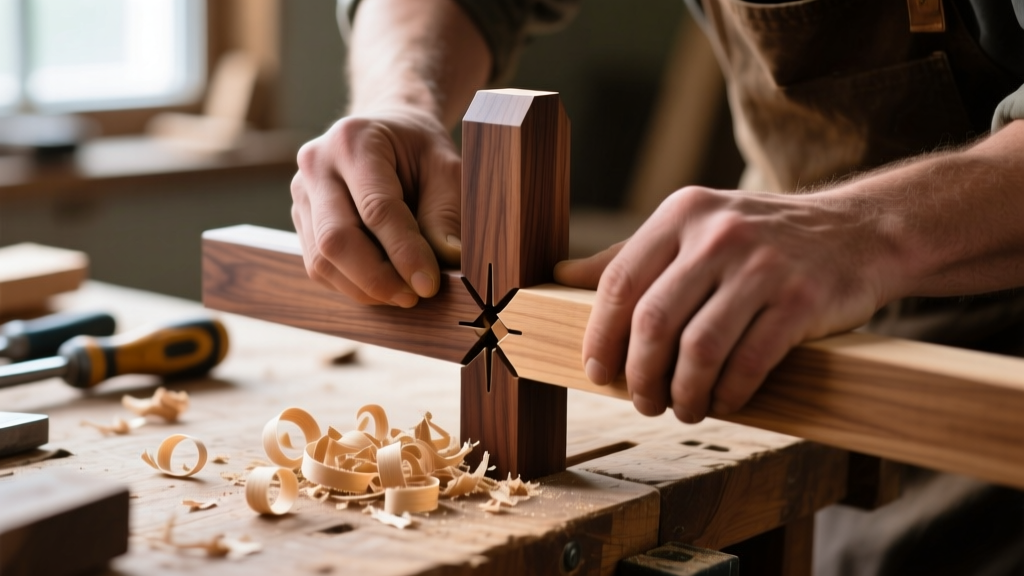
Species like Hard Maple (1,450 lbf Janka), White Oak (1,350 lbf), and Hickory (1,820 lbf) possess dense, interlocking grain structures. These species excel in traditional, interlocking joints such as mortise and tenons, dovetails, and finger joints.
- Mortise and Tenon: The high shear strength of hardwoods allows for relatively thin tenons (typically 1/3 the thickness of the stock) without risking snap failures under load.
- Dovetails: Hardwoods hold crisp baseline edges, preventing the crushing that occurs in softer species when pins and tails are seated.
Mechanical and Adhesive Joints for Softwoods
Softwoods like SPF (Spruce-Pine-Fir), Eastern White Pine (380 lbf), and Western Red Cedar (350 lbf) have lower shear strength and highly compressible earlywood bands. Traditional dovetails often crush or deform in these species.
- Pocket Screws and Dowels: Softwoods grip screws well but strip easily under torque. Use coarse-thread screws specifically designed for softwoods to maximize thread bite without reaming out the pilot hole.
- Biscuits and Dominoes: The compressibility of softwoods makes them ideal for floating tenon systems (like Festool Dominoes). The wood compresses slightly during assembly, creating a tight, rattle-free fit as the PVA glue expands the compressed fibers.
Wood Movement and Joint Failure Matrix
Wood moves primarily across the grain (tangentially and radially) and negligibly along the grain (longitudinally). According to data compiled by The Wood Database, tangential shrinkage can be up to twice as high as radial shrinkage. Ignoring this differential when designing joints guarantees seasonal failure.
| Wood Species | Janka Hardness (lbf) | Tangential Shrinkage | Radial Shrinkage | Optimal Joint Strategy |
|---|---|---|---|---|
| White Oak | 1,350 | 10.5% | 5.6% | Frame and panel (unglued panels); drawbore mortise & tenon |
| Hard Maple | 1,450 | 9.9% | 4.8% | Breadboard ends with slotted screw holes; traditional dovetails |
| Eastern White Pine | 380 | 8.2% | 3.8% | Reinforced butt joints; pocket screws with elongated slots |
| Teak | 1,000 | 5.9% | 2.6% | Loose-fitting mortise & tenon; epoxy-bonded mechanical locks |
Critical Rule: Never glue a solid wood panel across its width into a rigid frame. The panel will expand in high humidity and buckle, or shrink in low humidity and tear the frame apart. Always use a frame-and-panel construction where the panel floats in a groove.
Species-Specific Glue Compatibility
The chemical composition of the wood species fundamentally alters adhesive performance. Standard aliphatic resin (PVA) glues like Titebond II or III rely on penetrating the wood's cellular structure to create a mechanical bond. This fails entirely in oily or resinous exotic species.
Handling Oily and Resinous Woods
Species such as Teak, Ipe, Cocobolo, and Rosewood contain natural oils and resins that act as a bond-breaker for standard PVA and polyurethane glues.
End-Grain Gluing Challenges
End grain acts like a bundle of straws, wicking glue away from the joint line and resulting in a 'glue-starved' connection. When joining end-grain to long-grain (such as in a bridle joint or miter), apply a 10% diluted sizing coat of PVA glue first. Let it cure for 15 minutes to seal the pores, then apply your standard glue layer and clamp.
Engineered Wood Products: A Different Paradigm
The rise of engineered lumber has shifted how the Architectural Woodwork Institute (AWI) approaches structural connections. Materials like Laminated Veneer Lumber (LVL), Cross-Laminated Timber (CLT), and high-density fiberboard (HDF) lack the directional shrinkage of solid wood.
- LVL and Glulam: Because longitudinal stability is engineered, you can use long, continuous mechanical fasteners (like structural timber screws from Simpson Strong-Tie or Rothoblaas) without fear of seasonal withdrawal.
- Plywood and MDF: These materials have no true end grain, making them exceptionally stable for dado and rabbet joints. However, they lack screw-holding strength on the edges. Always use confirmat screws or specialized dowel systems when edge-fastening particleboard or MDF.
Troubleshooting Joint Failures by Species
When a joint fails, the fracture pattern reveals the root cause. Use this diagnostic framework to identify why your specific species-joint combination failed.
- Failure Mode: Clean sheared tenon.
Cause: The tenon was cut too small, relying entirely on glue rather than mechanical friction. Fix: Increase tenon thickness; ensure a 0.005-inch tolerance for PVA glue lines. - Failure Mode: Split cheek or rail.
Cause: Driving a wedge or screw into a high-density hardwood without adequate relief, or placing the joint too close to the end grain. Fix: Maintain a minimum setback distance equal to the diameter of the fastener or tenon. - Failure Mode: Glue line delamination.
Cause: Oily species (Teak/Ipe) or excessive clamp pressure squeezing out all adhesive (glue starvation). Fix: Solvent wipe exotics; use calibrated clamping pressure (approx. 100-150 psi for softwoods, 150-250 psi for medium hardwoods). - Failure Mode: Seasonal racking or loosening.
Cause: Cross-grain glue-up restricting natural tangential movement. Fix: Redesign to allow floating panels or use slotted mechanical fasteners.
Expert Decision Framework: Selecting Your Joint
Follow this sequence to lock in the correct joint for your next project:
- Identify the Species Category: Is it a porous hardwood, dense hardwood, softwood, or oily exotic?
- Calculate the Load Vector: Is the joint承受 shear force (like a chair leg), tensile pull (like a drawer front), or racking force (like a door frame)?
- Assess Environmental Exposure: Interior climate-controlled environments allow for standard PVA and tight tolerances. Exterior or high-humidity applications require mechanical interlocks (drawboring, wedges) and marine-grade adhesives (resorcinol or marine epoxy).
- Factor in Wood Movement: If the joint spans more than 6 inches across the grain of a solid wood species with >8% tangential shrinkage, you must incorporate a slip joint, floating panel, or elongated fastener slot.
Mastering the different type of joints in wood requires looking past the geometry of the cut and deeply understanding the biological reality of the tree it came from. By matching the mechanical properties of the species to the physics of the joint, you ensure structural integrity that outlasts the maker.
Written by
Priya KapoorPriya Kapoor is a real estate market analyst and construction economics researcher with expertise in housing affordability, development feasibility, and infrastructure investment. She holds a Master of Regional Planning from Cornell University and previously worked as a senior analyst at CBRE's Investment Properties group, where she modeled returns for $4B in mixed-use development pipelines. Priya now runs an independent research practice advising developers, municipalities, and REITs on construction cost forecasting and market timing. She publishes the quarterly "BuildMat Market Pulse" report tracking material price indices across 12 commodity categories. Based in Austin, TX, Priya serves on the board of Habitat for Humanity Austin and is a marathon runner.
More from Priya Kapoor
View all
Construction Cost
Cost to Build a 1600 Sq Ft Home in 2026: Full Breakdown
Accurate 2026 cost to build a 1600 sq ft home—material, labor, and regional pricing breakdowns included. Plan your budget with real-time estimates.
Aug 11, 2026

Wood & Lumber
Name the Types of Wood for Pressure Treatment and Preservation
Learn how to name the types of wood best suited for pressure treatment. Compare species treatability, chemical retention levels, and 2026 preservation costs.
Aug 4, 2026

Stone & Masonry
Stone Veneer Suppliers Lindenhurst: 2026 Cost Analysis
Analyze 2026 stone veneer costs in Lindenhurst, NY. Compare local supplier pricing, delivery fees, and Suffolk County installation labor rates.
Aug 4, 2026