Types of Wood Beetles: A Complete Species Guide for Builders
Identify destructive types of wood beetles with this complete species guide. Learn frass signatures, moisture thresholds, and borate treatment protocols.

The Hidden Threat to Structural Lumber
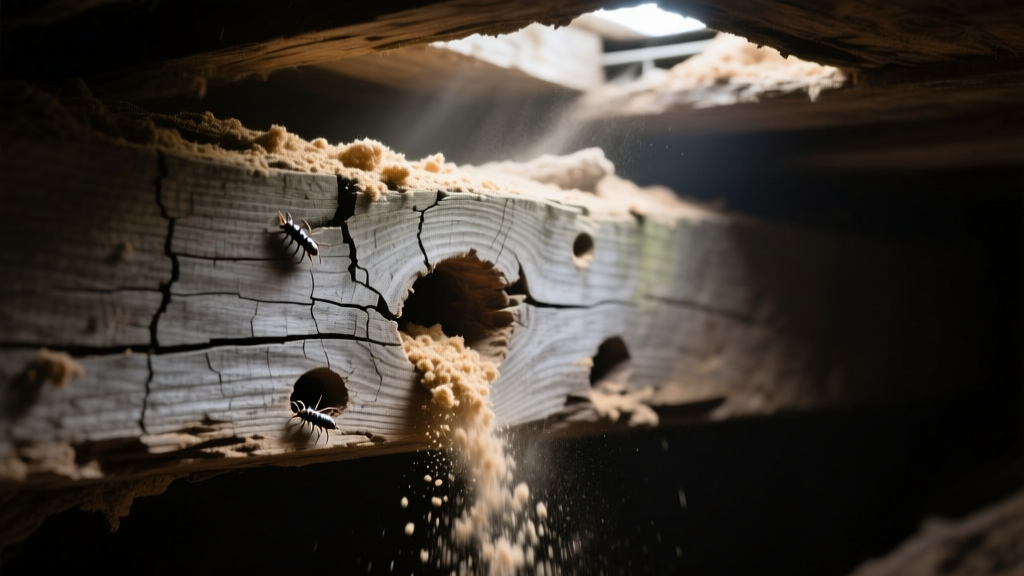
Wood-boring beetles represent a silent, compounding threat to structural timber, architectural millwork, and hardwood flooring. Unlike termites, which consume wood for cellulose, beetle larvae tunnel through lumber to feed on starch and create pupal chambers, leaving behind a honeycomb of structural voids. For builders, lumber yard managers, and restoration contractors, misidentifying the specific beetle species leads to ineffective chemical treatments and catastrophic structural failures. This guide breaks down the biological imperatives, identification markers, and remediation protocols for the three most destructive wood beetle families encountered in North American construction.
The Big Three: Destructive Beetle Species
While thousands of beetle species interact with dead wood, only three families routinely infest processed lumber and finished structures. Each has distinct biological requirements regarding wood species, moisture content, and starch availability.
1. Lyctid Beetles (True Powderpost Beetles)
Lyctid beetles (family Lyctidae) are strict hardwood specialists. They will not infest softwoods like pine or fir. You will typically find Lyctid damage in oak, ash, hickory, and walnut used for flooring, cabinetry, and interior trim.
- Exit Hole Diameter: 1/32 to 1/16 inch (pinpoint, perfectly round).
- Frass Signature: Extremely fine, talcum-like powder that packs tightly into tunnels.
- Moisture Requirement: Can survive in wood with moisture content (MC) as low as 8%, making them highly adaptable to climate-controlled interiors.
- Dietary Trigger: Larvae require high starch content. They typically ignore wood older than 10 years as starch depletes over time.
2. Anobiid Beetles (Deathwatch and Furniture Beetles)
Anobiids (family Anobiidae) attack both softwoods and hardwoods but are most notorious for destroying structural softwood joists and subflooring in damp environments. The Hemicoelus carinatus (Eastern deathwatch beetle) is a primary culprit in coastal and high-humidity regions.
- Exit Hole Diameter: 1/16 to 1/8 inch.
- Frass Signature: Gritty and granular, feeling like fine sand when rubbed between fingers.
- Moisture Requirement: Strictly requires wood MC above 14%. They are heavily reliant on capillary moisture and high ambient humidity.
- Life Cycle: Exceptionally long. Larval stages can persist for 2 to 7 years before emerging, meaning an infestation may not become visible until a decade after construction.
3. Cerambycid Beetles (Old House Borers)
Despite the common name "Old House Borer," the Hylotrupes bajulus (a longhorn beetle in the Cerambycidae family) is actually a severe threat to new construction. It exclusively targets softwoods (pine, spruce, fir, hemlock) and is frequently introduced to job sites via infested roof trusses or wall studs from the mill.
- Exit Hole Diameter: 1/4 to 3/8 inch (distinctly oval-shaped).
- Frass Signature: Coarse, cylindrical pellets mixed with sawdust, resembling tiny mouse droppings.
- Moisture Requirement: Highly resilient; can reinfest and thrive in wood with MC as low as 8% to 10%.
- Auditory Sign: Mature larvae produce a distinct clicking or rasping sound as they chew, which can sometimes be heard in quiet crawlspaces.
Species Identification Matrix
Accurate field identification relies on analyzing the exit holes and the texture of the frass (bore dust) expelled from the galleries. Use this matrix during structural inspections.
| Beetle Family | Wood Preference | Exit Hole Shape & Size | Frass Texture | Min. Moisture Content |
|---|---|---|---|---|
| Lyctid (Powderpost) | Hardwoods only | Round, 1/32" - 1/16" | Flour-like, tightly packed | 8% |
| Anobiid (Deathwatch) | Softwoods & Hardwoods | Round, 1/16" - 1/8" | Gritty, loose, sand-like | 14% |
| Cerambycid (Old House) | Softwoods only | Oval, 1/4" - 3/8" | Coarse pellets / sawdust | 8% - 10% |
Moisture Control as Primary Defense
Chemical treatments are secondary to environmental control. According to the USDA Forest Products Laboratory, wood-destroying insects cannot establish self-sustaining populations if the equilibrium moisture content (EMC) of the timber remains below their biological thresholds.
Anobiid beetles are entirely dependent on high moisture. If a crawlspace inspection reveals Anobiid damage, installing a 12-mil polyethylene vapor barrier over 100% of the dirt floor and sealing foundation vents to condition the space will naturally halt the infestation by dropping the joist MC below 12%. Chemical treatment is unnecessary if moisture is permanently controlled.
Advanced Treatment Protocols
When environmental controls are insufficient, or when dealing with Lyctid and Cerambycid beetles that thrive in dry wood, targeted chemical and thermal interventions are required. The Environmental Protection Agency (EPA) regulates these applications, and builders must adhere to label specifications.
Borate Wood Preservatives (DOT)
Disodium octaborate tetrahydrate (DOT) is the industry standard for remedial and preventative beetle treatment. Products like Bora-Care (a 40% DOT glycol-based solution) and Tim-Bor Professional (98% water-soluble DOT powder) act as stomach poisons to larvae.
- Surface Preparation: Borates cannot penetrate paint, varnish, or water repellents. Wood must be bare and absorbent.
- Application Rate: For Bora-Care, mix 1:1 with water and apply at a rate of 1 gallon of solution per 200 square feet of wood surface. This ensures penetration to a depth of roughly 1/4 inch, creating a lethal toxic zone for emerging adults and shallow-boring larvae.
- Limitation: Borates do not penetrate deep into the heartwood of large timbers. If Cerambycid larvae are tunneling 2 inches deep inside a 6x6 beam, surface borate application will not reach them.
Thermal Remediation (Heat Treatment)
For severe infestations in finished hardwood floors or historic millwork where chemicals cannot be applied, whole-room or whole-structure heat treatment is the definitive solution. Wood core temperatures must reach 130°F (54°C) and be maintained for a minimum of 30 minutes. This thermal shock denatures the proteins in all life stages of the beetle, from egg to adult, achieving 100% mortality without chemical residue.
Structural Assessment: When to Replace vs. Treat
Discovering beetle frass on a structural joist does not automatically mandate replacement. Structural engineers and pest control professionals use a specific decision framework to evaluate load-bearing capacity.
The Cross-Sectional Area Rule
Evaluate the depth and density of the galleries. If the tunneling has compromised more than 15% to 20% of the cross-sectional area of a load-bearing timber, the member must be sistered or replaced. Surface galleries (the outer 1/2 inch) on a 2x10 joist rarely affect its bending moment capacity, as the structural strength of a beam lies in its outer fibers. However, if Cerambycid larvae have hollowed the core of a roof rafter, the shear strength is compromised, necessitating immediate reinforcement.
Active vs. Historic Damage
Before authorizing expensive treatments, verify the infestation is active. Fresh frass is light-colored and loose. Historic frass darkens over time, oxidizes, and becomes impacted with dust and cobwebs. Mark the perimeter of existing frass piles with a pencil. If new, light-colored powder appears outside the pencil line within 30 days, the infestation is active and requires intervention.
Written by
Elena RodriguezElena Rodriguez is a civil engineer and technical writer specializing in concrete technology, masonry systems, and ASTM/ACI compliance. She earned her B.S. in Civil Engineering from Texas A&M University and spent a decade at a materials testing laboratory, performing over 2,000 concrete compressive strength tests and masonry prism evaluations. Elena is an ACI-certified Field Testing Technician (Grade I) and a member of ASTM Committee C12 on Natural Building Stone. She currently consults on forensic engineering cases involving concrete failures and moisture intrusion. Based in San Antonio, TX, Elena is a proud member of the Society of Women Engineers (SWE) and coaches her daughter's FIRST Robotics team.
More from Elena Rodriguez
View all
Walls & Panels
Cost Analysis: Light Gauge Steel Framing Advantages and Disadvantages
Evaluate light gauge steel framing advantages and disadvantages through a strict cost analysis lens, comparing material, labor, and lifecycle expenses.
Aug 4, 2026

Walls & Panels
Gypsum Board Types: Exact Specifications, Thickness & Dimensions
Compare standard, Type X, and moisture-resistant gypsum board types. Get exact specifications, thicknesses, dimensions, and ASTM standards for your project.
Aug 4, 2026

Fire Resistance
Best Fire-Resistant Outdoor Decking Materials: 2026 Buyer Guide
Discover the best fire-resistant outdoor decking materials for 2026. Compare Class A PVC, aluminum, and hardwood options for WUI compliance and safety.
Aug 4, 2026