The Strongest Type of Wood: A Complete Species & Hardness Guide
Discover the strongest type of wood for construction and flooring. Compare Janka hardness, bending strength, and top domestic vs. exotic species.

Defining Wood Strength: It Is Not Just About Hardness
When architects, builders, and woodworkers search for the strongest type of wood, they are usually looking for a single metric. However, wood strength is multidimensional. To specify the correct timber for structural beams, heavy-duty flooring, or marine applications, you must differentiate between surface hardness, bending strength, and crushing resistance. The Janka hardness test (ASTM D143) measures the force required to embed a 0.444-inch steel ball halfway into the wood, indicating resistance to denting and wear. Conversely, the Modulus of Rupture (MOR) measures bending strength, and the Modulus of Elasticity (MOE) measures stiffness.
The Undisputed Champions: Top 5 Strongest Exotic Species
The absolute strongest woods on Earth are largely exotic hardwoods originating from Australia, South America, and Africa. These species possess specific gravity ratings often exceeding 1.0, meaning they will sink in water. Due to their extreme density, they are typically reserved for specialized industrial applications, marine bearings, and luxury custom flooring rather than standard framing.
| Species | Janka Hardness (lbf) | Modulus of Rupture (psi) | Primary Application |
|---|---|---|---|
| Australian Buloke | 5,060 | 25,300 | Heavy-duty flooring, tool handles |
| Lignum Vitae | 4,390 | 18,400 | Marine bearings, mallet heads |
| Gidgee | 4,270 | 21,000 | Turned objects, custom knife scales |
| Snakewood | 3,800 | 20,200 | Bow frogs, luxury inlays |
| Camelthorn | 3,680 | 19,500 | Heavy construction (regional) |
Australian Buloke (Allocasuarina luehmannii)
Widely recognized as the strongest type of wood globally by Janka metrics, Australian Buloke registers an astonishing 5,060 lbf. Native to Australia, this ironwood features a fine, uniform texture with a reddish-brown heartwood. Its extreme density makes it nearly impervious to insect attack and moisture degradation. However, its interlocked grain causes severe tear-out during planing, requiring specialized machining techniques.
Lignum Vitae (Guaiacum officinale)
While slightly lower on the Janka scale at 4,390 lbf, Lignum Vitae possesses unmatched crushing strength and natural lubricity. The wood contains high levels of guaiac resin, allowing it to function as a self-lubricating bearing in marine propeller shafts and heavy machinery. Due to severe overharvesting, it is now strictly regulated under CITES Appendix II, making authentic stock rare and prohibitively expensive for most building projects.
The Strongest Domestic Woods for Construction and Flooring
For North American builders and homeowners, exotic ironwoods are impractical due to cost, tool wear, and sustainability concerns. Fortunately, several domestic species offer exceptional strength profiles suitable for high-traffic commercial flooring, structural timbers, and heavy-duty framing.
Hickory (Carya spp.)
Hickory is the strongest common domestic hardwood, boasting a Janka hardness of 1,820 lbf. It is the premier choice for high-traffic residential and commercial wood flooring. In 2026, pre-finished engineered hickory flooring typically ranges from $7.50 to $12.00 per square foot. Hickory also exhibits excellent shock resistance, making it the traditional and modern standard for hammer handles and axe hafts.
Hard Maple (Acer saccharum)
With a Janka rating of 1,450 lbf, Hard Maple (Sugar Maple) is the industry standard for bowling alleys, dance floors, and basketball courts. Its tight, closed-grain structure resists moisture penetration and scuffing. When specifying maple for gymnasium flooring, ensure the material is graded as Firsts or Seconds per the Maple Flooring Manufacturers Association (MFMA) standards to guarantee structural integrity and uniform wear.
Southern Yellow Pine (Pinus spp.)
When evaluating structural framing rather than surface hardness, Southern Yellow Pine (SYP) dominates. While its Janka hardness is only 690-870 lbf, its Modulus of Rupture reaches up to 14,500 psi, and its high density for a softwood allows it to hold nails and structural screws with immense withdrawal resistance. SYP is the primary species used in manufacturing pressure-treated lumber for deck framing and ground-contact applications.
Decision Matrix: Matching Wood Strength to Application
Selecting the strongest type of wood requires aligning the material's mechanical properties with the specific environmental and load-bearing demands of your project. Use the framework below to guide your specification.
| Application Scenario | Critical Strength Metric | Recommended Species |
|---|---|---|
| Heavy-Duty Commercial Flooring | Janka Hardness (>1,500 lbf) | Hickory, Hard Maple, Brazilian Cherry |
| Long-Span Structural Beams | Modulus of Elasticity (MOE) | Douglas Fir, Glulam (SPF or DF) |
| Marine or High-Moisture Bearings | Crushing Strength & Rot Resistance | Lignum Vitae, Ipe, Cumaru |
| Deck Framing & Ground Contact | Fastener Withdrawal & Decay Resistance | Pressure-Treated Southern Yellow Pine |
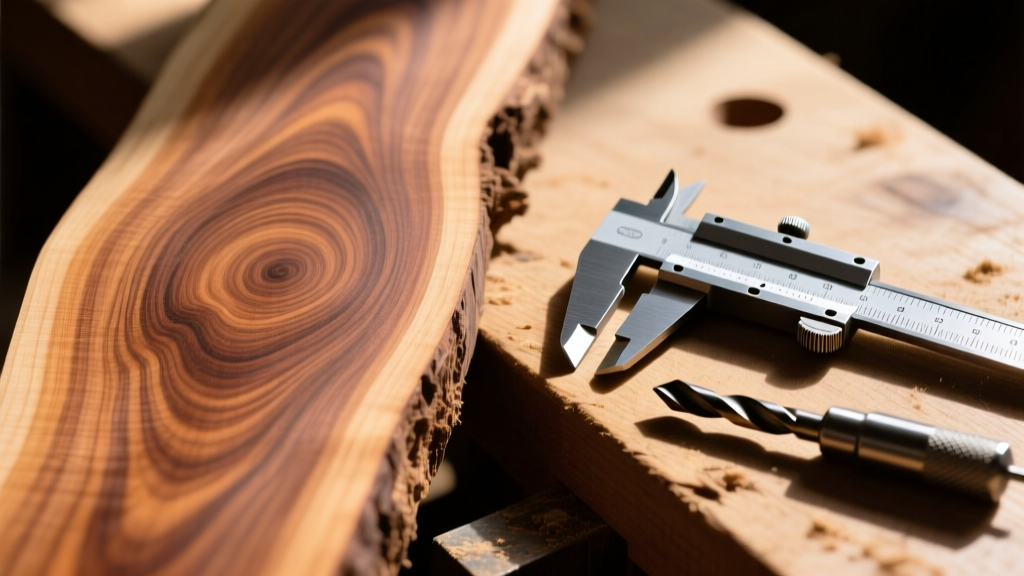
Machining and Fastening Ultra-Dense Hardwoods
Working with the strongest wood species introduces severe mechanical challenges. The high silica content and extreme density of woods like Ipe (3,510 lbf) and Australian Buloke will destroy standard high-speed steel (HSS) tooling in minutes.
- Tooling: Exclusively use carbide-tipped or polycrystalline diamond (PCD) saw blades and router bits. When cross-cutting Buloke or Ipe, utilize blades with a high tooth count (80+ teeth) and a negative hook angle to prevent dangerous kickback and splintering.
- Pre-Drilling: You cannot drive screws directly into ultra-dense hardwoods without splitting the material or snapping the fastener. Pre-drill pilot holes to 85% of the screw's shank diameter. For hardwoods exceeding 2,500 lbf Janka, a clearance hole through the top board and a pilot hole into the subfloor are mandatory.
- Fastener Selection: Use Type 305 or 316 stainless steel trim-head screws. Standard zinc-plated or galvanized screws will corrode rapidly due to the high tannin and acidic content present in many dense tropical hardwoods.
- Adhesives: Standard PVA (polyvinyl acetate) wood glues struggle to penetrate the dense, often oily cellular structure of woods like Lignum Vitae or Teak. Wipe the glue joints with acetone immediately before assembly to remove surface oils, and use a two-part marine epoxy or a polyurethane-based adhesive for structural bonding.
Sourcing, Sustainability, and CITES Restrictions
When specifying exotic hardwoods for architectural millwork or flooring, procurement must align with global conservation laws. Many of the world's strongest woods are subject to strict trade regulations. The CITES appendices govern the international trade of endangered timber species. Lignum Vitae (Guaiacum spp.) is listed in Appendix II, requiring extensive export permits and proof of sustainable harvesting. Brazilian Walnut (Ipe) faces increasing scrutiny and localized export bans in South America due to deforestation concerns.
For commercial projects seeking the extreme durability of exotic ironwoods without the regulatory friction or ecological impact, thermally modified domestic ash or high-density acetylated woods (like Accoya) offer viable, sustainable alternatives. These engineered processes alter the cellular structure of fast-growing domestic species, dramatically boosting their Janka hardness and rot resistance to rival tropical hardwoods, ensuring your project remains both structurally sound and environmentally compliant.
Written by
David NakamuraDavid Nakamura is a licensed architect (AIA) and construction technology writer focused on sustainable building methods, mass timber engineering, and high-performance building envelopes. He holds a Master of Architecture from the University of Washington and is a certified Passive House Consultant (CPHC). David spent eight years at the Seattle firm Mithun, where he led the design of three LEED Platinum projects, before founding his own practice specializing in net-zero residential design. He serves on the editorial advisory board of GreenBuilder Magazine and has authored peer-reviewed papers on cross-laminated timber (CLT) connections for the Journal of Structural Engineering. In his spare time, David teaches woodworking at Pratt Fine Arts Center and kayaks the Puget Sound.
More from David Nakamura
View all
Construction Cost
Labor Cost to Build a Deck Per Sq Ft: 2026 Installation Guide
Discover the exact labor cost to build a deck per sq ft in 2026. This installation guide breaks down contractor rates, complexity factors, and hidden fees.
Aug 4, 2026

Construction Cost
How Much Does It Cost to Build a 3 Bedroom House? Financing Guide
Learn exactly how much it costs to build a 3 bedroom house and explore 2026 financing options, construction loan types, and budget frameworks for your build.
Aug 4, 2026

Construction Cost
Cost to Build a Tennis Court: 2026 Guide
How much does it cost to build a tennis court in 2026? Breakdowns for asphalt, concrete, and synthetic surfaces plus fencing and lighting.
Jul 30, 2026