Structural Lumber ID: What Type of Wood Is This Framing?
Learn how to identify structural lumber and answer 'what type of wood is this' using grade stamps, visual grain profiling, and NDS data.

When evaluating an existing structure for a retrofit, or auditing a delivery of unlabeled framing lumber, the question 'what type of wood is this' becomes a critical structural engineering problem. Misidentifying a load-bearing joist, beam, or stud can lead to catastrophic deflection, shear failure, or code violations. Structural wood identification requires a systematic approach combining grade stamp decoding, macroscopic wood anatomy, and field moisture testing.
Decoding the Lumber Grade Stamp
The fastest and most authoritative way to identify structural lumber is by reading the grade stamp. In North America, the American Lumber Standard Committee (ALSC) oversees the grading system. If the stamp is faded but partially legible, you can reconstruct the species and structural capacity by identifying the remaining letters and numbers.
Anatomy of an ALSC Stamp
- Species Abbreviation: Look for two-to-four letter codes. DF-L indicates Douglas Fir-Larch. SYP or S-PINE denotes Southern Yellow Pine. HEM-FIR is Hemlock-Fir, and SPF stands for Spruce-Pine-Fir.
- Grade Designation: Structural light framing is typically graded as No. 1, No. 2, or No. 3. No. 2 is the standard for most residential floor and roof joists. Stud grade is specifically marked for vertical wall loads.
- Moisture Content at Surfacing: S-DRY means the wood was surfaced at a maximum moisture content (MC) of 19%. MC-15 indicates it was surfaced at 15% MC or less. S-GRN (surfaced green) means it was surfaced above 19% MC and will shrink significantly as it dries in place.
- Mill Number: A numeric code identifying the specific manufacturing mill, which can be cross-referenced with ALSC directories if the species is completely worn off.
Visual Grain and Color Profiling
When grade stamps are entirely absent—common in older timber framing, reclaimed lumber, or damaged stock—you must rely on visual and tactile identification. The four primary structural species groups in North America have distinct macroscopic characteristics.
Southern Yellow Pine (SYP)
SYP is the densest and heaviest common softwood framing material. It features a highly pronounced contrast between the light-colored earlywood (spring growth) and the dark, dense latewood (summer growth). The latewood bands are typically wide, giving the wood a striped appearance. SYP often has a distinct, sharp resinous odor when cut or sanded and is highly prone to checking (longitudinal splitting) as it dries.
Douglas Fir-Larch (DF-L)
Douglas Fir exhibits a straight, tight grain with a reddish-brown to yellowish tint. Unlike SYP, the transition between earlywood and latewood is more gradual. A definitive identifying feature of DF is the presence of vertical resin canals, which appear as tiny, light-colored streaks or dots on the end grain. DF-L is highly valued for its superior modulus of elasticity (stiffness), making it the preferred choice for long-span beams and headers.
Spruce-Pine-Fir (SPF)
SPF is a composite grouping characterized by its pale, almost white to light yellow color. The grain is generally straight and fine, with very little contrast between earlywood and latewood. Knots in SPF are typically small, tight, and dark. Because it lacks the natural decay resistance and high density of SYP or DF, SPF is primarily used for interior wall studs and protected structural applications.
Hemlock-Fir (Hem-Fir)
Hem-Fir is slightly darker than SPF but lighter than DF. It lacks the resin canals found in Douglas Fir and has a more uniform, pale brown color. The knots are often small and occasionally loose or 'fall out' when the wood is kiln-dried, leaving knot holes. Hem-Fir is highly workable and holds nails well, making it a staple for general framing.
Structural Property Comparison Matrix
Identifying the species is only the first step; translating that identification into load-bearing capacity is the ultimate goal. The following table outlines the baseline design values for No. 2 grade structural lumber, as published in the National Design Specification (NDS) for Wood Construction by the American Wood Council.
| Species Group | Bending (Fb) psi | Tension Parallel (Ft) psi | Modulus of Elasticity (E) psi | Specific Gravity (G) |
|---|---|---|---|---|
| Southern Pine (SYP) | 1,500 | 825 | 1,700,000 | 0.55 |
| Douglas Fir-Larch | 1,500 | 1,000 | 1,900,000 | 0.50 |
| Hem-Fir | 1,300 | 925 | 1,600,000 | 0.43 |
| Spruce-Pine-Fir (SPF) | 1,350 | 675 | 1,400,000 | 0.42 |
Note: These are base reference values. Actual allowable stress must be adjusted using NDS modification factors for wet service (CM), temperature (Ct), and repetitive member use (Cr).
Field Testing: Moisture and Density Verification
If visual profiling leaves ambiguity between two species (e.g., distinguishing between a dense SYP and a lighter DF), field testing provides definitive data.
Moisture Meter Profiling
Use a dual-depth pinless moisture meter to scan the wood. If the surface reads 12% but the deep reading shows 22%, the lumber was likely installed S-GRN (surfaced green) and is still drying. This requires applying the NDS Wet Service Factor (CM), which reduces the bending strength (Fb) of most species by 15% to 25% until the wood equilibrates below 19% MC.
Specific Gravity Estimation
Density is a primary indicator of species. According to the USDA Forest Products Laboratory, specific gravity directly correlates to fastener withdrawal capacity and shear strength. In the field, you can estimate specific gravity by weighing a precisely cut block of the wood (e.g., a 2x2x2 inch cube) and dividing its oven-dry weight by the weight of an equal volume of water. SYP will consistently yield a higher mass per cubic inch compared to SPF.
Identifying Reclaimed and Heavy Timber Framing
In renovation projects involving pre-1950s structures, you will frequently encounter heavy timber framing. The question 'what type of wood is this' becomes more complex because modern grading stamps did not exist. Furthermore, these timbers are often old-growth, possessing structural properties that exceed modern new-growth equivalents.
Old-Growth vs. New-Growth Ring Density
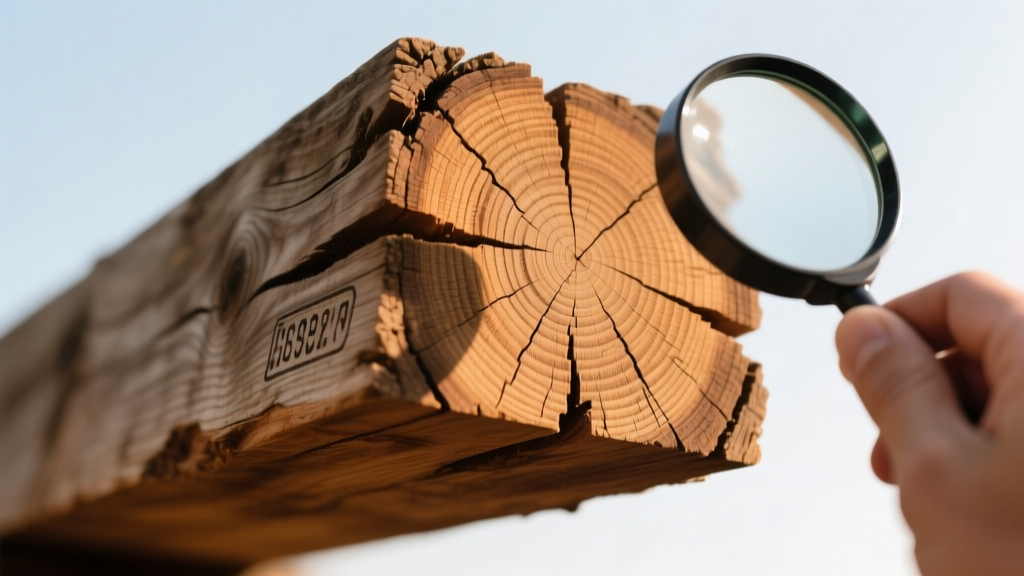
To qualify as old-growth structural timber under the Southern Pine Inspection Bureau (SPIB) reclaimed wood guidelines, the end grain must exhibit a minimum of six annual growth rings per inch. Count the rings on the exposed end grain. Old-growth Longleaf Southern Pine (often called 'Heart Pine') will show incredibly tight, dense rings with a high percentage of dark latewood, yielding bending strengths that can exceed 2,400 psi.
Evaluating Checking and Splits
Heavy timbers almost always exhibit 'checking'—radial splits that occur as the outer layers dry faster than the core. A common misconception is that checks compromise the timber. In reality, checks that do not pass entirely through the shear plane of the beam (the horizontal centerline) have a negligible effect on bending strength. However, if a split runs horizontally through the neutral axis, it severely compromises the beam's horizontal shear capacity, necessitating structural reinforcement or replacement.
Summary Decision Framework
When confronted with unidentified structural wood, follow this sequential framework:
- Locate and decode the ALSC stamp. If legible, use the NDS span tables for that exact species and grade.
- Analyze macroscopic anatomy. Check for resin canals (DF), latewood contrast (SYP), or pale uniformity (SPF/Hem-Fir).
- Measure moisture content. Apply NDS wet-service reduction factors if MC exceeds 19%.
- Count growth rings. For heavy timber, verify old-growth status (6+ rings/inch) to justify higher allowable stress values in engineering calculations.
By systematically applying these identification methods, builders and engineers can confidently determine the species, grade, and load-bearing capacity of any structural wood member, ensuring safe and code-compliant construction.
Written by
Priya KapoorPriya Kapoor is a real estate market analyst and construction economics researcher with expertise in housing affordability, development feasibility, and infrastructure investment. She holds a Master of Regional Planning from Cornell University and previously worked as a senior analyst at CBRE's Investment Properties group, where she modeled returns for $4B in mixed-use development pipelines. Priya now runs an independent research practice advising developers, municipalities, and REITs on construction cost forecasting and market timing. She publishes the quarterly "BuildMat Market Pulse" report tracking material price indices across 12 commodity categories. Based in Austin, TX, Priya serves on the board of Habitat for Humanity Austin and is a marathon runner.
More from Priya Kapoor
View all
Construction Cost
Cost to Build a 1600 Sq Ft Home in 2026: Full Breakdown
Accurate 2026 cost to build a 1600 sq ft home—material, labor, and regional pricing breakdowns included. Plan your budget with real-time estimates.
Aug 11, 2026

Wood & Lumber
Name the Types of Wood for Pressure Treatment and Preservation
Learn how to name the types of wood best suited for pressure treatment. Compare species treatability, chemical retention levels, and 2026 preservation costs.
Aug 4, 2026

Stone & Masonry
Stone Veneer Suppliers Lindenhurst: 2026 Cost Analysis
Analyze 2026 stone veneer costs in Lindenhurst, NY. Compare local supplier pricing, delivery fees, and Suffolk County installation labor rates.
Aug 4, 2026