A Grade & Quality Guide to the Different Types of Walnut Wood
Master the NHLA grading rules and quality metrics for the different types of walnut wood, from Black to Claro, ensuring premium lumber selection.

The NHLA Walnut Exception: Why Standard Grading Fails
When sourcing premium hardwoods, woodworkers and procurement specialists rely on the National Hardwood Lumber Association (NHLA) grading rules. However, walnut is a notable exception to standard grading conventions. Because of its high commercial value and the natural contrast between its dark heartwood and pale sapwood, the NHLA created special grading rules specifically for walnut. Understanding these exceptions is critical when evaluating the different types of walnut wood for fine furniture, cabinetry, and architectural millwork.
Species Matrix: Quality & Performance Metrics
The term "walnut" encompasses several distinct species, each with unique mechanical properties, visual characteristics, and market pricing. The matrix below outlines the primary species encountered in the North American and European lumber markets.
| Species | Botanical Name | Janka Hardness | Avg FAS Price (2026) | Primary Quality Indicator |
|---|---|---|---|---|
| Black Walnut | Juglans nigra | 1,010 lbf | $12 - $18 / BF | Heartwood uniformity, minimal checks |
| Claro Walnut | Juglans hindsii | 1,130 lbf | $25 - $45+ / BF | Marbled figure, burl density |
| English Walnut | Juglans regia | 1,220 lbf | $15 - $24 / BF | Quarter-sawn ribbon figure |
| Butternut | Juglans cinerea | 490 lbf | $8 - $14 / BF | Grain straightness, rot resistance |
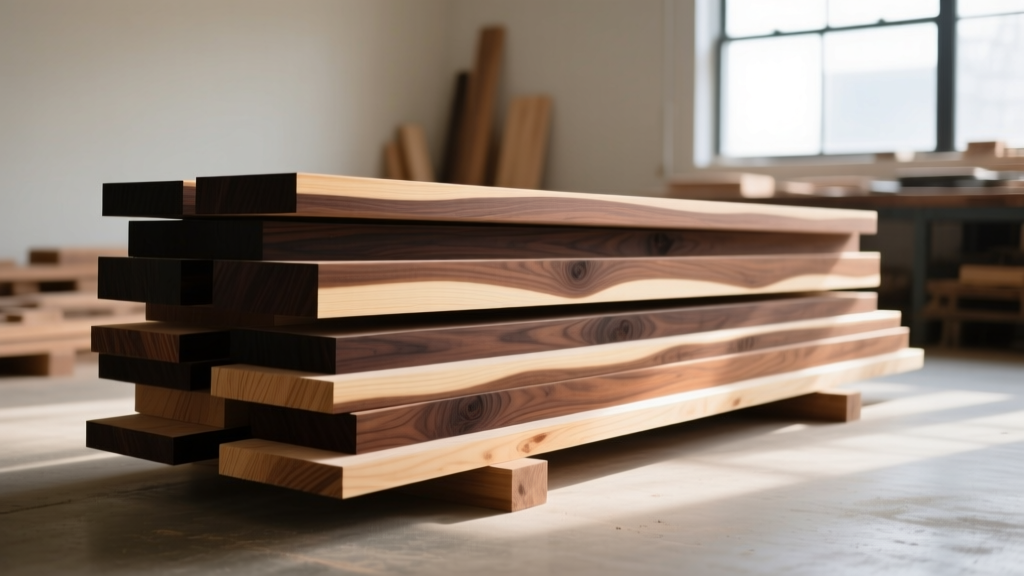
Black Walnut (Juglans nigra): The Commercial Standard
Eastern Black Walnut is the benchmark for North American premium hardwoods. When grading Black Walnut, the primary quality determinant is the ratio of dark heartwood to pale sapwood. While the NHLA permits sapwood in FAS grades, high-end furniture makers typically demand "all-heart" or "90/10" (90% heartwood, 10% sapwood) selections, which command a 20% to 30% premium over standard FAS pricing.
The Steaming Process and Honeycomb Checking
To maximize yield and reduce the visual jarring of white sapwood against dark heartwood, most commercial Black Walnut is kiln-steamed before drying. The lumber is subjected to high humidity and temperatures around 190°F, which forces the dark tannins from the heartwood into the sapwood. While this creates a more uniform color profile, aggressive or poorly controlled steaming can cause honeycomb checking—internal fractures in the wood that are invisible on the surface but ruin the board when resawn. When inspecting steamed Black Walnut, always check the end-grain for microscopic radial splits and request a sample cutoff to verify internal integrity before purchasing an entire bunk.
Claro Walnut (Juglans hindsii): Grading Figured Lumber
Native to the Pacific Northwest, Claro Walnut is prized for its spectacular marbled figure, featuring swirling patterns of brown, grey, tan, and black. This figure is caused by genetic variations and soil mineral interactions. Standard NHLA grading rules are essentially useless for highly figured Claro Walnut, as the "defects" (burls, crotches, and wild grain) are exactly what give the wood its value.
Claro is graded visually by figure density rather than clear-cutting yield. "Figured FAS" or "Burl Grade" Claro Walnut is often priced by the pound or by individual board-foot increments based on visual impact rather than dimensional stability. According to data compiled by The Wood Database, Claro Walnut is slightly harder and denser than its Eastern cousin, but its interlocked grain makes it highly susceptible to tear-out during planing. When purchasing Claro, prioritize boards that have been quartersawn or riftsawn to mitigate warping caused by the highly irregular grain structure.
English Walnut (Juglans regia): Quarter-Sawn Premiums
Often referred to as European or Circassian Walnut, English Walnut yields a lighter, more golden-brown heartwood than Black Walnut. The highest quality English Walnut is graded based on its cut. Quarter-sawn English Walnut exhibits a striking ribbon figure and prominent medullary rays (fleck), which are highly sought after in luxury architectural paneling and gunstocks. Plain-sawn English Walnut, while stable, lacks this visual depth and is graded closer to standard Black Walnut. When sourcing English Walnut, verify the origin; true European Juglans regia is frequently substituted with South American tropical walnuts (like Nogal) by less scrupulous importers. True English Walnut will have a distinct, slightly sweet scent when machined, unlike the odorless tropical substitutes.
Kiln-Drying Standards and Moisture Verification
Walnut is moderately dimensionally stable, but it is highly susceptible to case-hardening if dried too rapidly. Case-hardening occurs when the outer shell of the board dries and shrinks while the core remains wet, locking severe internal stresses into the wood. According to the USDA Forest Products Laboratory Wood Handbook, proper kiln schedules for walnut require a prolonged conditioning phase at the end of the drying cycle to relieve these stresses.
For interior furniture and millwork in climate-controlled environments, walnut must be dried to a Moisture Content (MC) of 6% to 8%. When evaluating lumber at the yard, do not rely on the supplier's tag. Use a dual-depth pin-type moisture meter. Take readings on the surface and drive the pins deeper into the board's core. If the differential between the surface MC and the core MC exceeds 2%, the board is improperly conditioned and will warp or cup once milled.
The Lumber Yard Inspection Checklist
To ensure you are acquiring top-tier material, execute this specific inspection protocol when evaluating the different types of walnut wood at a distributor:
- Verify NHLA Grade Stamps: Ensure the bundle tag explicitly states "Walnut FAS" or "Walnut Select". Standard FAS tags applied to walnut bundles may indicate the supplier is using generic hardwood rules, which penalizes the board for sapwood that should be legally clear in walnut grading.
- Inspect for End Checks: Walnut dries rapidly at the ends. Check that the boards have been properly end-sealed with a commercial wax emulsion (like Anchorseal). If the ends are painted with standard latex paint or left bare, expect to lose at least 2 to 3 inches per end to checking.
- Evaluate Sapwood Distribution: If the project requires a uniform dark finish, reject boards where the sapwood exceeds 15% of the total width, even if they technically meet NHLA FAS requirements. The steaming process rarely penetrates deeply enough to completely mask thick sapwood edges.
- Check for Pith and Wane: Walnut trees are often harvested from mature orchards or fence rows, leading to irregular growth. Avoid boards containing the pith (the very center of the tree), as this area is structurally weak and guaranteed to split as the wood undergoes seasonal humidity fluctuations.
- Assess Machining Readiness: Bring a block plane to the yard. Take a single shaving off the edge of a board. If the shaving is brittle and crumbles, the wood is over-dried or case-hardened. A clean, continuous shaving indicates proper moisture equilibrium and conditioning.
Mastering the nuances of walnut grading requires looking beyond the standard NHLA rulebook. By understanding the botanical differences between Black, Claro, and English species, and by rigorously verifying moisture and steaming quality, procurement professionals and master woodworkers can consistently secure the highest yielding, most visually striking walnut lumber available on the market.
Written by
Elena RodriguezElena Rodriguez is a civil engineer and technical writer specializing in concrete technology, masonry systems, and ASTM/ACI compliance. She earned her B.S. in Civil Engineering from Texas A&M University and spent a decade at a materials testing laboratory, performing over 2,000 concrete compressive strength tests and masonry prism evaluations. Elena is an ACI-certified Field Testing Technician (Grade I) and a member of ASTM Committee C12 on Natural Building Stone. She currently consults on forensic engineering cases involving concrete failures and moisture intrusion. Based in San Antonio, TX, Elena is a proud member of the Society of Women Engineers (SWE) and coaches her daughter's FIRST Robotics team.
More from Elena Rodriguez
View all
Walls & Panels
Cost Analysis: Light Gauge Steel Framing Advantages and Disadvantages
Evaluate light gauge steel framing advantages and disadvantages through a strict cost analysis lens, comparing material, labor, and lifecycle expenses.
Aug 4, 2026

Walls & Panels
Gypsum Board Types: Exact Specifications, Thickness & Dimensions
Compare standard, Type X, and moisture-resistant gypsum board types. Get exact specifications, thicknesses, dimensions, and ASTM standards for your project.
Aug 4, 2026

Fire Resistance
Best Fire-Resistant Outdoor Decking Materials: 2026 Buyer Guide
Discover the best fire-resistant outdoor decking materials for 2026. Compare Class A PVC, aluminum, and hardwood options for WUI compliance and safety.
Aug 4, 2026