Choosing the Right Type of Wood: A Construction Cost Analysis
Compare the cost and long-term value of different structural lumber types. Discover which type of wood maximizes ROI for your next construction project.

The True Cost of Lumber: Beyond the Price Tag
When evaluating the best type of wood for structural framing, builders and developers often default to the lowest per-board-foot price. This is a fundamental miscalculation. The true cost of structural timber encompasses material yield, labor efficiency, fastener compatibility, and long-term dimensional stability. A cheaper stick of lumber that requires 15% culling due to warp and twist ultimately costs more than a premium, straight-grained alternative that installs flawlessly.
Industry data indicates that framing crews typically cull 8% to 12% of standard Spruce-Pine-Fir (SPF) #2 lumber due to excessive bow, crook, or twist. For premium Douglas Fir-Larch (DF-L) or Southern Yellow Pine (SYP), the cull rate drops to 3% to 5%. When factoring in the labor cost of sorting and returning unusable material, the effective price gap between economy and premium solid-sawn lumber narrows by approximately 18%.
Solid Sawn Lumber: SPF vs. Douglas Fir vs. SYP
The selection between the three primary softwood species groups dictates not only the initial budget but also the structural span capabilities. According to the USDA Forest Products Laboratory Wood Handbook, the mechanical properties of these species vary drastically, directly impacting joist spacing and beam sizing.
| Material (No. 2 Grade) | Modulus of Elasticity (E) | Bending Stress (Fb) | Avg. Cost per LF (2x10) | Best Application |
|---|---|---|---|---|
| Spruce-Pine-Fir (SPF) | 1,200,000 psi | 875 psi | $8.50 - $11.00 | Standard wall studs, short-span floor joists |
| Douglas Fir-Larch (DF-L) | 1,600,000 psi | 1,000 psi | $12.00 - $16.50 | Long-span floor joists, roof rafters, shear walls |
| Southern Yellow Pine (SYP) | 1,700,000 psi | 1,100 psi | $9.50 - $13.00 | Heavy timber framing, high-load headers, trusses |
When to Specify Douglas Fir-Larch
Douglas Fir commands a premium price, but its value emerges in roof framing and long-span floor systems. Because of its higher Modulus of Elasticity (E), DF-L allows for wider joist spacing or longer spans without upsizing the lumber dimension. Furthermore, DF-L holds nails and screws with superior withdrawal resistance compared to SPF, reducing the risk of squeaky floors and drywall pops caused by seasonal shrinkage.
The Budget Choice: Spruce-Pine-Fir (SPF)
SPF remains the dominant type of wood for vertical wall framing (studs, plates, and cripples). In vertical applications, bending stress (Fb) is largely irrelevant; the primary concern is compression parallel to grain, where SPF performs adequately for standard residential and light commercial loads. Specifying DF-L for interior, non-load-bearing partition walls is a common budget leak that yields zero structural ROI.
Engineered Wood Products (LVL): The Premium ROI
Laminated Veneer Lumber (LVL) has disrupted traditional solid-sawn beam construction. While the upfront material cost of an LVL is significantly higher than a built-up dimensional lumber beam, the lifecycle and labor economics often favor engineered wood.
- Material Cost: A 1.75" x 9.25" 1.9E LVL costs approximately $38.00 to $48.00 per linear foot. A comparable built-up beam (three 2x10s nailed together) costs roughly $28.00 to $35.00 per linear foot in DF-L.
- Labor Savings: An LVL beam weighs less than a built-up SYP or DF-L beam of equivalent capacity and requires only two carpenters to install, whereas a multi-ply solid beam often requires three or a mechanical lift.
- Dimensional Stability: LVL exhibits virtually zero shrinkage or twisting. This eliminates costly drywall callbacks caused by sagging or shifting headers over multi-story spans.
- Fastener Compatibility: Because LVL is exceptionally dense, it requires specific high-capacity joist hangers and specialized structural screws (e.g., Simpson Strong-Tie SDWS or equivalent) to prevent splitting, which adds roughly 4% to the hardware budget.
"We stopped using built-up 2x12 headers for spans over 6 feet. The labor to crown, align, and nail three boards together, plus the inevitable callback to fix drywall cracks when the wood dries and shrinks, completely erases the $40 we saved on the lumber. LVL is non-negotiable for our headers and flush beams."
— Senior Framing Contractor, Pacific Northwest Region
Hidden Costs: Moisture, Shrinkage, and Fastener Schedules
The moisture content (MC) of the chosen type of wood at the time of installation dictates long-term building performance. Standard S-Dry (surfaced dry) lumber has an MC of 19% or less, but it frequently arrives at the job site at 15-18%. As it acclimates to the interior environment (typically 8-10% MC), it shrinks.
In a three-story wood-framed structure, cumulative cross-grain shrinkage of solid-sawn joists and top/bottom plates can result in 1 to 1.5 inches of total vertical settlement. This differential shrinkage can tear plumbing stacks, bind elevator shafts, and crack exterior cladding. For multi-story projects, the ROI heavily favors engineered I-joists and LVL rim boards, which exhibit negligible cross-grain shrinkage, mitigating these catastrophic secondary costs.
Additionally, the density of the wood species dictates the fastener schedule. According to the American Wood Council (AWC), the specific gravity (G) of SYP (0.55) requires different nail spacing and edge distances compared to SPF (0.42) to achieve the same shear wall capacity. Misapplying an SPF nailing schedule to SYP can result in split studs and failed inspections, leading to expensive structural retrofitting.
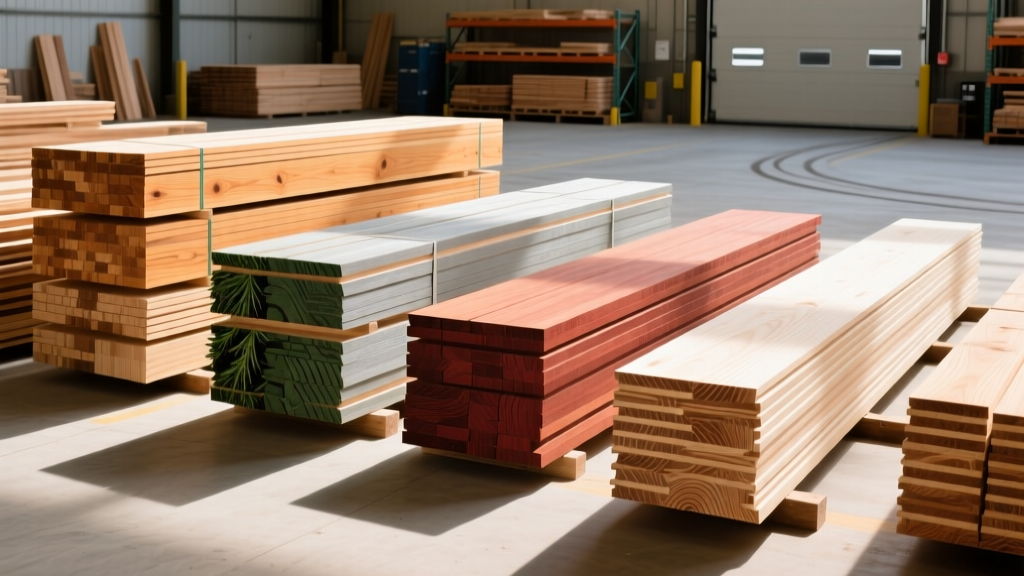
Decision Framework: Matching the Type of Wood to the Load
To maximize the construction budget, avoid using a single type of wood across the entire structural envelope. Instead, apply this targeted specification framework based on the APA - The Engineered Wood Association design guidelines:
- Vertical Studs & Plates: Specify SPF #2 or #3. The loads are primarily compressive, and the lower cost maximizes budget efficiency. Ensure MC is below 19% to minimize drywall cracking.
- Floor Joists (Spans under 14 feet): Solid-sawn DF-L #2 or SYP #2 provides excellent stiffness and limits floor bounce. If budget is strictly constrained, SPF #2 can be used, but spacing must be reduced to 12" on-center to match the deflection criteria (L/360) of the denser species.
- Floor Joists (Spans over 14 feet): Transition to engineered wood I-joists. Solid lumber at these spans becomes prohibitively expensive, heavy, and prone to severe warping. I-joists offer superior straightness and allow for easy HVAC and plumbing routing through pre-punched webs, saving MEP subcontractors significant labor hours.
- Headers, Beams, and Rims: Specify 1.9E or 2.0E LVL. The elimination of shrinkage and the ability to span longer distances without intermediate support columns provides immense architectural and financial value that solid lumber simply cannot match in modern construction.
Optimizing lumber selection requires looking past the initial invoice. By aligning the specific mechanical properties, shrinkage profiles, and labor requirements of each type of wood with its exact structural application, builders can reduce overall project costs by 4% to 7% while simultaneously improving the structural integrity and finish quality of the final build.
Written by
Elena RodriguezElena Rodriguez is a civil engineer and technical writer specializing in concrete technology, masonry systems, and ASTM/ACI compliance. She earned her B.S. in Civil Engineering from Texas A&M University and spent a decade at a materials testing laboratory, performing over 2,000 concrete compressive strength tests and masonry prism evaluations. Elena is an ACI-certified Field Testing Technician (Grade I) and a member of ASTM Committee C12 on Natural Building Stone. She currently consults on forensic engineering cases involving concrete failures and moisture intrusion. Based in San Antonio, TX, Elena is a proud member of the Society of Women Engineers (SWE) and coaches her daughter's FIRST Robotics team.
More from Elena Rodriguez
View all
Walls & Panels
Cost Analysis: Light Gauge Steel Framing Advantages and Disadvantages
Evaluate light gauge steel framing advantages and disadvantages through a strict cost analysis lens, comparing material, labor, and lifecycle expenses.
Aug 4, 2026

Walls & Panels
Gypsum Board Types: Exact Specifications, Thickness & Dimensions
Compare standard, Type X, and moisture-resistant gypsum board types. Get exact specifications, thicknesses, dimensions, and ASTM standards for your project.
Aug 4, 2026

Fire Resistance
Best Fire-Resistant Outdoor Decking Materials: 2026 Buyer Guide
Discover the best fire-resistant outdoor decking materials for 2026. Compare Class A PVC, aluminum, and hardwood options for WUI compliance and safety.
Aug 4, 2026