Types of Wood Grains: A Quality and Lumber Grading Guide
Master the types of wood grains with our grading guide. Learn how grain orientation, slope, and defects impact lumber quality, stability, and pricing.

The Anatomy of Wood Grain and Lumber Grading
Wood grain is the longitudinal arrangement, size, and direction of wood fibers within a tree. In construction and fine woodworking, understanding the different types of wood grains is not merely an aesthetic exercise; it is a fundamental requirement for assessing structural integrity, predicting dimensional stability, and determining commercial grade. The orientation of these fibers dictates how a board will react to moisture, how it will behave under load, and how it will machine on a planer or router.
Lumber grading agencies evaluate grain patterns to assign structural and appearance grades. For structural softwoods, agencies like the Southern Pine Inspection Bureau (SPIB) heavily penalize grain deviations that compromise load-bearing capacity. For hardwoods, the National Hardwood Lumber Association (NHLA) grading rules focus on the yield of clear, defect-free cuttings, where wild grain patterns can either create high-value "figure" or restrict clear-face yields. This guide breaks down the specific types of wood grains, their structural implications, and how to specify them for your 2026 building projects.
Directional Grain Types: Structural and Machining Impacts
The direction in which fibers run relative to the longitudinal axis of the sawn board defines its directional grain type. This is the primary factor in structural derating and machining tear-out.
Straight Grain
Fibers run parallel or nearly parallel to the longitudinal axis of the board. Straight-grained lumber exhibits maximum tensile and compressive strength along its length. In visual stress grading, straight grain is the baseline for establishing allowable design values. It also machines cleanly, with minimal tear-out, making it the required standard for structural framing, stair stringers, and high-quality millwork.
Spiral and Diagonal Grain
Spiral grain occurs when fibers grow in a helical pattern around the tree trunk. When sawn into lumber, this manifests as diagonal grain across the face or edge of the board. The American Wood Council (AWC) and visual grading rules strictly limit the Slope of Grain (SOG) in structural timber. A steeper slope drastically reduces bending and tensile strength.
Structural grading rules penalize diagonal grain based on the ratio of longitudinal deviation to transverse distance. For Southern Pine:
• Select Structural: Maximum SOG of 1:12 (1 inch of deviation over 12 inches of length).
• No. 1 Grade: Maximum SOG of 1:10.
• No. 2 Grade: Maximum SOG of 1:8.
Boards exceeding 1:8 are typically downgraded to utility or stud grades due to severe structural derating and a high propensity for longitudinal warping (twisting) during drying.
Interlocked Grain
Common in tropical hardwoods like Sapele and Mahogany, as well as domestic Sycamore, interlocked grain occurs when fibers alternate their spiral direction every few years. This creates exceptional resistance to splitting, making it excellent for heavy timber framing and tool handles. However, it is a nightmare for machining; planing interlocked grain almost guarantees severe tear-out unless the cutting angle is strictly controlled and shallow passes are used.
Wavy and Irregular Grain
Wavy grain (producing "fiddleback" or "curl" figure) and irregular grain (producing "burl" or "birdseye" figure) occur due to localized genetic mutations, stress, or injury to the tree. Structurally, these boards are weak and prone to localized failure. Commercially, however, they are highly prized for veneer and fine furniture. Under NHLA rules, these patterns are not considered "defects" unless they include bark pockets or pith, but they severely limit the size of clear cuttings due to the clustered nature of the anomalies.
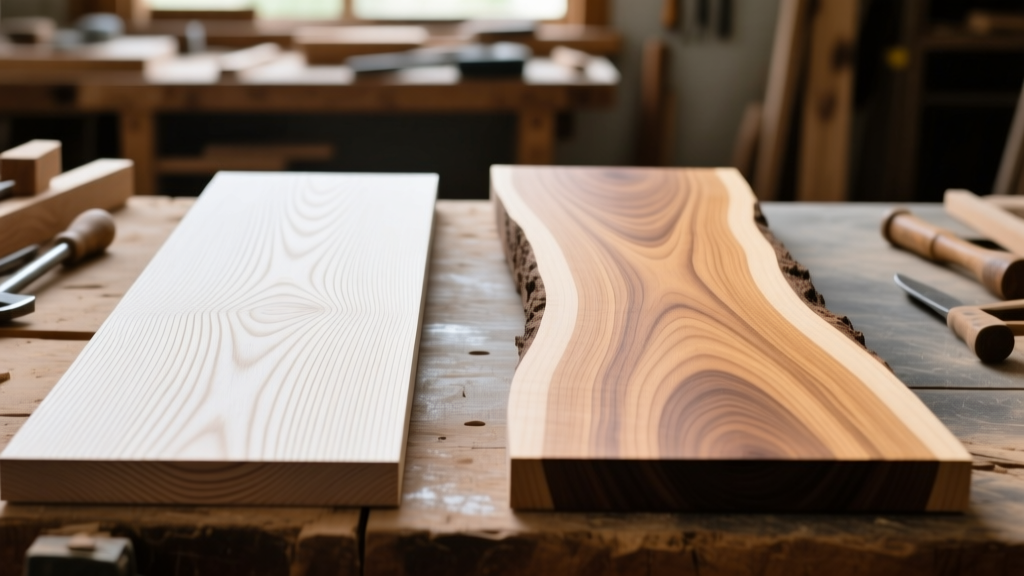
Grain Orientation: Flat-Sawn vs. Quarter-Sawn vs. Rift-Sawn
How a log is sliced at the mill determines the grain orientation on the face of the board. This dictates the board's dimensional stability, aesthetic profile, and cost. According to the USDA Forest Products Laboratory Wood Handbook, wood shrinks and swells at different rates depending on the angle to the growth rings.
| Cut Type | Grain Appearance | Dimensional Stability | 2026 Avg. Cost Premium (White Oak) | Best Application |
|---|---|---|---|---|
| Flat-Sawn (Plain-Sawn) | Cathedral pattern; wide growth rings on face. | Low. High tangential shrinkage causes cupping. | Baseline ($5.50 - $7.50 / bdft) | Standard framing, utility millwork, painted cabinetry. |
| Quarter-Sawn | Straight, tight lines; prominent ray fleck in oak. | High. Shrinks mostly in thickness, resists cupping. | +35% to 45% ($8.50 - $11.00 / bdft) | Hardwood flooring, high-end furniture, exterior trim. |
| Rift-Sawn | Perfectly straight, linear grain on all four faces. | Highest. Uniform shrinkage across all axes. | +50% to 65% ($11.50+ / bdft) | Architectural millwork, stair treads, modern minimalist interiors. |
Moisture Dynamics: Tangential vs. Radial Shrinkage
Understanding grain types is critical for predicting moisture-related movement. Wood is anisotropic; it moves differently in three distinct directions: longitudinal (along the grain), radial (perpendicular to growth rings), and tangential (parallel to growth rings).
The 2:1 Shrinkage Rule: For almost all commercial hardwoods, tangential shrinkage (which dominates flat-sawn boards) is approximately twice the radial shrinkage (which dominates quarter-sawn boards). For example, Hard Maple exhibits a tangential shrinkage of 9.9% from green to oven-dry, but only 4.8% radially. This is why flat-sawn maple flooring is highly susceptible to edge-cupping in environments with fluctuating HVAC humidity, while quarter-sawn remains flat.
When specifying wood for environments with high moisture variance (e.g., exterior cladding, unconditioned entryways, or radiant-heated flooring), always mandate quarter-sawn or rift-sawn grain orientation in your purchase orders to mitigate tangential movement.
Practical Framework: Specifying Grain on Purchase Orders
Relying on generic terms like "Select Grade" or "No. 1 Common" leaves too much room for interpretation regarding grain orientation. To ensure you receive the correct material for your specific application, use the following specification framework when drafting lumber purchase orders:
- Define the Structural Requirement First: If the lumber is load-bearing, specify the visual stress grade and explicitly state the maximum allowable Slope of Grain (e.g., "SPIB No. 1 Southern Yellow Pine, maximum SOG 1:12").
- Specify the Cut Orientation for Appearance/ Flooring: Do not just order "FAS White Oak." Order "FAS White Oak, minimum 70% quarter-sawn yield, ray fleck required" if you are milling flooring or paneling that requires high dimensional stability.
- Address Machining Constraints: If ordering interlocked or highly figured grain for millwork, include a machining allowance. Specify that the supplier must provide rough-sawn thicknesses with an extra 1/8-inch allowance to accommodate the deeper planer passes required to eliminate tear-out.
- Mandate Moisture Content (MC) Equilibrium: Grain orientation dictates how fast wood dries. Quarter-sawn lumber dries slower and more evenly than flat-sawn. Specify the exact target MC (e.g., 6-8% for interior millwork, 12-15% for exterior) and require a kiln-drying certificate to ensure the internal stresses caused by differential grain shrinkage have been properly relieved.
Summary of Grain Selection by Application
- Structural Framing & Joists: Prioritize straight grain; strictly enforce SOG limits to maintain bending (Fb) and tension (Ft) design values.
- Hardwood Flooring: Mandate a high percentage of quarter-sawn or rift-sawn grain to prevent edge-cupping and seasonal gapping.
- Painted Cabinetry & Trim: Flat-sawn is acceptable and cost-effective, provided the wood is properly sealed on all six sides to restrict tangential moisture exchange.
- Exterior Millwork & Siding: Quarter-sawn or vertical-grain cedar and redwood are mandatory to minimize checking, splitting, and paint failure caused by tangential shrinkage.
Written by
Marcus ChenMarcus Chen is a licensed structural engineer (PE) and building materials analyst with over 12 years of experience across residential, commercial, and industrial construction. He holds a Master of Science in Civil Engineering from UC Berkeley and spent six years at Thornton Tomasetti before transitioning to independent consulting and technical writing. Marcus specializes in material selection for seismic-prone regions, concrete reinforcement strategies, and lifecycle cost analysis. His work has been cited by the American Concrete Institute (ACI) and the Structural Engineers Association of California (SEAOC). When he is not on a job site or at his desk, you will find him hiking the Sierra Nevada or restoring a 1920s craftsman bungalow in Oakland, CA.
More from Marcus Chen
View all
Construction Cost
How Much Did the Eiffel Tower Cost to Build?
How much did the Eiffel Tower cost to build in 1889? We adjust for inflation and compare its budget to modern skyscraper construction.
Aug 4, 2026

Fire Resistance
What Is a Fire Resistant Material? Testing & Certification Guide
Discover what is a fire resistant material through ASTM and UL testing. Learn how fire ratings, certifications, and assemblies work in construction.
Aug 4, 2026

Construction Cost
How Much Did the Burj Khalifa Cost to Build?
How much did the Burj Khalifa cost to build? We break down the $1.5B project and extract 5 money-saving strategies for your next build.
Jul 30, 2026