Grading Different Types of Wood Siding: A Quality Guide
Master the grading systems for different types of wood siding. Learn how clarity, moisture content, and knot grades impact durability and cost.

Selecting from the different types of wood siding requires looking past the species and profile to understand the grading stamp. A #2 grade cedar shingle performs entirely differently than a Premium grade, dictating not just aesthetics but structural holdout, moisture resistance, and long-term maintenance cycles. Wood grading is a standardized measurement of structural integrity and visual quality, governed by agencies like the National Lumber Grades Authority (NLGA) and the Western Wood Products Association (WWPA). Misinterpreting these grades is the leading cause of premature siding failure, extractive bleeding, and warped installations.
The Core Grading Systems for Wood Siding
- Clear Grades (A, B, C, D): Graded primarily on the face that will be exposed. Dictated by the absence of knots, pitch pockets, and sapwood.
- Knotty Grades (Select, Quality, Architectural): Graded on the size, frequency, and soundness of knots, as well as the ratio of heartwood to sapwood.
Clear Grades: A Through D
Clear grades are the premium tier for wood siding, prized for their uniform appearance and superior paint-holding capabilities. According to the USDA Forest Products Laboratory Wood Handbook, clear grades possess the highest density of latewood (the dense, dark rings in a tree's growth cycle), which provides superior dimensional stability.
- Clear A (Clear Heart): 100% heartwood on the exposed face. No knots, no sapwood, no pitch streaks. This is the only grade recommended for high-end, film-forming finishes where tannin bleed would ruin the aesthetic.
- Clear B: Allows minor imperfections on the exposed face, such as one small pin knot (under 1/2 inch) per 3 linear feet, or slight, easily repairable pitch pockets.
- Clear C: Permits small knots and limited sapwood on the exposed face. Best suited for semi-transparent penetrating stains rather than solid paints.
- Clear D: The lowest clear grade. Often used for fascia or trim where it will be painted with heavy-bodied acrylics, but not recommended for primary siding fields.
Knotty Grades: Character with Structural Caveats
Knotty grades embrace the natural character of the wood but introduce structural variables. Knots are essentially the base of branches; they disrupt the continuous grain of the board, creating localized weak points where moisture can infiltrate and cause checking (splitting).
- Select Tight Knot (STK): The gold standard for rustic siding. Knots must be 'tight' (flush with the surrounding wood) and under 2.5 inches in diameter. No loose or decayed knots are permitted.
- Architectural Knotty: Allows larger knots (up to 3.5 inches) and minor knot holes, provided they do not compromise the board's structural integrity. Requires thicker milling (e.g., 3/4 inch instead of 5/8 inch) to compensate for the grain disruption.
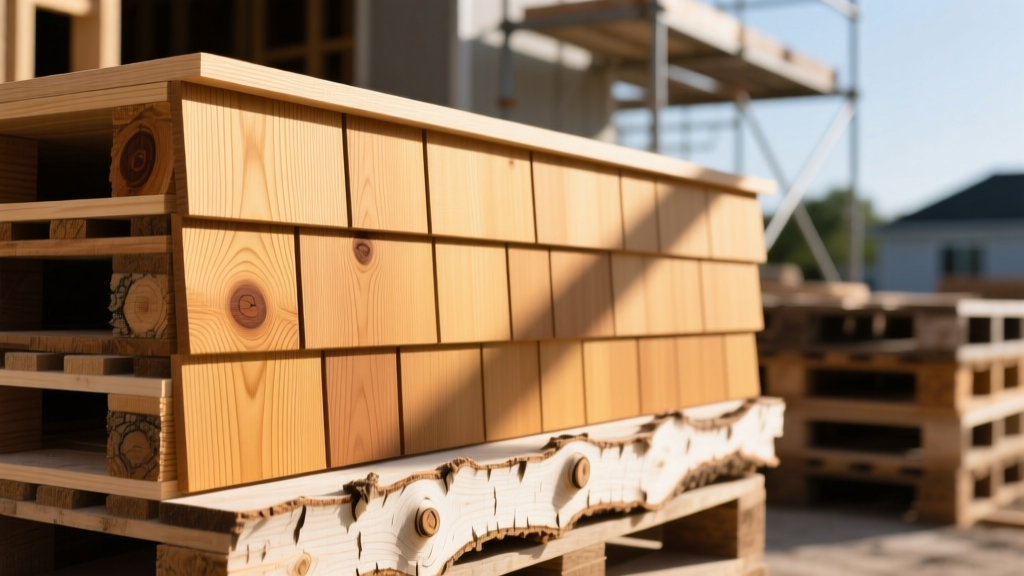
Matching Grades to Different Types of Wood Siding Profiles
Not all siding profiles tolerate lower grades equally. The physical geometry of the siding dictates how much stress the wood will endure during seasonal expansion and contraction. Below is a framework for matching grades to the different types of wood siding profiles.
| Siding Profile | Recommended Minimum Grade | Failure Mode if Under-Graded | Milling Requirement |
|---|---|---|---|
| Bevel / Clapboard | Clear C or Select Tight Knot | Cupping across the wide face; bottom edge splitting due to knot-induced grain deviation. | Vertical grain (edge-grain) preferred for widths over 6 inches. |
| Cedar Shingles | #1 Certigrade (100% Heartwood) | Curling and rapid decay at the butt line if sapwood is present. | Must be edge-grain; flat-grain shingles will curl in direct sunlight. |
| Board and Batten | Architectural Knotty | Warping of the wide boards pulling the battens off the wall. | KD15 (Kiln Dried to 15% MC) mandatory to prevent post-install shrinkage. |
| Tongue and Groove | Select Tight Knot | Tongue snapping during installation if a knot intersects the milled edge. | End-matched (T&G on ends) recommended to reduce waste and blind-nailing needs. |
Moisture Content and Milling Tolerances
The grade stamp tells you about visual defects, but the moisture content (MC) stamp dictates how the wood will behave after installation. Wood is hygroscopic; it will acclimate to the ambient relative humidity of its environment. Installing wood siding at the wrong MC guarantees callback issues.
Decoding the Moisture Stamps
- S-GRN (Surfaced Green): MC is above 19%. This lumber will shrink significantly as it dries on the wall. Never use S-GRN for siding; it is intended for structural framing that will be enclosed.
- S-DRY (Surfaced Dry): MC is 19% or less at the time of surfacing. Acceptable for some exterior applications, but still prone to movement in dry climates.
- MC-15 or KD-15: Moisture content is 15% or less. This is the strict requirement for premium wood siding. Kiln-drying (KD) to this level not only stabilizes the dimensions but also sets the natural resins (pitch), preventing them from bleeding through paint later.
When ordering clear grades for wide clapboard (8 inches or wider), specify vertical grain (also known as edge-grain or quartersawn). Flat-grain boards shrink twice as much across their width as vertical-grain boards. A flat-grain Clear A board will still cup and pull nails if exposed to direct southern sunlight, negating the premium you paid for the visual grade.
Heartwood, Sapwood, and Extractive Bleeding
A common mistake when evaluating the different types of wood siding is ignoring the heartwood-to-sapwood ratio. Heartwood is the dead, inner core of the tree, packed with extractives (tannins, oils, and resins) that provide natural decay and insect resistance. Sapwood is the living, outer layer that transports water.
Sapwood contains almost no natural preservatives. If a lower grade of cedar or redwood siding contains high percentages of sapwood, it will absorb moisture rapidly and rot from the inside out. Furthermore, the water-soluble tannins in sapwood and lower-grade heartwood will leach out when wet, causing severe brown and black streaking on light-colored paints. If you are specifying a white or light-gray acrylic finish, you must use 100% heartwood grades (Clear A) and apply an alkyd-based stain-blocking primer before the topcoat.
Species-Specific Grading Nuances
Grading rules shift depending on the species. The Western Red Cedar Lumber Association maintains specific grading parameters that differ from those used for Southern Yellow Pine or Redwood.
Western Red Cedar
Cedar is graded heavily on the presence of 'black check' (a localized decay around a knot) and the tightness of the grain. Because cedar is relatively soft, impact resistance is low; therefore, Select Tight Knot grades must be milled to a minimum thickness of 11/16 inch to prevent denting and splitting during blind-nailing.
Redwood
Redwood grading is strictly divided into 'Heart' grades and 'Sap' grades. 'Construction Heart' is the standard for exterior siding, allowing knots but mandating that all exposed faces be heartwood. 'B Grade' redwood allows sapwood on the back face, which is acceptable for siding since the back is hidden, but it must be back-primed to prevent differential moisture absorption.
Pressure-Treated Pine
Pine used for siding (often Southern Yellow Pine) relies on pressure treatment (like ACQ or Micronized Copper) for rot resistance rather than natural extractives. The visual grade is less critical than the treatment retention level. For above-ground siding, a retention level of 0.25 pcf (pounds per cubic foot) is required. However, treated pine is highly prone to warping; it must be fastened every 16 inches on center, compared to 24 inches for cedar.
2026 Cost Implications by Grade
Understanding the price delta between grades helps contractors and homeowners allocate budgets effectively. Pricing below reflects national averages for Western Red Cedar in 2026, per square foot of wall coverage (not board foot).
- Clear A (Vertical Grain): $11.50 - $16.00 / sq. ft. (Premium custom homes, historical restorations).
- Clear B / C (Mixed Grain): $8.00 - $11.00 / sq. ft. (High-end residential, painted finishes).
- Select Tight Knot (STK): $5.50 - $7.50 / sq. ft. (Standard residential, stained finishes).
- Architectural Knotty: $4.00 - $5.50 / sq. ft. (Cabins, rustic aesthetics, budget-conscious builds).
On-Site Delivery Inspection Checklist
Do not accept a lumber delivery without verifying the grade and condition. Use this checklist when the siding arrives on-site:
- Verify the Stamp: Check the end-tags or ink stamps on the bundles. Ensure the grade (e.g., 'STK' or 'Clear B') and the moisture content ('KD15') match the purchase order.
- Check for End-Coating: Premium grades of cedar and redwood should have factory-applied end-sealer (usually a wax-based coating in red or blue) to prevent the end-grain from wicking moisture before installation.
- Measure for Cupping: Lay a 6-foot straightedge across a random sample of boards. If the gap between the board and the straightedge exceeds 1/4 inch, the wood was likely stored improperly at the yard and has taken a permanent set.
- Inspect the Wrapping: Siding bundles must be wrapped in heavy-duty, UV-resistant poly. If the plastic is torn or water is pooling inside the bundle, reject the shipment. Wet wood installed behind a vapor barrier will trigger mold growth within months.
Written by
David NakamuraDavid Nakamura is a licensed architect (AIA) and construction technology writer focused on sustainable building methods, mass timber engineering, and high-performance building envelopes. He holds a Master of Architecture from the University of Washington and is a certified Passive House Consultant (CPHC). David spent eight years at the Seattle firm Mithun, where he led the design of three LEED Platinum projects, before founding his own practice specializing in net-zero residential design. He serves on the editorial advisory board of GreenBuilder Magazine and has authored peer-reviewed papers on cross-laminated timber (CLT) connections for the Journal of Structural Engineering. In his spare time, David teaches woodworking at Pratt Fine Arts Center and kayaks the Puget Sound.
More from David Nakamura
View all
Construction Cost
Labor Cost to Build a Deck Per Sq Ft: 2026 Installation Guide
Discover the exact labor cost to build a deck per sq ft in 2026. This installation guide breaks down contractor rates, complexity factors, and hidden fees.
Aug 4, 2026

Construction Cost
How Much Does It Cost to Build a 3 Bedroom House? Financing Guide
Learn exactly how much it costs to build a 3 bedroom house and explore 2026 financing options, construction loan types, and budget frameworks for your build.
Aug 4, 2026

Construction Cost
Cost to Build a Tennis Court: 2026 Guide
How much does it cost to build a tennis court in 2026? Breakdowns for asphalt, concrete, and synthetic surfaces plus fencing and lighting.
Jul 30, 2026