Choosing the Right Type of Wood Fences for Wind Loads
Discover which type of wood fences offer the best structural integrity for high wind loads, including post sizing, lumber grades, and installation specs.

The Structural Reality of Wood Fencing
When selecting a type of wood fences for residential or commercial properties, most buyers focus on aesthetic profiles—shadowbox, board-on-board, or stockade. However, from a structural engineering perspective, a fence is essentially a series of cantilevered retaining walls designed to resist lateral wind loads. A 6-foot-tall solid privacy fence acts as a massive sail. During severe weather events, the structural failure of a fence rarely occurs because the pickets snap; it occurs because the posts shear at the ground line, the concrete footings rotate in the soil, or the fasteners pull through the rails.
Designing a structurally resilient wood fence requires moving beyond standard contractor defaults and applying rigorous material science and load calculations. This guide breaks down the exact wood species, lumber grades, dimensional requirements, and engineering principles necessary to build a fence that withstands modern wind load codes.
Evaluating Wood Species for Structural Posts
The fence post is the primary structural member, transferring lateral wind loads into the soil. The species you choose dictates the modulus of elasticity (MOE) and bending design values (Fb) of the assembly. While pickets and rails can utilize lower-grade or softer woods, posts demand high structural capacity and decay resistance.
| Wood Species | Modulus of Elasticity (MOE) | Bending Design Value (Fb) | Natural Decay Resistance | Best Application |
|---|---|---|---|---|
| Southern Yellow Pine (SYP) - Treated | 1,800,000 psi | 1,500 - 2,400 psi | Low (Requires AWPA UC4B treatment) | Primary structural posts in all soil types |
| Western Red Cedar (WRC) | 1,110,000 psi | 1,000 - 1,300 psi | Moderate to High | Rails, pickets, and above-grade decorative posts |
| Douglas Fir-Larch | 1,900,000 psi | 1,500 - 2,200 psi | Low | Heavy timber framing, not recommended for ground contact |
| Black Locust | 2,010,000 psi | 2,200+ psi | Exceptional (Class 1) | Premium, untreated ground-contact structural posts |
According to the Forest Products Laboratory Wood Handbook, Southern Yellow Pine offers the highest structural stiffness among readily available commercial softwoods, making it the undisputed standard for pressure-treated fence posts. Western Red Cedar, while prized for its dimensional stability and natural rot resistance, lacks the bending strength required for 6-foot privacy fences in high-wind zones unless upsized to 6x6 dimensions.
Lumber Grades and AWPA Treatment Standards
Not all pressure-treated lumber is engineered for structural ground contact. The American Wood Protection Association (AWPA) categorizes treated wood into specific Use Categories. When purchasing structural posts, you must verify the end-tags for the correct AWPA designation.
Critical AWPA Use Categories for Fence Posts
- UC4A (Ground Contact, General Use): Minimum standard for residential fence posts in well-drained soils. Retention level typically 0.28 pcf (pounds per cubic foot) for CA-C or MCA preservatives.
- UC4B (Ground Contact, Heavy Duty): Required for structural posts in poorly drained soils, high-decay regions, or critical load-bearing applications. Retention level jumps to 0.40 pcf. Always specify UC4B for 6x6 structural corner and gate posts.
- UC4C (Ground Contact, Extreme Duty): Reserved for permanent wood foundations and heavy timber retaining walls; generally overkill and cost-prohibitive for standard fencing.
Verify these standards directly via the American Wood Protection Association guidelines to ensure your supplier is providing code-compliant materials.
Furthermore, lumber grading stamps dictate structural reliability. For fence posts, specify No. 1 Grade or Select Structural. Avoid No. 2 or Standard grades for primary load-bearing posts, as the allowable knot sizes and slope-of-grain deviations in lower grades significantly reduce the shear capacity at the ground line.
Engineering for Wind Loads: The 4x4 vs. 6x6 Post Debate
The most common structural failure in wood fencing stems from the use of 4x4 posts in solid privacy applications. To understand why, we must calculate the lateral wind load.
Assume a 6-foot-tall solid wood fence in a region with a basic design wind speed of 115 mph (Exposure C). This generates approximately 22 pounds per square foot (psf) of lateral pressure. An 8-foot fence span (48 square feet of surface area) will catch roughly 1,056 pounds of total lateral force. Because this force is distributed across the height of the fence, it creates a massive bending moment at the base of the post.
The Structural Math: Why 4x4 Posts Fail
A standard 4x4 post has actual dimensions of 3.5" x 3.5", yielding a section modulus (S) of 7.15 cubic inches. If the post is embedded 36 inches into the ground, the bending moment at the ground line is approximately 38,000 inch-pounds. Dividing the moment by the section modulus reveals a bending stress exceeding 5,300 psi. This vastly exceeds the 1,500 to 2,400 psi bending design value (Fb) of treated SYP, guaranteeing structural failure during severe storms.
Conversely, a 6x6 post (actual 5.5" x 5.5") has a section modulus of 35.7 cubic inches. Under the exact same wind load, the bending stress drops to approximately 1,064 psi—well within the safe structural limits of No. 1 SYP. For any solid privacy fence exceeding 5 feet in height, 6x6 posts are not an upgrade; they are a structural necessity.
For a cantilevered fence post to resist rotational overturning in the soil, the embedment depth must be at least 1/3 the total height of the post. A 9-foot total post length (6 feet above grade, 3 feet below) is the absolute minimum for a 6-foot fence. In high-wind coastal zones or sandy soils with low bearing capacity, increase embedment to 42 inches and bell the bottom of the concrete footing to increase uplift resistance.
Hardware and Connection Integrity
Structural wood is only as strong as its connections. The chemicals used in modern pressure-treated lumber (such as Copper Azole or Micronized Copper Azole) are highly corrosive to standard metals. Using electroplated zinc fasteners will result in severe galvanic corrosion, compromising the structural joints within 3 to 5 years.
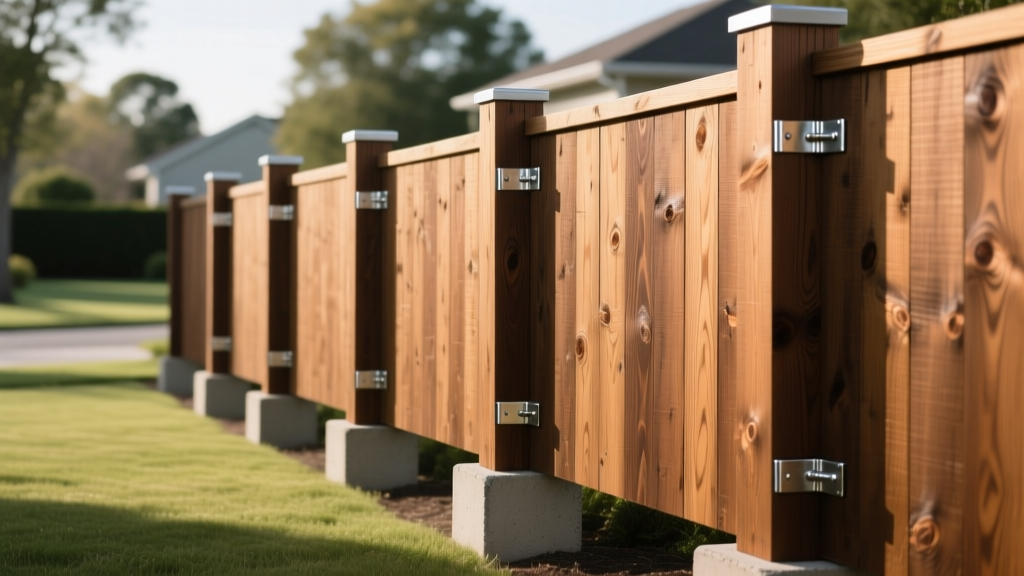
- Post Bases: Use heavy-gauge (7-gauge or thicker) hot-dipped galvanized (HDG) steel post bases meeting ASTM A153 standards. Elevate the base 1 inch above the concrete footing to prevent the wood from wicking ground moisture.
- Fasteners: Specify HDG nails and structural screws (e.g., Simpson Strong-Tie SDWS or comparable structural timber screws). For coastal environments within 3,000 feet of saltwater, upgrade to Type 304 or Type 316 stainless steel fasteners.
- Rail Connections: Avoid simple toe-nailing. Utilize structural rail brackets or mortise-and-tenon joinery to transfer shear loads from the rails directly into the core of the 6x6 posts.
2026 Cost Analysis: Standard vs. Structural Builds
Building to structural wind-load standards requires a higher initial capital investment, but it eliminates the catastrophic replacement costs associated with storm damage. Below is a comparative cost breakdown per linear foot (materials and professional installation) for a 6-foot solid privacy fence in the current market.
| Build Tier | Post Dimension & Grade | Footings & Hardware | Estimated Cost per Linear Foot | Expected Lifespan (Structural) |
|---|---|---|---|---|
| Standard Builder-Grade | 4x4 No. 2 SYP (UC4A) | Sonotube, standard spikes | $45 - $60 | 7 - 12 years (high wind failure risk) |
| Structural Residential | 6x6 No. 1 SYP (UC4B) | Belled footing, HDG brackets | $75 - $95 | 20 - 25 years |
| Premium Heavy-Duty | 6x6 Black Locust / Cedar | Concrete pier, SS hardware | $110 - $150+ | 30+ years |
Frequently Asked Structural Questions
Can I use steel posts instead of wood for structural support?
Yes. Galvanized steel pipe posts (e.g., 2-3/8" OD Schedule 40) set in concrete offer superior tensile and shear strength compared to wood. However, attaching wood rails to steel requires specialized welded tabs or mechanical saddle brackets, which increases labor time and hardware costs. Many structural builds utilize steel posts for corners and gate hinges, transitioning to 6x6 wood posts for the intermediate runs.
Does leaving a gap between pickets reduce structural wind load?
Significantly. A solid board-on-board fence has a solidity ratio of 1.0, catching 100% of the wind pressure. A shadowbox fence (alternating pickets on opposite sides of the rails) has a solidity ratio of roughly 0.6 to 0.7. This allows wind to pass through, reducing the lateral load on the posts by up to 40%, which can permit the use of 4x4 posts in moderate wind zones.
How deep should the concrete footing be?
The concrete footing must extend below the local frost line to prevent frost heave from lifting and rotating the post. In northern climates, this may require 42 to 48 inches of depth. The diameter of the footing should be at least three times the width of the post (e.g., a 18-inch diameter bell footing for a 6x6 post) to provide adequate soil bearing area.
Written by
James ThorntonJames Thornton is a construction industry veteran with 25 years of hands-on experience in wood framing, lumber grading, and residential building codes. He started as a framing carpenter in rural Oregon, earned his ICC Residential Building Inspector certification, and eventually became a senior plan reviewer for the City of Portland Bureau of Development Services. James holds a B.S. in Wood Science & Technology from Oregon State University and is a certified lumber grader through the West Coast Lumber Inspection Bureau (WCLIB). He has inspected over 3,000 residential construction sites and authored the city's internal guide on advanced framing techniques (2x6 at 24" O.C.). James lives in Bend, OR, where he builds custom timber-frame cabins and competes in lumberjack sports.
More from James Thornton
View all
Insulation
Best Home Insulation Materials: Complete 2026 Guide
Compare top home insulation materials for 2026. Find R-values, installed costs per square foot, and best uses for fiberglass, spray foam, and mineral wool.
Aug 4, 2026

Sustainable Building
Certify Your Green Building Material for LEED and WELL
Step-by-step guide to certifying a green building material for LEED v5 and WELL v2. Master EPDs, HPDs, and VOC limits for 2026 project specifications.
Aug 4, 2026

Stone & Masonry
Veneer Stacked Stone Panels: Interior Design & Style Showcase
Discover how veneer stacked stone panels transform interiors. Explore modern design profiles, material pairings, and technical installation specs.
Aug 4, 2026