Wood Siding Materials Compared: 2026 Cost & Durability Guide
Compare top wood siding materials for 2026. Expert analysis of cedar, redwood, cypress, and modified wood costs, Janka hardness, and installation specs.

The 2026 Wood Siding Landscape: Beyond Basic Pine
Selecting the right wood siding materials requires balancing aesthetic warmth against biological vulnerability. While painted pine and finger-jointed composites dominated budget builds in the past, the 2026 market has shifted heavily toward naturally decay-resistant species and chemically modified timbers. Homeowners and builders are increasingly prioritizing lifecycle cost over initial material savings, recognizing that premature siding failure due to rot, cupping, or UV degradation costs thousands in remediation.
This comparison evaluates the structural integrity, Janka hardness ratings, natural decay resistance, and real-world installed costs of the premier wood siding materials available today. We bypass generic marketing claims to focus on board-grade specifications, fastener metallurgy, and the exact environmental conditions where each species thrives or fails.
Quick Decision Matrix: Match Species to Climate
- Coastal & High Humidity: Alaskan Yellow Cedar, Southern Cypress, or Accoya (Modified). Avoid standard pine and untreated fir.
- Arid & High UV (Southwest): Western Red Cedar (Clear Vertical Grain) with heavy pigmented oil stains. Avoid dark-colored modified woods that will bake and check.
- Freeze-Thaw Cycles (Northeast/Midwest): Redwood (Heartwood) or Thermally Modified Ash. Requires strict back-priming and rainscreen detailing to prevent moisture trapping.
Solid Wood Species: Head-to-Head Comparison
Western Red Cedar (The Benchmark)
Western Red Cedar remains the most specified wood siding material in North America, prized for its dimensional stability and natural tannins that resist fungal decay. However, performance varies drastically by grade. Clear Vertical Grain (CVG) features growth rings running perpendicular to the board face, minimizing expansion and contraction to roughly 1-2% across the width. Select Tight Knot (STK) contains flat-sawn sections that can expand up to 4-5%, making it highly susceptible to cupping if installed without a rainscreen gap.
According to the Real Cedar association, the natural preservative oil (thujaplicin) in the heartwood provides a Class II durability rating. However, sapwood offers zero decay resistance. When ordering, specify '100% Heartwood' for STK grades to ensure longevity.
- Janka Hardness: 350 lbf (relatively soft; dents easily from hail or impacts).
- Material Cost (2026): $5.50 - $9.00 per sq. ft. (CVG); $3.50 - $5.50 per sq. ft. (STK).
- Installed Cost: $11.00 - $16.50 per sq. ft.
Coast Redwood (The Premium Tier)
Coast Redwood offers superior dimensional stability and a richer initial color profile than cedar. Its open-cell structure allows it to absorb and release moisture without severe checking. For exterior cladding, you must specify Construction Heart or better grades; 'Sap' grades will rot within 3 to 5 years in damp climates. Redwood's high tannin content provides excellent insect resistance, but it requires careful fastener selection to prevent severe black streaking.
- Janka Hardness: 420 lbf.
- Material Cost (2026): $8.00 - $14.00 per sq. ft.
- Installed Cost: $14.00 - $22.00 per sq. ft.
Southern Cypress (The Coastal Specialist)
Grown in the swamps of the American South, old-growth Cypress (often reclaimed or salvaged today) is virtually impervious to water rot due to 'cypressene', a natural oil in the heartwood. Second-growth cypress has lower oil concentrations but still outperforms cedar in continuous moisture exposure. It is denser and harder to machine, often requiring pre-drilling for blind-nailing to prevent splitting at the board ends.
- Janka Hardness: 510 lbf.
- Material Cost (2026): $6.50 - $11.00 per sq. ft.
- Installed Cost: $12.00 - $18.00 per sq. ft.
The Rise of Modified Wood: Accoya and Thermowood
For projects demanding the aesthetic of solid wood but the maintenance cycle of composite materials, modified wood siding materials have captured significant market share. These are not plastics or fiber-cements; they are real timber altered at the cellular level.
Acetylated Wood (Accoya): Radiata pine is submerged in acetic anhydride, which replaces the wood's free hydroxyl groups with acetyl groups. This process, detailed in the Accoya Technical Documentation, reduces the wood's equilibrium moisture content (EMC) by up to 80%. The result is a siding material with a 50-year above-ground warranty, exceptional dimensional stability (swelling/shrinking is reduced by 75%), and a Janka hardness boosted to 1,400 lbf. It machines beautifully and holds coatings up to four times longer than unmodified cedar.
Thermally Modified Wood (Thermory, Kebony): Timber (often Ash or Pine) is baked at 400°F+ in an oxygen-depleted environment. This caramelizes the sugars, removing the food source for fungi and insects. While incredibly rot-resistant and aesthetically striking (deep chocolate browns), thermal modification makes the wood brittle. It cannot be structurally load-bearing and is prone to surface checking if exposed to direct, unshaded southern UV exposure without annual oiling.
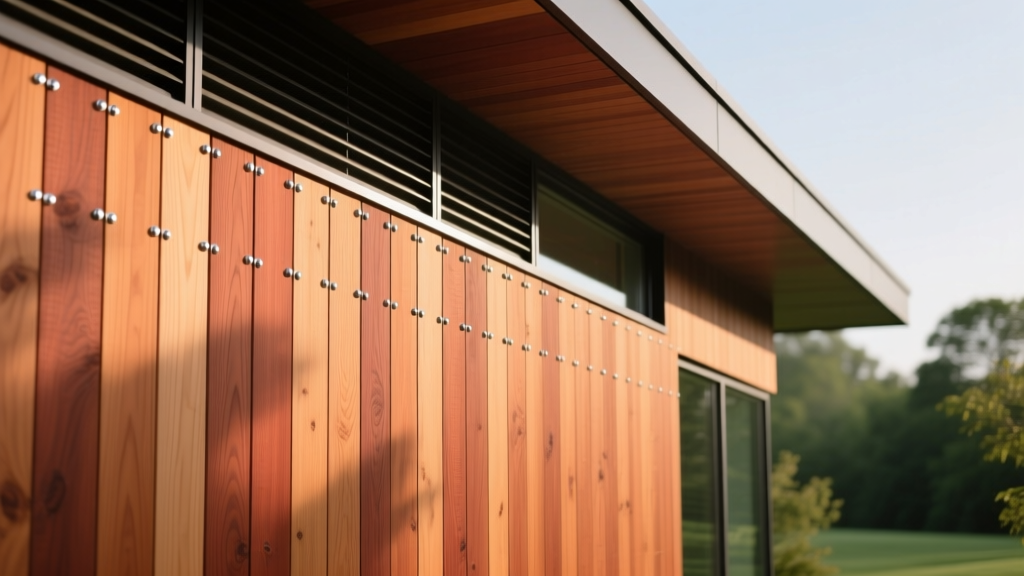
Comprehensive Cost & Performance Matrix
| Material / Species | Janka Hardness | Decay Resistance | Coating Lifespan | Installed Cost (Sq. Ft.) |
|---|---|---|---|---|
| W. Red Cedar (CVG) | 350 lbf | High (Heartwood) | 3-5 Years | $11 - $16.50 |
| Coast Redwood (Heart) | 420 lbf | High | 3-5 Years | $14 - $22.00 |
| Southern Cypress | 510 lbf | Very High | 4-6 Years | $12 - $18.00 |
| Accoya (Acetylated) | 1,400 lbf | Extreme (Class 1) | 8-12 Years | $19 - $28.00 |
| Thermory Ash | 1,300 lbf | Very High | 2-4 Years (UV fade) | $16 - $24.00 |
Critical Installation Details That Dictate Lifespan
The USDA Forest Products Laboratory explicitly notes that wood decay requires moisture content above 20%. Therefore, the installation methodology is just as critical as the species selected. Ignoring these three installation parameters will void warranties and guarantee premature failure.
1. The Rainscreen Imperative
Never install wood siding flat against housewrap or sheathing. A ventilated rainscreen gap of 3/8-inch to 1/2-inch, created using vertical furring strips or a specialized drainage mat (like Cor-A-Vent), is mandatory. This gap allows hydrostatic pressure to equalize and provides a drainage plane for bulk water. Crucially, the top and bottom of the rainscreen cavity must be screened with corrosion-resistant insect mesh to prevent wasps and rodents from nesting behind the cladding.
2. Fastener Metallurgy and Placement
Cedar, Redwood, and Cypress are highly acidic. Using standard galvanized nails will result in a chemical reaction that dissolves the zinc coating, leading to rust streaks and fastener failure within a decade. The Rule: Use 304-grade stainless steel ring-shank nails for standard applications. If the project is within 5 miles of a saltwater coastline, upgrade to 316-grade marine stainless steel. Nails should be blind-nailed at a 45-degree angle through the tongue (for T&G profiles) or face-nailed with two nails per board, placed 1/4-inch from the edges to prevent splitting.
3. End-Grain Sealing and Back-Priming
Wood absorbs moisture 50 times faster through the end-grain than through the face. Every cut end, miter joint, and window casing intersection must be heavily coated with an end-grain sealer (like Anchorseal) before installation. Furthermore, all six sides of the board should receive a factory-applied primer or penetrating oil back-coat to prevent the back face from absorbing moisture migrating outward from the interior of the home.
Expert Warning on Tannin Bleed: Cedar and Redwood will bleed heavy brown tannins through water-based acrylic primers. You must use an oil-based or shellac-based stain-blocking primer (such as Zinsser B-I-N) on the face before applying your topcoat, or opt for a semi-transparent penetrating oil stain that allows the tannins to breathe without blistering the finish.
Real-World Failure Modes (And How to Avoid Them)
Even premium wood siding materials fail when subjected to specific environmental stressors. Understanding these edge cases allows for proactive mitigation during the design phase.
- Cupping in Wide Boards: Boards wider than 8 inches (especially flat-sawn STK cedar) will inevitably cup at the edges as the outer face shrinks faster than the inner face. Fix: Limit board exposure to 6 inches, or switch to a shiplap profile with a 1/4-inch reveal that hides minor movement.
- Extractive Staining on Stucco/Concrete: The natural oils in redwood and cedar will leach out during the first year of weathering, permanently staining adjacent light-colored masonry or stucco. Fix: Install a metal drip edge or Z-flashing at the bottom course of the siding to direct runoff into the gutter system, keeping it off the masonry base.
- UV Degradation of Modified Wood: Thermally modified woods turn a silvery-gray when exposed to UV light. While this does not compromise structural integrity, it alters the aesthetic. Fix: If the dark chocolate color must be maintained, specify a UV-inhibiting pigmented oil (like Rubio Monocoat Exterior) and plan for a re-application every 24 to 36 months.
Final Verdict: Matching Material to Project Budget
For traditional residential projects where budget and classic aesthetics align, Western Red Cedar (CVG) remains the undisputed champion, offering the best balance of workability, natural resistance, and cost. For high-end architectural builds in harsh, wet climates where maintenance access is difficult, the premium upfront cost of Accoya pays for itself by eliminating the need for scaffolding and re-staining every four years. Avoid unmodified pine and fir entirely for exterior cladding; the long-term maintenance costs invariably eclipse the initial material savings.
Written by
Marcus ChenMarcus Chen is a licensed structural engineer (PE) and building materials analyst with over 12 years of experience across residential, commercial, and industrial construction. He holds a Master of Science in Civil Engineering from UC Berkeley and spent six years at Thornton Tomasetti before transitioning to independent consulting and technical writing. Marcus specializes in material selection for seismic-prone regions, concrete reinforcement strategies, and lifecycle cost analysis. His work has been cited by the American Concrete Institute (ACI) and the Structural Engineers Association of California (SEAOC). When he is not on a job site or at his desk, you will find him hiking the Sierra Nevada or restoring a 1920s craftsman bungalow in Oakland, CA.
More from Marcus Chen
View all
Construction Cost
How Much Did the Eiffel Tower Cost to Build?
How much did the Eiffel Tower cost to build in 1889? We adjust for inflation and compare its budget to modern skyscraper construction.
Aug 4, 2026

Fire Resistance
What Is a Fire Resistant Material? Testing & Certification Guide
Discover what is a fire resistant material through ASTM and UL testing. Learn how fire ratings, certifications, and assemblies work in construction.
Aug 4, 2026

Construction Cost
How Much Did the Burj Khalifa Cost to Build?
How much did the Burj Khalifa cost to build? We break down the $1.5B project and extract 5 money-saving strategies for your next build.
Jul 30, 2026