Types of Knots in Wood: A Lumber Grading & Quality Guide
Master lumber grading with our guide to types of knots in wood. Learn how tight, loose, and sound knots impact structural integrity and visual grades.
The Biological Origin and Structural Implication of Knots
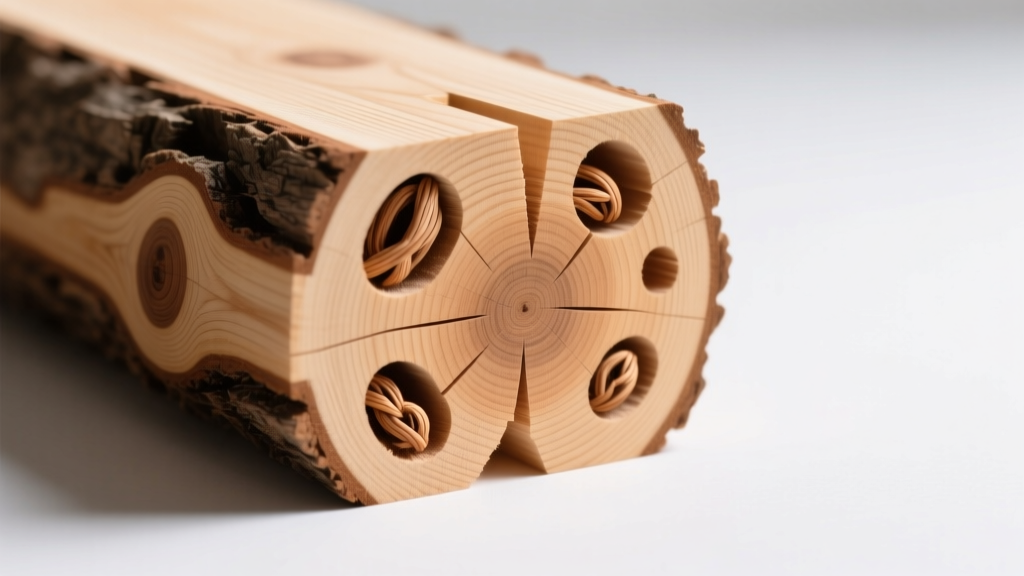
In structural timber and architectural woodworking, a knot is not merely a visual defect; it is the biological base of a branch embedded within the trunk of the tree. As the tree grows in diameter, the cambium layer continues to produce wood over the base of the branch. When the tree is harvested and sawn into dimensional lumber, these branch bases are exposed as knots. For structural engineers, architects, and builders, understanding the types of knots in wood is critical because knots disrupt the continuous longitudinal grain of the timber. This grain deviation creates localized stress concentrations, directly reducing the Modulus of Rupture (MOR) and Modulus of Elasticity (MOE) of the board. According to the USDA Forest Products Laboratory, the severity of this strength reduction depends entirely on the knot's size, position on the cross-section, and its physical attachment to the surrounding wood.
Primary Classifications in Lumber Grading Rules
Grading agencies such as the Southern Pine Inspection Bureau (SPIB) and the National Lumber Grades Authority (NLGA) categorize knots based on their structural integrity and growth patterns. Visual lumber grading rules strictly dictate the allowable size and frequency of these classifications.
Intergrown (Tight) vs. Encased (Loose) Knots
Intergrown knots, commonly referred to as tight knots, occur when the branch was alive and growing at the time the tree was felled. The wood fibers of the branch are continuous with the wood fibers of the trunk. In a dried piece of lumber, an intergrown knot is firmly fixed in place and will not fall out. While still a point of grain deviation, tight knots retain a degree of structural continuity.
Encased knots, or loose knots, form when a branch dies but remains on the tree. The trunk continues to grow around the dead branch, but the fibers do not interlock. Instead, a layer of bark or a distinct boundary forms between the knot and the surrounding wood. During the kiln-drying process, the knot shrinks at a different rate than the surrounding timber, often causing it to loosen or fall out entirely, leaving a void known as a "knot hole." In structural grading, encased knots are penalized much more heavily than intergrown knots of the exact same diameter.
Sound vs. Unsound Knots
The classification of soundness dictates whether the wood within the knot itself is structurally viable.
Sound knots are solid, hard, and free from decay. They are as dense as the surrounding wood and can bear compressive loads, even if they disrupt tensile strength along the grain.
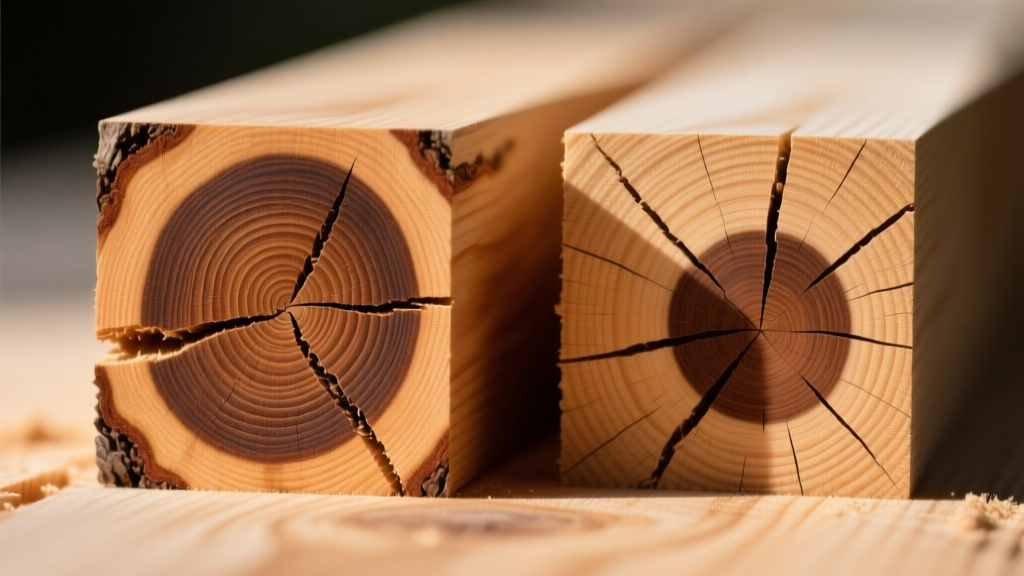
Unsound knots contain evidence of decay, pith (the soft center of the branch), or checking (deep radial splits). In high-grade structural lumber (such as Select Structural or No. 1 framing), unsound knots are strictly prohibited or severely limited in size, as they act as failure initiation points under dynamic or seismic loading.
A spike knot is cut longitudinally along its length, appearing as a dark streak on the face of the board rather than a circular or oval shape. Spike knots are exceptionally dangerous in structural applications because they force the surrounding grain to deviate at a severe slope (often exceeding the 1:8 or 1:12 slope-of-grain limits set by the American Wood Council). A board with a large spike knot is highly susceptible to horizontal shear failure and should be rejected for load-bearing headers or joists.
Knot Area Ratio (KAR): The Mathematics of Structural Grading
Modern structural grading does not simply measure the single largest knot on a board. Instead, engineers and grading machines utilize the Knot Area Ratio (KAR). KAR is calculated by measuring the aggregate cross-sectional area of all knots within a specific gauge length (typically 6 inches or 12 inches) and dividing it by the total cross-sectional area of the board in that same zone.
This metric acknowledges that multiple small knots clustered together can be just as detrimental to a board's bending strength as one massive knot. Below are typical maximum allowable KAR limits for visually graded structural joists and planks:
| Lumber Grade | Edge Knot Limit (2x4 Nominal) | Maximum KAR (Tension Zone) | Primary Use Case |
|---|---|---|---|
| Select Structural | 1-1/4 inches | 1/4 (25%) | Heavy loads, long spans, critical tension members |
| No. 1 | 2-1/8 inches | 1/3 (33%) | Standard residential joists and rafters |
| No. 2 | 2-3/4 inches | 1/2 (50%) | General framing, studs, plates, blocking |
| No. 3 / Utility | Unrestricted (within wane limits) | Not specified (low stress) | Temporary bracing, non-load-bearing crates |
Visual Grading vs. Machine Stress Rating (MSR)
Historically, inspectors had to visually estimate the types of knots in wood and apply grading rules manually. As of the 2026 building season, the majority of dimensional framing lumber (particularly Spruce-Pine-Fir and Southern Pine) is graded using Machine Stress Rating (MSR) or Machine Evaluated Lumber (MEL) systems.
MSR machines pass each board through non-destructive bending rollers that measure the actual Modulus of Elasticity (MOE) in real-time. How does this change the impact of knots? An MSR machine does not "see" a knot; it measures the board's overall stiffness. A board with a large, tight, intergrown knot might still achieve a high MSR grade (e.g., 2400f-2.0E) if the surrounding clear wood is exceptionally dense and stiff, compensating for the localized weakness. However, grading rules still impose absolute maximum limits on edge knots and cluster knots even in MSR lumber, because localized stress concentrations can cause brittle, sudden failures that overall MOE testing cannot predict.
Specification Decision Matrix: Matching Knot Types to Applications
Specifying the correct lumber grade based on knot tolerance prevents both structural failure and aesthetic disappointment. Use the following decision matrix to guide your material procurement.
| Project Application | Acceptable Knot Types | Recommended Grade / Material | Critical Restriction |
|---|---|---|---|
| Exposed Architectural Beams | Sound, tight intergrown knots | Architectural Glulam or No. 1 Free-Heart | No loose or decayed knots; minimal spike knots |
| Concealed Floor Joists | Tight and encased (if within KAR limits) | MSR 1950f-1.7E or No. 2 Visual | Avoid large knots on the bottom tension edge |
| Paint-Grade Interior Trim | None (or pin-knots only) | Clear All Heart (CLH) or MDF/Finger-joint | Knots bleed resin through paint over time |
| Exterior Decking Boards | Sound tight knots | No. 1 Grade Cedar or Redwood | Loose knots will fall out, creating rot pockets |
Edge Cases: Wane and Bark Pockets
When evaluating the types of knots in wood, inspectors must also look for associated defects. Wane (the original rounded outer surface of the log left on the board) often accompanies large edge knots. If a knot is located within a wane area, its effective cross-sectional weakness is compounded by the missing wood. Furthermore, bark pockets—small inclusions of bark trapped between the knot and the trunk wood—act as internal checks. In high-moisture environments, these bark pockets trap water, accelerating localized fungal decay and compromising the long-term durability of the timber.
By understanding the precise biological and mechanical differences between intergrown, encased, sound, and unsound knots, builders can accurately interpret grading stamps, optimize material yields, and ensure the structural integrity of their projects.
Written by
Priya KapoorPriya Kapoor is a real estate market analyst and construction economics researcher with expertise in housing affordability, development feasibility, and infrastructure investment. She holds a Master of Regional Planning from Cornell University and previously worked as a senior analyst at CBRE's Investment Properties group, where she modeled returns for $4B in mixed-use development pipelines. Priya now runs an independent research practice advising developers, municipalities, and REITs on construction cost forecasting and market timing. She publishes the quarterly "BuildMat Market Pulse" report tracking material price indices across 12 commodity categories. Based in Austin, TX, Priya serves on the board of Habitat for Humanity Austin and is a marathon runner.
More from Priya Kapoor
View all
Construction Cost
Cost to Build a 1600 Sq Ft Home in 2026: Full Breakdown
Accurate 2026 cost to build a 1600 sq ft home—material, labor, and regional pricing breakdowns included. Plan your budget with real-time estimates.
Aug 11, 2026

Wood & Lumber
Name the Types of Wood for Pressure Treatment and Preservation
Learn how to name the types of wood best suited for pressure treatment. Compare species treatability, chemical retention levels, and 2026 preservation costs.
Aug 4, 2026

Stone & Masonry
Stone Veneer Suppliers Lindenhurst: 2026 Cost Analysis
Analyze 2026 stone veneer costs in Lindenhurst, NY. Compare local supplier pricing, delivery fees, and Suffolk County installation labor rates.
Aug 4, 2026