Types of Guitar Wood: A Luthier's Grading and Quality Guide
Master the grading standards for types of guitar wood. Learn how luthiers evaluate tonewood density, grain, moisture, and acoustic tap tone.
The Anatomy of Tonewood Grading
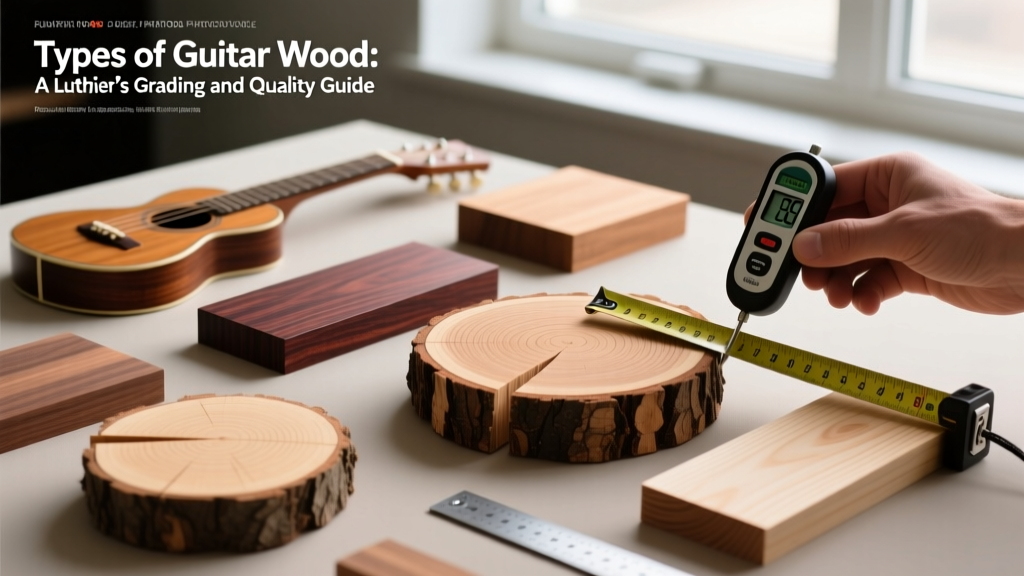
Selecting the right types of guitar wood extends far beyond choosing a specific tree species. For master luthiers and acoustic engineers, the grading matrix is what separates a $500 factory instrument from a $5,000 heirloom acoustic. Tonewood grading evaluates the physical and acoustic properties of the timber, focusing on stiffness-to-weight ratios, damping coefficients, and structural integrity under 160+ pounds of string tension.
Unlike construction lumber graded for load-bearing sheer strength, tonewood is graded for acoustic velocity and visual symmetry. The most critical metric in soundboard grading is the quarter-sawn angle. Premium guitar tops must be cut so the growth rings intersect the face of the board at 90 degrees (or a minimum of 75 degrees for Mastergrade). This orientation exposes the medullary rays, providing cross-grain stiffness that prevents the soundboard from bellying or warping under bridge torque.
Luthier's Insight: The Tap Tone Test
Before cutting a rough soundboard billet, experienced builders perform a tap tone test. By suspending the wood at its nodal points and striking it, they listen for a clear, sustained bell-like ring with a distinct fundamental pitch. A dull thud indicates high damping (often caused by compression wood or excessive runout), rendering the piece unsuitable for high-end acoustic tops regardless of its visual grain.
Grading Matrix for Top Types of Guitar Wood
The classification of tonewoods relies on a combination of visual grain spacing, structural runout, and acoustic responsiveness. Below is the industry-standard grading matrix used by premium acoustic manufacturers and independent luthiers.
| Grade | Grain Spacing & Angle | Runout / Structural Defects | Visual Aesthetics | Primary Application |
|---|---|---|---|---|
| Mastergrade | 14-18 grains/inch; 90° quarter-sawn | Zero measurable runout; perfect silk | Flawless color uniformity; intense medullary rays | Concert-level custom acoustics |
| AAA (Triple-A) | 12-16 grains/inch; 85°+ quarter-sawn | Minimal runout (< 1:15 slope) | Minor color variations; tight, straight grain | High-end production models |
| AA (Double-A) | 10-14 grains/inch; 75°+ quarter-sawn | Slight slope of grain acceptable | Visible winter/summer grain contrast; minor sapwood | Mid-tier studio instruments |
| A (Single-A) | 8-12 grains/inch; variable angle | Moderate runout; occasional compression wood | Wide grain spacing; color inconsistencies | Student models; electric guitar tops |
Soundboard Species: Spruce and Cedar Breakdown
The soundboard acts as the primary acoustic amplifier of the guitar. The wood must be exceptionally light yet stiff enough to resist string tension. According to data from the The Wood Database, spruce species dominate this category due to their unparalleled stiffness-to-weight ratios.
Sitka Spruce (Picea sitchensis)
Sitka is the industry workhorse. With a Janka hardness of 510 lbf and a high modulus of elasticity, it offers a broad dynamic range. Mastergrade Sitka requires tight, evenly spaced grain lines. It is highly forgiving, making it the preferred choice for aggressive flatpickers who need a soundboard that won't compress and distort under heavy attack.
Adirondack Spruce (Picea rubens)
Known as "Red Spruce," Adirondack is stiffer and heavier than Sitka. It possesses a higher acoustic velocity, resulting in a louder, more complex overtone series with immense headroom. Because old-growth Adirondack is scarce, modern grading allows for slightly wider grain spacing, provided the wood exhibits the characteristic high stiffness and pronounced medullary "silk" across the face.
Western Red Cedar (Thuja plicata)
Cedar is significantly softer (Janka 350 lbf) and less dense than spruce. It is graded less on grain tightness and more on uniform color and lack of pitch pockets. Cedar soundboards respond instantly to light touch, making them the premier choice for classical and fingerstyle guitars, though they lack the volume ceiling required for heavy strumming.
Back and Side Woods: Impedance and Reflection
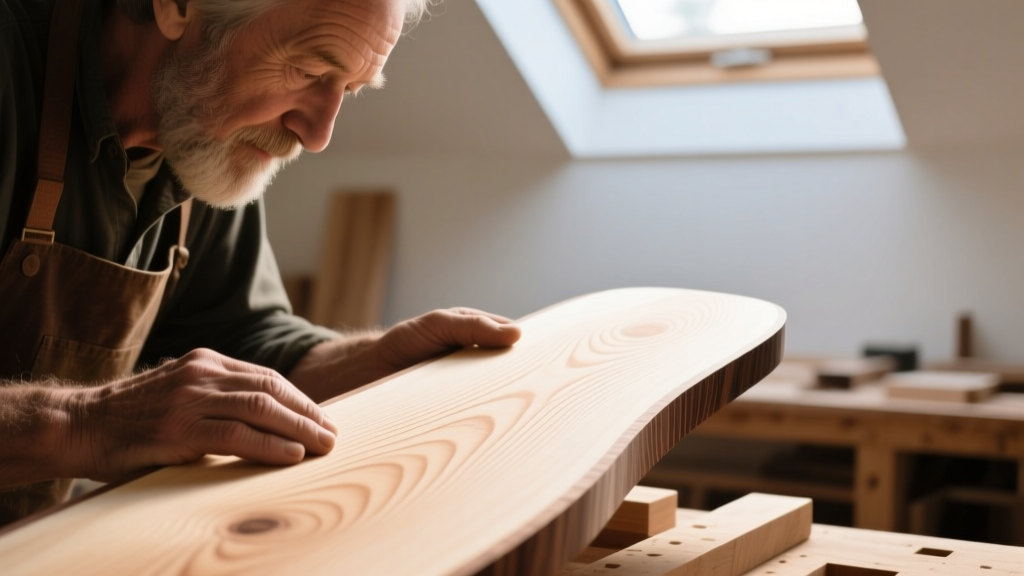
While the top generates the sound, the back and sides act as the acoustic enclosure, reflecting and filtering frequencies. The grading for these woods prioritizes density, resin content, and visual figure.
- Indian Rosewood (Dalbergia latifolia): The standard for back and sides. With a Janka hardness of 2,440 lbf, it provides a deep low-end and sparkling high-end. Grading focuses on the richness of the dark brown/purple hue and the presence of resinous streaks. Due to CITES regulations, properly documented, legally sourced Indian Rosewood commands a premium.
- Honduran Mahogany (Swietenia macrophylla): Graded by its interlocking grain and ribbon figure. Mahogany is lighter and more porous than rosewood, yielding a fundamental-heavy, midrange-focused tone. Premium sets are quarter-sawn to expose the medullary ray "fleck" or ribbon stripe.
- Maple (Acer saccharum): Highly reflective with a fast decay rate. Maple is graded almost entirely on its visual figure—specifically "flame" (chatoyancy) or "quilt" patterns. Structurally, it is incredibly stiff, requiring luthiers to carve the back thinner to achieve proper acoustic resonance.
Structural Warning: The Bearclaw Anomaly
"Bearclaw" or "hazelfigure" in spruce soundboards creates a stunning, rippled visual effect. However, this figure is caused by irregular, wavy grain growth. While visually graded as Mastergrade, the cross-grain deviation reduces longitudinal stiffness by up to 15%. Luthiers must compensate by leaving bearclaw tops slightly thicker or using taller, stiffer scalloped bracing to prevent structural failure.
Moisture Content and Acclimation Standards
The acoustic performance of any tonewood is entirely dependent on its moisture content (MC). Wood is hygroscopic; it expands and contracts with ambient relative humidity (RH). According to the USDA Forest Products Laboratory Wood Handbook, structural timber stabilizes based on its environment, but tonewood requires extreme precision.
- Kiln-Dried (KD) Standard: Most commercial tonewoods are kiln-dried to 8-10% MC. This is acceptable for factory production but lacks the cellular stability of aged wood.
- Air-Dried Premium: High-end luthiers demand air-dried spruce that has been stored in climate-controlled environments for 5 to 10 years. This slow process relieves internal cellular stresses that kiln-drying locks in.
- The 6-8% Target: Before bracing and gluing, soundboards must be acclimated to a workshop environment of 45-50% RH, bringing the wood's MC down to exactly 6-8%. Gluing a top at 10% MC in a 45% RH room will result in catastrophic top cracking when the guitar is shipped to a dry winter climate.
2026 Pricing Tiers for Tonewood Sets
The cost of premium types of guitar wood has risen due to stricter environmental harvesting regulations and increased global demand. Below are the current market rates for matched acoustic sets (one soundboard, two back halves, two side halves) from specialized tonewood suppliers.
| Species Combination | Grade | Average Set Price (USD) | Availability & Sourcing Notes |
|---|---|---|---|
| Mastergrade Adirondack / Brazilian Rosewood | Master / AAA | $850 - $1,500+ | Brazilian requires pre-1992 CITES paperwork; extremely limited. |
| AAA Sitka Spruce / Indian Rosewood | AAA / AAA | $140 - $220 | The industry standard; widely available from certified dealers. |
| Mastergrade Engelmann / Flamed Maple | Master / AAA | $250 - $350 | Engelmann is becoming scarce; high-quality clear sets are rare. |
| AA Western Red Cedar / Honduran Mahogany | AA / AA | $90 - $130 | Mahogany prices are climbing due to South American export limits. |
Frequently Asked Questions
Does the visual figure of wood affect its acoustic tone?
Yes, but often inversely to what beginners expect. Highly figured woods (like quilted maple or bearclaw spruce) have irregular grain patterns that disrupt the uniform transmission of sound waves, increasing acoustic damping. A visually "boring," perfectly straight-grained piece of spruce will almost always yield a louder, more responsive guitar than a heavily figured piece of the same species.
What is 'runout' and why do luthiers reject wood with it?
Runout occurs when the wood grain does not run perfectly parallel to the edge of the board, but instead slopes out of the face. In a soundboard, severe runout creates a weak point that can crack under string tension. Acoustically, it causes the 'tap tone' to sound dead and uneven across the board's surface. Luthiers check for runout by scraping the wood; if it tears or fuzzes in one direction but cuts cleanly in the other, runout is present.
Can I use construction-grade pine as a substitute for spruce?
While pine and spruce are both softwoods in the Pinaceae family, construction pine (like Southern Yellow Pine) is generally too dense, resinous, and improperly quarter-sawn for acoustic soundboards. It lacks the necessary stiffness-to-weight ratio. However, some historical and parlor guitars successfully used old-growth, tight-grained heart pine, provided it was quarter-sawn and air-dried for decades.
Written by
David NakamuraDavid Nakamura is a licensed architect (AIA) and construction technology writer focused on sustainable building methods, mass timber engineering, and high-performance building envelopes. He holds a Master of Architecture from the University of Washington and is a certified Passive House Consultant (CPHC). David spent eight years at the Seattle firm Mithun, where he led the design of three LEED Platinum projects, before founding his own practice specializing in net-zero residential design. He serves on the editorial advisory board of GreenBuilder Magazine and has authored peer-reviewed papers on cross-laminated timber (CLT) connections for the Journal of Structural Engineering. In his spare time, David teaches woodworking at Pratt Fine Arts Center and kayaks the Puget Sound.
More from David Nakamura
View all
Construction Cost
Labor Cost to Build a Deck Per Sq Ft: 2026 Installation Guide
Discover the exact labor cost to build a deck per sq ft in 2026. This installation guide breaks down contractor rates, complexity factors, and hidden fees.
Aug 4, 2026

Construction Cost
How Much Does It Cost to Build a 3 Bedroom House? Financing Guide
Learn exactly how much it costs to build a 3 bedroom house and explore 2026 financing options, construction loan types, and budget frameworks for your build.
Aug 4, 2026

Construction Cost
Cost to Build a Tennis Court: 2026 Guide
How much does it cost to build a tennis court in 2026? Breakdowns for asphalt, concrete, and synthetic surfaces plus fencing and lighting.
Jul 30, 2026