Timber Floor Polishers: 2026 Maintenance & Cleaning Playbook
Master your timber floor maintenance with our 2026 playbook. Compare top timber floor polishers, pad grits, and screen-and-recoat costs.
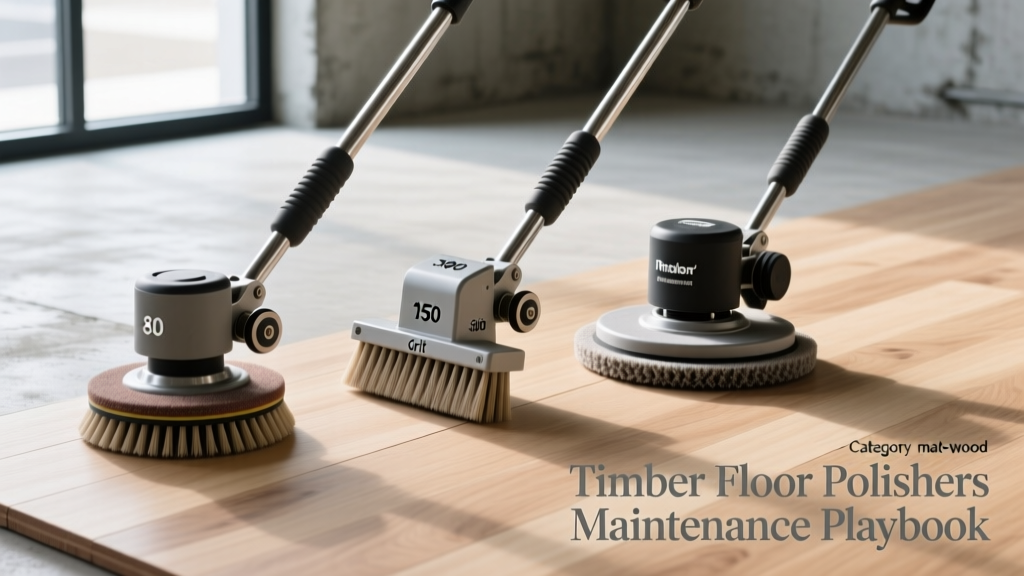
The Mechanics of Timber Floor Polishing: Screen vs. Deep Sand
In commercial and high-traffic residential environments, timber floors require periodic rejuvenation long before a full structural resand is necessary. This is where timber floor polishers—specifically low-speed rotary buffers and planetary screening machines—become the core of your maintenance playbook. Unlike heavy-duty drum sanders that remove raw wood, polishers are engineered to abrade the top 1-2 mils of the existing finish, creating a mechanical profile for a new topcoat to adhere to.
The fundamental rule of timber floor maintenance is the 80/20 principle: 80% of floor degradation is surface-level scratching and chemical dulling, while only 20% involves deep gouges requiring bare-wood exposure. Using a polisher for a 'screen-and-recoat' procedure addresses the 80% at roughly 15% of the cost and downtime of a full sanding project.
Machine Selection Matrix: Rotary vs. Planetary Polishers
Selecting the correct machine dictates the quality of the mechanical profile and the absence of swirl marks. The two dominant categories in 2026 are direct-drive rotary buffers and multi-disc planetary polishers.
| Machine Model | Type | RPM / Speed | Weight / Downforce | Best Application | Est. Rental (Daily) |
|---|---|---|---|---|---|
| Clarke Super 7R | Rotary Buffer | 175 RPM | 102 lbs | Screening polyurethane finishes; heavy scuff removal | $65 - $85 |
| Bona FlexiSand 1.5 | Rotary / Modular | 175 RPM | 95 lbs (base) | Versatile screening; accepts wire brushes for hardwax oils | $75 - $95 |
| Lagler Speed | Planetary | Variable / High | 165 lbs | Swirl-free polishing; hardwax oil maintenance; fine grits | $110 - $140 |
| American Sanders RS-16 | Rotary Buffer | 175 RPM | 115 lbs | High-downforce screening for heavily trafficked commercial gyms | $70 - $90 |
For standard waterborne and oil-modified polyurethanes, the 175-RPM rotary buffer (like the Clarke Super 7R) remains the industry standard. However, if your facility utilizes hardwax oils (such as Rubio Monocoat or Osmo Polyx-Oil), a planetary polisher like the Lagler Speed is mandatory. Planetary heads counter-rotate, neutralizing the directional swirl marks that a single-pad rotary buffer would permanently etch into a hardwax oil surface.
The 2026 Screen-and-Recoat Playbook (Step-by-Step)
Executing a flawless screen-and-recoat requires strict adherence to dwell times, pad selection, and environmental controls. The National Wood Flooring Association (NWFA) mandates that ambient temperatures remain between 65°F and 80°F, with relative humidity between 35% and 55% during application.
Phase 1: Deep Cleaning and Degreasing
- Chemical Strip-Clean: Do not rely on sweeping. Apply a heavy-duty cleaner like Bona PowerRemove or Basic Squeak. These alkaline solutions break down lipid-based soils and silicone residues that cause 'fish-eyes' in the new topcoat.
- Agitation: Use a white scrubbing pad on an auto-scrubber or a stiff-bristle brush for grout lines and edges to lift embedded particulates.
- Neutralization: Mop the floor with clean water and a neutral pH cleaner to prevent alkaline residue from attacking the new finish's catalyst.
Phase 2: Screening (The Mechanical Profile)
- Pad Selection: Attach a maroon 3M Scotch-Brite pad (equivalent to 120-150 grit) or a Bona Diamond Abrasive pad (grit 120) to the polisher's drive block.
- Perimeter Edging: Hand-scrape or use a vibrating edge sander with 120-grit screens within 4 inches of the baseboards where the polisher cannot reach.
- Machine Passes: Operate the polisher at a steady walking pace (approx. 2 feet per second). Overlap each pass by 50%. Keep the machine moving while the pad is engaged to prevent burnishing the finish.
- Inspection: Wipe a 2-foot section with a damp cloth. The floor should appear uniformly dull with no glossy patches. Glossy patches indicate inadequate screening and will result in delamination.
Phase 3: Tack and Recoat
- Particulate Removal: Vacuum with a HEPA-filtered canister vacuum. Follow with a microfiber dust mop slightly dampened with mineral spirits or the manufacturer's specific tack solution.
- Topcoat Application: Apply a two-component waterborne finish like Bona Traffic HD. Mix the hardener and let it dwell for 5 minutes before cutting in the edges and rolling the main field with a 1/4-inch woven microfiber roller.
Chemical Compatibility & Pad Selection Guide
Using the wrong abrasive pad is the most common cause of maintenance failure. Pads that are too aggressive will cut through the wear layer into the raw timber, requiring a full resand. Pads that are too soft will fail to break the surface tension of the old finish.
| Pad Color | Grit Equivalent | Aggressiveness | Target Finish Type | Risk Factor |
|---|---|---|---|---|
| White | 220+ / Polish | Very Low | Burnishing hardwax oils; final buffing | Will not abrade polyurethane sufficiently for recoat |
| Maroon | 120 - 150 | Medium | Standard polyurethanes; waterborne topcoats | Low risk; industry standard for screening |
| Green | 80 - 100 | High | Removing heavy wax buildup; old oil-modified finishes | High risk of cutting through thin waterborne finishes to raw wood |
| Black | 40 - 60 | Extreme | Stripping finishes entirely (not for screening) | Will destroy the existing finish; requires full resand |
Critical Edge Cases & Failure Modes
Even with the correct timber floor polishers and chemicals, specific environmental and historical factors can cause catastrophic adhesion failure. Facility managers must screen for these edge cases before committing to a recoat.
If the floor was previously maintained by an untrained janitorial staff using consumer-grade 'mop-and-shine' products (e.g., Pledge, Murphy's Oil Soap, or acrylic polishes), silicone or wax residues may have penetrated the micro-fissures of the wood. A polisher will smear these residues rather than remove them. Always perform a 'tape test' or apply a test patch of new finish in a closet. If the test patch beads up or crawls away from the edges, the floor must be chemically stripped or fully resanded.
- Swirl Marks in Waterborne Finishes: Caused by using a dirty maroon pad or operating the polisher too slowly. The pad loads with finish dust, creating micro-scratches that become highly visible under LED lighting once the new clear coat is applied.
- Delamination over Aluminum Oxide: Factory-finished timber floors often contain aluminum oxide abrasives embedded in the UV-cured finish. Standard maroon pads cannot scratch aluminum oxide. You must use specialized Bona Diamond Abrasive pads or Zirconia screens to fracture the aluminum oxide surface, or the new topcoat will peel within 6 months.
- Moisture Vapor Drive: If screening a ground-floor or basement timber floor, use a pinless moisture meter to verify the wood is below 12% MC. Screening opens the pores of the finish; if hydrostatic pressure is pushing moisture up through the slab, the newly applied waterborne finish will turn milky white (blush) as it cures.
Cost Breakdown: DIY vs. Professional Polishing (Per 500 Sq. Ft.)
Understanding the financial threshold between renting a polisher for a DIY screen-and-recoat versus hiring a certified NWFA contractor is critical for facility budgeting.
| Cost Category | DIY / In-House Maintenance | Professional Contractor |
|---|---|---|
| Machine Rental / Depreciation | $85 (1-day Clarke buffer rental) | Factored into labor rate |
| Abrasives & Pads | $35 (2x Maroon pads, 1x White pad) | $45 (Commercial diamond pads) |
| Chemicals (Cleaner + Topcoat) | $190 (1 Gallon Bona Traffic HD kit) | $160 (Bulk contractor pricing) |
| Labor (Prep, Screen, Recoat) | 8 hours internal staff time | $800 - $1,200 (2-man crew, 1 day) |
| Total Estimated Cost | $310 + Labor Burden | $1,005 - $1,405 |
| Cost Per Square Foot | $0.62 / sq. ft. | $2.01 - $2.81 / sq. ft. |
While the DIY route offers a 75% cost reduction, the risk of adhesion failure due to improper screening technique or environmental mismanagement shifts the liability entirely to the facility owner. For high-visibility commercial lobbies or heritage timber floors, the professional-grade equipment and certified application techniques justify the premium.
Post-Recoat Maintenance Protocol
Once the new topcoat has fully cross-linked (typically 72 hours for light foot traffic and 14 days for full chemical cure), the daily cleaning playbook must be strictly enforced to maximize the lifespan of the polish.
- Dry Dusting: Use untreated microfiber mops daily. Never use treated dust mops, as the mineral oils will transfer to the floor and create a slip hazard while dulling the finish.
- Damp Mopping: Use a neutral-pH, non-rinsing cleaner specifically formulated for the topcoat (e.g., Bona Hardwood Floor Cleaner). Apply via a fine-mist spray bottle, not a wet bucket mop. Excess water is the primary enemy of timber floor longevity.
- Protective Footwear Policies: Implement a strict ban on stiletto heels and cleats. A 120-pound person wearing stiletto heels exerts over 2,000 PSI of point-load pressure, which will permanently crush the timber fibers beneath the finish, rendering polishing ineffective.