Identifying Types of Wood for Flawless Installation Results
Learn the best practices for identifying types of wood on-site to select the right fasteners, adhesives, and acclimation methods for flawless installation.

The Hidden Cost of Misidentified Lumber on the Job Site
In commercial and high-end residential construction, a misidentified wood species is rarely just a cosmetic error; it is a structural liability. When site supervisors fail at accurately identifying types of wood before installation, the downstream effects cascade through fastener corrosion, adhesive failure, and catastrophic moisture warping. A framing crew treating a high-tannin Western Red Cedar like standard Spruce-Pine-Fir (SPF) will inevitably face galvanic corrosion and black streaking within months. Similarly, installing interior-grade Red Oak in an exterior application where White Oak was specified guarantees water wicking and rot due to fundamental differences in cellular structure.
Visual and Tactile Frameworks for Identifying Types of Wood
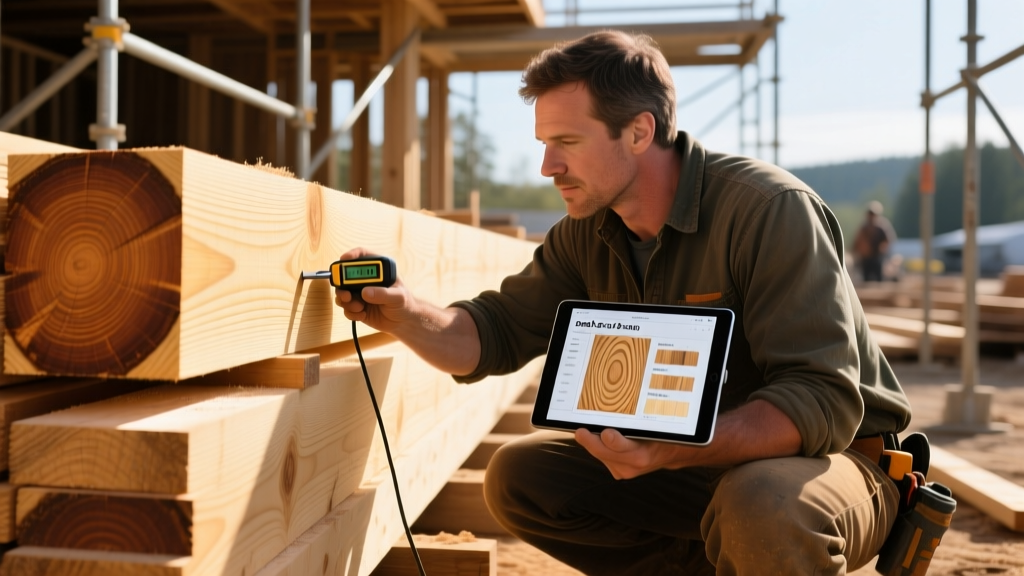
Accurate field identification requires moving beyond surface appearance and analyzing the wood's physical anatomy. The USDA Forest Products Laboratory emphasizes that end-grain analysis is the most reliable visual method for differentiating closely related species that behave vastly differently under environmental stress.
End-Grain Analysis vs. Face-Grain Guesswork
- Red Oak vs. White Oak: Both appear similar on the face, but end-grain analysis reveals the truth. Red Oak has large, open pores that resemble a bundle of straws. White Oak pores are plugged with tyloses (cellular growths). Installation Impact: Red Oak will wick water continuously if exposed to weather, making it strictly an interior material. White Oak is highly rot-resistant and suitable for exterior trim and marine applications.
- Douglas Fir vs. Southern Yellow Pine (SYP): Douglas Fir end-grain shows a sharp, abrupt transition from earlywood to latewood. SYP shows a more gradual transition but possesses much higher resin ducts. Installation Impact: SYP holds nails exceptionally well but requires specific pre-drilling protocols near edges to prevent splitting, whereas Douglas Fir is more forgiving but prone to surface checking if installed at high moisture content.
- Western Red Cedar vs. Incense Cedar: Often confused in siding applications. Western Red Cedar has a distinct, sweet, acidic odor and a straight, uniform grain. Incense Cedar smells like a graphite pencil (due to its use in pencil manufacturing) and has a more irregular grain. Installation Impact: Western Red Cedar requires specific clearances for expansion due to its high initial moisture content when delivered green.
How Wood Identification Dictates Fastener Selection
The chemical makeup of wood—specifically its tannins, oils, and acidity—reacts directly with metal fasteners. The Western Red Cedar Lumber Association explicitly warns against using standard electroplated zinc fasteners with cedar and redwood. Below is a field-reference matrix for matching identified wood types to the correct ASTM-rated fasteners.
| Identified Wood Category | Extractive / Acid Level | Required Fastener Specification | Failure Mode if Misapplied |
|---|---|---|---|
| SPF / Hem-Fir | Low Tannin / Neutral pH | G185 Zinc or Hot-Dipped Galvanized (ASTM A153) | Minimal risk; standard structural failure if undersized. |
| Western Red Cedar / Redwood | High Tannins / Mild Acid | Type 304 Stainless Steel or Polymer-Coated | Black tannin streaking, zinc degradation, nail pop. |
| White Oak / Ipe / Cumaru | High Tannic Acid / High Density | Type 316 Stainless Steel (Pre-drilled) | Rapid galvanic corrosion, sheared screws, wood splitting. |
| ACQ / MCA Pressure-Treated Pine | High Copper Alkaline | Hot-Dipped Galvanized (ASTM A153) or SS | Copper eats standard zinc; fastener snaps under load. |
Acclimation and Moisture Content: Species-Specific Timelines
Identifying the exact species of wood is mandatory for calculating site acclimation timelines. Dense hardwoods and oily tropical species react to ambient humidity far slower than porous softwoods. Installing wood before it reaches Equilibrium Moisture Content (EMC) guarantees seasonal gapping, cupping, or structural buckling.
Species-Specific Acclimation Matrix
- Standard SPF Framing Lumber: Target EMC 15-19% for exterior, 8-12% for interior. Acclimation time: 3 to 5 days in the conditioned space. Minimal dimensional movement post-installation.
- Southern Yellow Pine (SYP) Flooring: Target EMC 8-10%. Acclimation time: 7 to 10 days. SYP is highly reactive to moisture swings; cross-stacking is mandatory to allow airflow to the bottom boards.
- White Oak Hardwood: Target EMC 6-9%. Acclimation time: 10 to 14 days. The tyloses that block water also slow down the release of internal moisture. Kiln-dried White Oak must be acclimated slowly to prevent case-hardening checks.
- Ipe / Cumaru (Tropical Decking): Target EMC 12-15% (exterior). Acclimation time: 14 to 21 days. These woods must be end-sealed with a wax emulsion (like Anchorseal) immediately upon cutting on-site to prevent rapid end-grain checking and splitting.
Adhesive Compatibility and Extractive Interference
When structural gluing or laminating is required, wood identification dictates surface preparation. Many woods contain natural oils, resins, and antioxidants that actively inhibit the curing process of standard Polyvinyl Acetate (PVA) wood glues (e.g., Titebond) and epoxies.
'When bonding woods with high extractive content, such as Teak, Rosewood, or certain high-resin Pines, a solvent wipe with acetone or denatured alcohol immediately prior to adhesive application is not optional—it is a structural requirement to prevent bond-line starvation and delamination.' — Composite Panel Association Technical Guidelines
If you identify a wood species as highly resinous, switch from standard PVA to a moisture-curing polyurethane adhesive (like PL Premium) or a specialized structural epoxy designed for oily substrates. Always perform a 24-hour test bond on an offcut of the identified species before committing to the full installation.
Field Testing: When Visual Identification Fails
When mill stamps are faded, or you are dealing with reclaimed lumber where visual cues are obscured by patina and old finishes, rely on these rapid field tests to confirm your species identification before proceeding with installation.
- The Water Drop Test (For Oak Differentiation): Place a single drop of water on the end-grain. If the wood is Red Oak, the water will immediately wick into the open pores and spread. If it is White Oak, the water will bead up and sit on the surface due to the tyloses blockage.
- The Iron Sulfate Test (For Tannin Detection): Dissolve a small amount of iron sulfate (available at garden centers) in water and spray it on a hidden area of the wood. Woods high in tannins (Cedar, Redwood, Oak, Walnut) will instantly turn black or deep blue-green. This confirms the need for stainless steel fasteners and tannin-blocking primers if painting.
- The Smell Test (For Softwood Differentiation): Sand a small, hidden patch of the wood to expose fresh cells. Douglas Fir has a distinct, sharp, resinous 'pine' smell. Western Red Cedar smells sweet and acidic. Incense Cedar smells like a sharpened pencil. Southern Yellow Pine has a heavy, turpentine-like odor.
Expert Takeaways for Site Supervisors
Integrating wood identification into your pre-installation checklist is a hallmark of professional craftsmanship. According to the Southern Pine Council, the majority of callbacks related to fastener corrosion and wood movement can be traced back to a failure to match the installation materials to the specific biological traits of the lumber.
Before driving the first nail or applying the first bead of adhesive, mandate that your lead carpenters verify the species via end-grain analysis, confirm the moisture content with a calibrated meter, and cross-reference the extractive profile against your fastener and adhesive matrix. This five-minute verification process per bundle of lumber will eliminate thousands of dollars in warranty claims and ensure the structural longevity of the build.
Written by
David NakamuraDavid Nakamura is a licensed architect (AIA) and construction technology writer focused on sustainable building methods, mass timber engineering, and high-performance building envelopes. He holds a Master of Architecture from the University of Washington and is a certified Passive House Consultant (CPHC). David spent eight years at the Seattle firm Mithun, where he led the design of three LEED Platinum projects, before founding his own practice specializing in net-zero residential design. He serves on the editorial advisory board of GreenBuilder Magazine and has authored peer-reviewed papers on cross-laminated timber (CLT) connections for the Journal of Structural Engineering. In his spare time, David teaches woodworking at Pratt Fine Arts Center and kayaks the Puget Sound.
More from David Nakamura
View all
Construction Cost
Labor Cost to Build a Deck Per Sq Ft: 2026 Installation Guide
Discover the exact labor cost to build a deck per sq ft in 2026. This installation guide breaks down contractor rates, complexity factors, and hidden fees.
Aug 4, 2026

Construction Cost
How Much Does It Cost to Build a 3 Bedroom House? Financing Guide
Learn exactly how much it costs to build a 3 bedroom house and explore 2026 financing options, construction loan types, and budget frameworks for your build.
Aug 4, 2026

Construction Cost
Cost to Build a Tennis Court: 2026 Guide
How much does it cost to build a tennis court in 2026? Breakdowns for asphalt, concrete, and synthetic surfaces plus fencing and lighting.
Jul 30, 2026