The Real Cost of Lumber to Build a House: Treatment Premiums 2026
Analyze the 2026 cost of lumber to build a house through wood treatment. Compare borate vs copper preservatives, AWPA codes, and framing premiums.

The Hidden Premium: Upfront vs. Lifecycle Lumber Costs
When calculating the total cost of lumber to build a house, most builders and owner-builders focus exclusively on the base commodity price of untreated Spruce-Pine-Fir (SPF) or Douglas Fir framing. However, evaluating framing lumber purely on initial sticker price ignores the critical variables of moisture intrusion, termite susceptibility, and long-term structural degradation. In 2026, integrating targeted wood preservation and treatment protocols into your framing package is no longer just a commercial building standard; it is a vital risk-mitigation strategy for residential construction.
The modern lumber yard offers a spectrum of preservative treatments, primarily categorized by the American Wood Protection Association (AWPA). Upgrading specific structural zones—from sill plates to exterior sheathing—from untreated SPF to preservative-treated alternatives adds a measurable premium to your material budget. Yet, this upfront cost is frequently offset by the elimination of future remediation expenses, lowered insurance premiums in termite-prone zones, and enhanced structural longevity.
2026 Framing Lumber Cost Snapshot (Per 8-Foot 2x4 Stud)
- Untreated SPF (Interior/Dry): $4.10 - $4.60
- Borate-Treated (UC2 - Damp Interior/Sill Plates): $4.85 - $5.30
- Micronized Copper Azole / MCA (UC3B - Exterior Above Ground): $5.40 - $6.10
- Ground Contact UC4A (Posts/Sill Plates on Slab): $6.80 - $7.50
Decoding AWPA Use Categories for Residential Framing
To accurately forecast the cost of lumber to build a house, you must specify the correct treatment for the correct application. Over-treating interior partition walls is a waste of capital, while under-treating rim joists in humid climates invites catastrophic failure. The American Wood Protection Association (AWPA) U1 Standards dictate the minimum preservative retention levels required for specific environmental exposures.
| AWPA Category | Application Zone | Preservative Type | Retention (pcf) | Est. Cost Premium |
|---|---|---|---|---|
| UC1 | Interior, completely dry | None (Untreated) | N/A | Baseline |
| UC2 | Interior, damp/wet (Sill plates, bathrooms) | Borate (SBX/DOT) | 0.17 | +15% to +20% |
| UC3A | Exterior, above ground, coated | MCA or CA-C | 0.15 | +25% to +30% |
| UC3B | Exterior, above ground, uncoated/leaching | MCA or CA-C | 0.15 | +30% to +40% |
| UC4A | Ground contact, fresh water | MCA or CA-C | 0.25 | +60% to +75% |
Borate vs. Copper-Based Preservatives: A Builder’s Decision Matrix
The two dominant chemical families used in residential framing treatments operate on entirely different mechanisms. Understanding these differences is crucial when itemizing your lumber package.
Borate Treatments (Disodium Octaborate Tetrahydrate - DOT)
Best For: Interior sill plates, rim joists, and areas prone to occasional dampness but protected from liquid water leaching.
- Pro: Colorless, odorless, and does not corrode standard steel fasteners or aluminum flashing.
- Pro: Highly effective against subterranean termites and wood-decaying fungi.
- Con: Water-soluble. If exposed to continuous rain or liquid water, the borate will leach out, rendering the wood unprotected.
- Con: Cannot be used for exterior sheathing or ground-contact applications.
Copper-Based Treatments (MCA, CA-C, ACQ)
Best For: Exterior wall framing, deck ledgers, uncoated exterior sheathing, and direct ground contact.
- Pro: Insoluble in water once fixed; withstands continuous weather exposure and leaching.
- Pro: Provides robust protection against both fungal decay and wood-destroying insects.
- Con: Copper is highly corrosive to standard steel and aluminum. Requires hot-dip galvanized (HDG) or stainless steel fasteners, adding to hidden hardware costs.
- Con: Leaves a green/brown tint that can bleed through light-colored interior paints if used in exposed aesthetic zones.
Real-World Cost Scenario: 2,500 Sq. Ft. Home Framing Package
To contextualize how treatment impacts the overall cost of lumber to build a house, consider a standard 2,500-square-foot, two-story wood-framed home built on a monolithic concrete slab in a high-humidity, termite-prone region (e.g., the US Southeast). This structure requires approximately 18,000 board feet (MBF) of framing lumber.
The Hybrid Treatment Strategy
Instead of treating the entire house (which is cost-prohibitive and structurally unnecessary), advanced builders use a zoned approach:
- Zone 1: Sill Plates & Bottom 24 Inches (3,000 BF). Specified as UC4A Ground Contact (MCA) or UC2 Borate if elevated above the slab with a capillary break. Cost: ~$20,400 (at $6.80/stud equivalent).
- Zone 2: Exterior Wall Framing & Sheathing (10,000 BF). Specified as UC3B (MCA) to resist wind-driven rain intrusion before the weather-resistant barrier (WRB) is fully sealed. Cost: ~$57,000.
- Zone 3: Interior Partitions & Roof Trusses (5,000 BF). Standard Untreated SPF (UC1). Cost: ~$21,500.
Total Hybrid Lumber Cost: ~$98,900.
Total Baseline (100% Untreated) Cost: ~$78,300.
The Treatment Premium: $20,600 (a 26% increase in the raw lumber budget).
While a $20,600 premium is substantial, it represents less than 1.5% of the total turnkey construction cost of a $1.5M custom home. According to the EPA guidelines on pressure-treated wood, this upfront investment drastically reduces the probability of structural rot and termite infestation, which typically cost between $15,000 and $40,000 to remediate post-construction.
Critical Failure Mode: The 'Wet Wood' Trap
Ordering UC3B treated lumber is useless if it is mishandled on-site. A common 2026 job-site failure occurs when treated framing packages are dropped in muddy, low-lying areas of the lot and left uncovered for weeks. While the preservative protects against fungal decay, the extreme moisture content (often 35%+ upon arrival from the treatment plant) causes severe warping, twisting, and shrinkage as the wood acclimates to the interior environment. Rule of thumb: Demand that your supplier deliver treated framing lumber within 48 hours of installation, or store it on elevated dunnage covered with breathable tarps to allow moisture equalization without trapping condensation.
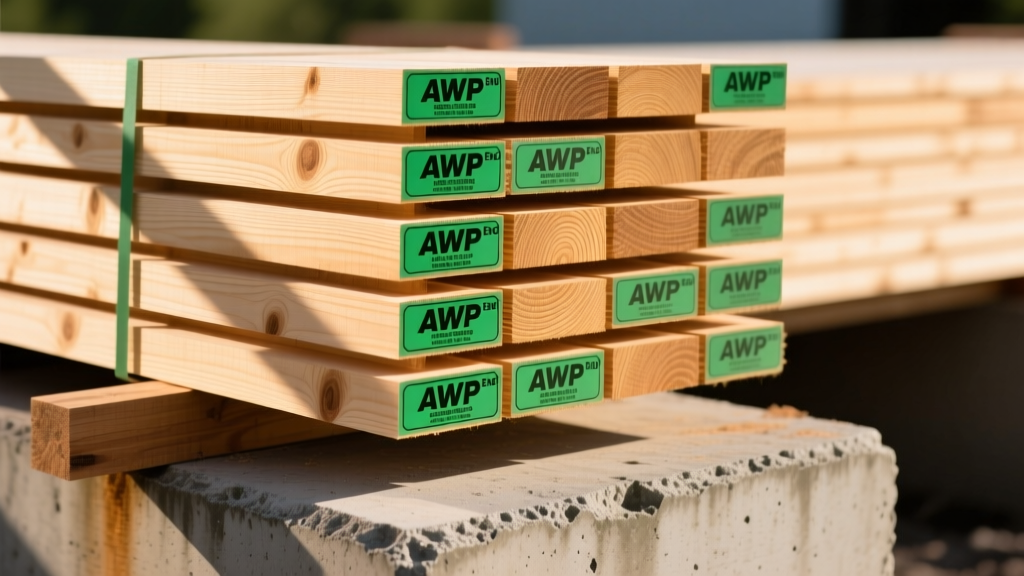
Moisture Management and In-Transit Preservation
Preservation does not end at the treatment plant. For high-end builds utilizing kiln-dried after treatment (KDAT) lumber, the cost premium is higher (often 15% above standard wet-treated lumber), but the return on investment is realized in reduced drywall cracking, minimized nail pops, and tighter building envelopes. KDAT lumber is re-dried to a moisture content of 19% or less after the pressure-treatment process, stabilizing the cellular structure before it ever reaches the job site.
On-Site End-Cut Protocols
Every time a carpenter cross-cuts a piece of pressure-treated lumber, the untreated core is exposed. The AWPA strictly mandates that all field cuts, drill holes, and notches in treated wood be coated with a supplemental preservative. In 2026, builders must keep a supply of Copper Naphthenate (e.g., Cuprinol Green or equivalent AWPA-approved end-cut solutions) on-site. Failing to brush-on treat cut ends voids the manufacturer's warranty and creates a direct highway for moisture and carpenter ants into the untreated heartwood.
How to Specify and Verify Treated Lumber on the Job Site
When auditing your lumber delivery to ensure you received what you paid for, inspect the AWPA quality mark stamped on the end tag or ink-jetted onto the board. A valid 2026 stamp must include:
- The Standard: AWPA U1.
- The Preservative: e.g., MCA, CA-C, or SBX (Borate).
- Retention Level: e.g., 0.15 pcf.
- Use Category: e.g., UC3B or UC4A.
- Quality Assurance Symbol: An ALSC (Accredited Laboratories Standards Council) logo or approved third-party inspector mark.
By shifting the conversation from the baseline commodity price to a lifecycle-oriented treatment strategy, builders can accurately forecast the true cost of lumber to build a house, ensuring the structural skeleton remains resilient against biological and environmental threats for decades.
Written by
James ThorntonJames Thornton is a construction industry veteran with 25 years of hands-on experience in wood framing, lumber grading, and residential building codes. He started as a framing carpenter in rural Oregon, earned his ICC Residential Building Inspector certification, and eventually became a senior plan reviewer for the City of Portland Bureau of Development Services. James holds a B.S. in Wood Science & Technology from Oregon State University and is a certified lumber grader through the West Coast Lumber Inspection Bureau (WCLIB). He has inspected over 3,000 residential construction sites and authored the city's internal guide on advanced framing techniques (2x6 at 24" O.C.). James lives in Bend, OR, where he builds custom timber-frame cabins and competes in lumberjack sports.
More from James Thornton
View all
Insulation
Best Home Insulation Materials: Complete 2026 Guide
Compare top home insulation materials for 2026. Find R-values, installed costs per square foot, and best uses for fiberglass, spray foam, and mineral wool.
Aug 4, 2026

Sustainable Building
Certify Your Green Building Material for LEED and WELL
Step-by-step guide to certifying a green building material for LEED v5 and WELL v2. Master EPDs, HPDs, and VOC limits for 2026 project specifications.
Aug 4, 2026

Stone & Masonry
Veneer Stacked Stone Panels: Interior Design & Style Showcase
Discover how veneer stacked stone panels transform interiors. Explore modern design profiles, material pairings, and technical installation specs.
Aug 4, 2026