13 Types of Wood Joints With Pictures: Cost & Value Analysis
Analyze the labor costs, tooling investments, and structural value of 13 types of wood joints to optimize your woodworking and construction budgets.
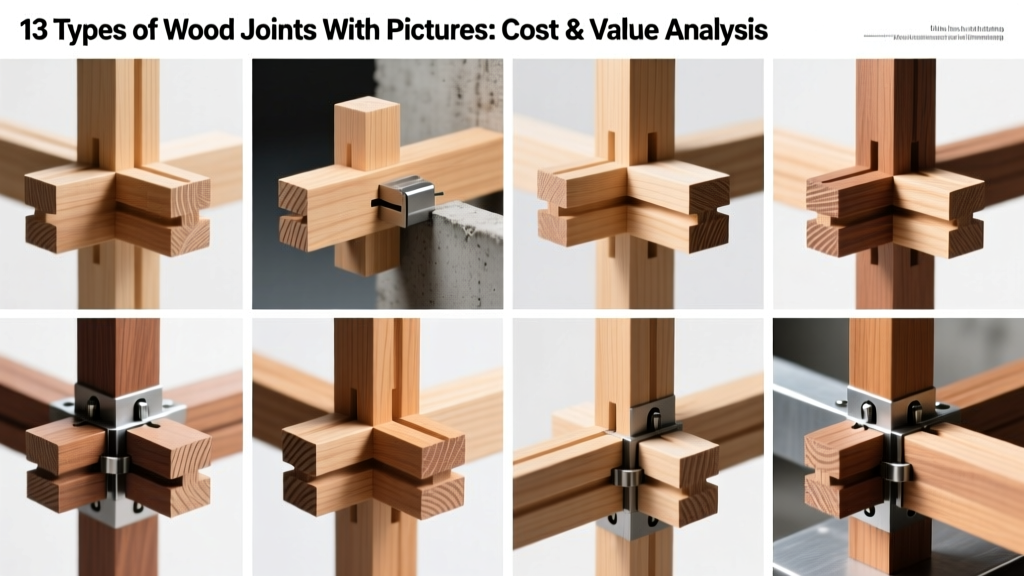
The Economics of Wood Joinery: Beyond the Aesthetics
Selecting the right wood joint is rarely just about structural integrity or visual appeal; it is fundamentally a cost-value calculation. In custom millwork, cabinetmaking, and timber framing, labor accounts for 60% to 80% of the total project cost. A joint that saves $5 in material but requires 45 minutes of skilled hand-chiseling will destroy your profit margins compared to a joint that utilizes a $150 CNC setup to complete the same connection in three minutes. This guide breaks down 13 types of wood joints, analyzing the hidden tooling costs, labor time, and long-term structural ROI of each method.
Master Cost & Value Matrix: 13 Wood Joints Compared
The following matrix categorizes joints by their economic footprint. Labor times assume a mid-level journeyman woodworker using standard power tools, not mass-production CNC machinery.
| Joint Type | Avg. Labor Time | Tooling Investment | Structural Value | Best ROI Application |
|---|---|---|---|---|
| 1. Butt Joint | 1-2 mins | $0 - $50 | Low | Painted face frames, temporary jigs |
| 2. Lap Joint | 3-5 mins | $50 - $150 | Medium | Utility shelving, basic boxes |
| 3. Dado Joint | 4-6 mins | $120 - $250 | High | Cabinet shelving, bookcases |
| 4. Rabbet Joint | 3-5 mins | $100 - $200 | Medium-High | Cabinet backs, drawer bottoms |
| 5. Miter Joint | 2-4 mins | $200 - $600 | Low-Medium | Picture frames, trim molding |
| 6. Tongue & Groove | Continuous | $150 - $300 | High (Panel) | Flooring, wall paneling, tabletops |
| 7. Half-Lap Joint | 5-8 mins | $100 - $200 | High | Door frames, cross-bracing |
| 8. Cross-Lap Joint | 6-10 mins | $100 - $200 | Medium-High | X-bracing, trestle table bases |
| 9. Dowel Joint | 5-8 mins | $30 - $150 | High | Edge-joining panels, chair rails |
| 10. Biscuit Joint | 3-5 mins | $150 - $250 | Medium | Panel alignment, miter reinforcement |
| 11. Box (Finger) Joint | 10-15 mins | $200 - $400 | Very High | Drawer boxes, heavy-duty totes |
| 12. Mortise & Tenon | 15-30 mins | $300 - $1,500 | Maximum | Chair legs, heavy timber framing |
| 13. Dovetail Joint | 30-60 mins | $250 - $2,000 | Maximum | Heirloom drawers, premium casework |
Tier 1: The Economy Joints (Low Labor, High Volume)
These joints form the backbone of high-volume, budget-conscious construction and basic cabinetry. The tooling costs are minimal, but they often require mechanical fasteners or specialized adhesives to compensate for structural weaknesses.
1. Butt Joint
The simplest joint in woodworking, formed by gluing the end grain of one board to the face or edge of another. Cost Reality: End grain acts like a bundle of straws, absorbing PVA wood glue and resulting in a notoriously weak bond. To achieve structural viability, you must use mechanical fasteners (pocket screws at $0.08 each) or two-part epoxy ($18 per 8oz kit). Value Verdict: Excellent for painted, non-load-bearing face frames where pocket-hole jigs ($50) can process 20 joints per hour.
2. Lap Joint
Created by removing half the thickness of each board where they overlap. Cost Reality: Requires a router with a straight bit or a table saw with multiple passes. The glue surface area is doubled compared to a butt joint, allowing standard aliphatic resin glue (like Titebond II at $8/gallon) to create a bond stronger than the wood fibers themselves. Value Verdict: High value for utility shelving where sheer strength is needed but aesthetic concealment of the joint is not a priority.
3. Dado Joint
A three-sided channel cut across the grain of one board to receive the end of another. Cost Reality: Cutting dados efficiently requires a $150 stacked dado blade set or a $40 router bit and edge guide. The industry rule of thumb is to cut the dado no deeper than 1/3 the thickness of the host board to prevent catastrophic snapping under load. Value Verdict: Unbeatable ROI for cabinet shelving. The mechanical lock supports heavy vertical loads, reducing the need for expensive metal shelf pins.
4. Rabbet Joint
An L-shaped notch cut along the edge or end of a board. Cost Reality: Similar tooling costs to the dado joint. Often used to recess 1/4" plywood back panels into cabinet carcases. Value Verdict: Provides vital structural squaring for large cabinet boxes. Skipping the rabbet and simply nailing the back to the carcass edge saves 3 minutes per box but reduces the cabinet's racking resistance by up to 40%.
Tier 2: The Mid-Range Investment Joints (Balanced ROI)
These joints require higher initial tooling investments and tighter tolerances (often within 0.005 inches) but offer superior aesthetics and moderate structural upgrades.
5. Miter Joint
Two boards cut at 45-degree angles to form a 90-degree corner. Cost Reality: Demands a highly accurate miter saw ($400+) or a precision table saw sled. Because it relies entirely on end-grain-to-end-grain gluing, it is structurally fragile. Value Verdict: Essential for picture frames and trim. To increase value without ruining the aesthetic, woodworkers add internal hardwood splines or use V-nail pneumatic joiners ($1,200) for rapid production.
6. Tongue and Groove (T&G)
A protruding ridge (tongue) on one board fits into a slot (groove) on the adjacent board. Cost Reality: Material waste is roughly 8-10% higher due to the milled profiles. Value Verdict: The undisputed king of solid wood flooring and ceiling paneling. It allows for seasonal wood movement while hiding the fasteners. According to the USDA Forest Products Laboratory, T&G profiles distribute localized point loads across adjacent boards, increasing overall floor stiffness by 15-20%.
7 & 8. Half-Lap and Cross-Lap Joints
Half-laps join boards at an angle or end-to-end, while cross-laps join two boards in the middle of their lengths to form an 'X' or '+'. Cost Reality: Both require precise depth stops on a router or saw to ensure flush surfaces. Value Verdict: Cross-laps are critical for trestle table bases, preventing the legs from splaying under heavy top loads. The large long-grain glue surface makes these joints exceptionally durable for the labor invested.
When cutting lap, dado, or rabbet joints in solid hardwood, ensure the wood's moisture content (MC) is equilibrated to the installation environment (typically 6-8% for interior spaces). A 2% shift in MC can cause a 1/8" expansion in a 6" wide oak board, which can split the host board of a tight dado joint if not accounted for with a slight clearance gap.
Tier 3: Premium Structural & Aesthetic Joints (High Labor, Max Value)
These joints represent the pinnacle of woodworking. They command premium pricing from clients and offer maximum structural longevity, often outlasting the hardware and finishes used in the same project.
9. Dowel Joint
Uses cylindrical wooden pins to align and reinforce edge or butt joints. Cost Reality: A high-precision doweling jig costs $30-$150. Fluted dowels allow glue to escape, preventing hydraulic splitting. Value Verdict: The most cost-effective method for edge-joining wide tabletops. It provides hidden reinforcement that rivals the strength of a mortise and tenon at a fraction of the labor time.
10. Biscuit Joint
Uses compressed, football-shaped beech wood wafers (biscuits) inserted into matching crescent slots. Cost Reality: Requires a dedicated plate joiner ($150-$250). The biscuits swell when exposed to water-based PVA glue, locking the joint tight. Value Verdict: Unmatched for rapid panel alignment during glue-ups. However, they add almost zero structural strength to a joint; their value is purely in reducing clamping time and preventing board slippage.
11. Box (Finger) Joint
A series of interlocking rectangular pins and tails. Cost Reality: Requires a precise table saw jig or a $200 router bit set. Value Verdict: Offers massive glue surface area, making it ideal for heavy-duty drawer boxes and shipping totes. It provides 90% of the strength of a dovetail joint but can be machined in 10% of the time, making it the smart economic choice for production drawer manufacturing.
12. Mortise and Tenon
A projecting pin (tenon) fits tightly into a cavity (mortise). Cost Reality: Hand-cutting takes 20-30 minutes per joint. Hollow-chisel mortisers ($400) or CNC routers reduce this to 3 minutes. The APA - The Engineered Wood Association notes that traditional timber framing relies heavily on pegged mortise and tenon joints to handle immense shear and tensile loads without metal fasteners. Value Verdict: Mandatory for fine chair making and structural timber framing. Drawboring (offsetting the peg hole to pull the joint tight) adds 5 minutes of labor but creates a mechanical lock that survives centuries.
13. Dovetail Joint
Interlocking flared pins and tails that resist being pulled apart. Cost Reality: Hand-cutting a single drawer corner takes an expert 45-60 minutes. A $250 router jig reduces this to 10 minutes, while a 5-axis CNC mill does it in 2 minutes. Value Verdict: Pure aesthetic and perceived value. Structurally, a well-made box joint is equally strong. Dovetails are utilized in high-end casework to justify premium price tags, offering an ROI based on client perception rather than raw structural engineering.
Hidden Costs in Wood Joinery: The Profit Killers
When calculating the true cost of a wood joint, contractors and woodworkers must account for three hidden variables:
- Clamping and Cure Time: A complex mortise and tenon might take 15 minutes to cut, but requires 45 minutes of clamping and 24 hours of cure time before machining can continue. This bottlenecks shop space.
- Abrasive Wear on Tooling: Cutting finger joints in dense hardwoods like Hard Maple or Hickory will dull a $60 carbide router bit after just 40-50 linear feet of cutting. Factor in $1.20 per joint for bit replacement/sharpening.
- Sand and Finish Prep: Joints that rely on heavy squeeze-out of glue (like box joints) require extensive scraping and sanding to prevent finish rejection. A joint that goes together dry and tight saves 15 minutes of finishing labor per assembly.
Decision Framework: Selecting the Right Joint
Use this logical flow to optimize your joinery budget:
- Is the joint visible to the end-user? If no, default to Dado, Rabbet, or Pocket-Screw Butt joints for maximum speed.
- Will the joint experience racking or shear forces (e.g., chair legs, table aprons)? If yes, Mortise & Tenon or Dowel joints are mandatory. Avoid Miters and simple Butt joints.
- Is the project a high-margin heirloom piece or a volume production run? For heirloom, use Hand-Cut Dovetails or Drawbored M&T to justify the price. For volume, use CNC Box Joints and Biscuit-aligned edge joints to protect margins.
When assembling deep joints like Mortise & Tenon or long Dovetails, applying glue only to the tenon or pins often results in glue starvation at the base of the joint due to hydraulic pressure pushing the adhesive out. Always apply a thin, even coat to both the male and female components using an acid brush to ensure complete fiber penetration and maximum structural value.
Mastering the economics of these 13 types of wood joints allows builders to accurately bid projects, reduce shop bottlenecks, and deliver structural integrity that aligns perfectly with the client's budget. By matching the joint complexity to the actual load and aesthetic requirements, you eliminate wasted labor and maximize the value of every board foot of lumber.
Written by
Marcus ChenMarcus Chen is a licensed structural engineer (PE) and building materials analyst with over 12 years of experience across residential, commercial, and industrial construction. He holds a Master of Science in Civil Engineering from UC Berkeley and spent six years at Thornton Tomasetti before transitioning to independent consulting and technical writing. Marcus specializes in material selection for seismic-prone regions, concrete reinforcement strategies, and lifecycle cost analysis. His work has been cited by the American Concrete Institute (ACI) and the Structural Engineers Association of California (SEAOC). When he is not on a job site or at his desk, you will find him hiking the Sierra Nevada or restoring a 1920s craftsman bungalow in Oakland, CA.
More from Marcus Chen
View all
Construction Cost
How Much Did the Eiffel Tower Cost to Build?
How much did the Eiffel Tower cost to build in 1889? We adjust for inflation and compare its budget to modern skyscraper construction.
Aug 4, 2026

Fire Resistance
What Is a Fire Resistant Material? Testing & Certification Guide
Discover what is a fire resistant material through ASTM and UL testing. Learn how fire ratings, certifications, and assemblies work in construction.
Aug 4, 2026

Construction Cost
How Much Did the Burj Khalifa Cost to Build?
How much did the Burj Khalifa cost to build? We break down the $1.5B project and extract 5 money-saving strategies for your next build.
Jul 30, 2026