Best Types of Wood for Doors: A Builder's Selection Framework
Compare the best types of wood for doors using our builder's selection matrix. Includes Janka ratings, 2026 pricing, and moisture stability data.

The 4-Quadrant Door Selection Matrix
Selecting the correct wood species for a door requires balancing dimensional stability, Janka hardness, acoustic mass, and budget. The most common failure in custom wood doors is seasonal binding or stile-and-rail separation caused by ignoring the tangential-to-radial (T/R) shrinkage ratio. To specify the right material, run your project requirements through this four-quadrant decision framework before reviewing species.
Application Decision Tree
- Quadrant 1: Exterior Entry (High UV, High Moisture) → Requires closed-cell structure (tyloses) or natural oils. Target T/R ratio < 2.0.
- Quadrant 2: Interior Passage (Moderate Traffic, Paint-Grade) → Prioritize machinability and cost. Target Janka 600-900 lbf.
- Quadrant 3: Interior Acoustic/Privacy (High Mass) → Requires solid core or dense hardwoods. Target STC ≥ 35.
- Quadrant 4: High-Moisture Interior (Bathrooms, Saunas) → Requires extreme decay resistance and low Equilibrium Moisture Content (EMC) fluctuation.
Exterior Entry Doors: Defeating Moisture and UV
Exterior doors face the harshest dimensional shifts. A 36-inch wide door can swell up to 1/4 inch across its width if the species has high volumetric shrinkage and the finish fails. According to the USDA Forest Products Laboratory Wood Handbook, species with interlocked grain or natural extractives perform best outdoors.
Sapele (Entandrophragma cylindricum)
With CITES Appendix II restrictions severely limiting the supply of Genuine Honduran Mahogany (pushing 2026 prices past $28 per board foot), Sapele has become the industry standard for premium exterior doors.
- Janka Hardness: 1,410 lbf (excellent dent resistance).
- Stability: High. However, its interlocking grain requires helical cutterheads during milling to prevent severe tearout.
- Finishing Requirement: Sapele is highly porous. It requires a minimum of two coats of epoxy sealer on all end-grains (top and bottom) before applying the topcoat UV-inhibited polyurethane.
Quartersawn White Oak (Quercus alba)
White oak contains tyloses—cellular outgrowths that plug the xylem vessels, making the wood virtually impermeable to water (which is why it is used for boat building and whiskey barrels). For doors, specifying quartersawn lumber is non-negotiable.
Douglas Fir (Pseudotsuga menziesii)
Often used for paint-grade exterior doors or rustic clear-finished applications. Douglas Fir is a softwood (Janka 660 lbf) and is highly susceptible to UV degradation of its lignin. If used in direct sunlight, it must be protected by a deep-penetrating alkyd primer and high-build elastomeric paint system, re-coated every 3 to 5 years.
Interior Doors: Acoustics, Weight, and Machinability
Interior doors prioritize aesthetics, hardware retention, and sound transmission class (STC) ratings. True solid-slab interior doors wider than 28 inches are highly prone to warping; therefore, premium interior doors utilize a stile-and-rail construction with a floating panel, or a stave-core wrapped in a veneer.
Clear Alder (Alnus rubra)
Alder is the dominant stain-grade interior door species in North America. It mimics the look of cherry or mahogany when stained but machines like a dream.
- Janka Hardness: 590 lbf. This is soft enough for clean routing and mortising without burning router bits, but hard enough to hold standard hinge screws securely.
- Edge Case Warning: Alder has a high tendency to blotch when stained. A pre-stain wood conditioner or a gel stain is mandatory for a uniform finish.
Hard Maple (Acer saccharum) vs. Poplar (Liriodendron tulipifera)
For paint-grade interiors, the choice depends on traffic. Poplar (Janka 540 lbf) is cost-effective and paints beautifully, but the stile edges will dent if hit by furniture or vacuums. Hard Maple (Janka 1,450 lbf) is specified for high-abuse commercial corridors or luxury residential applications where edge-crispness must be maintained for decades. Note that Maple requires carbide-tipped tooling and slower feed rates to avoid burning during profile cuts.
High-Moisture & Specialty Applications
Bathrooms, saunas, and indoor pool enclosures demand materials that resist fungal decay and dimensional swelling.
Accoya (Acetylated Radiata Pine): Through a non-toxic acetylation process, the free hydroxyl groups in the wood are converted into acetyl groups, reducing the wood's ability to absorb water by up to 80%. Accoya carries a 50-year above-ground warranty and is increasingly specified for luxury bathroom pocket doors and exterior marine environments where traditional hardwoods fail. According to The Wood Database, modified woods like Accoya exhibit an anti-shrink efficiency (ASE) of over 70%, making them the most dimensionally stable option on the market.
2026 Lumber Pricing & Procurement Matrix
Pricing reflects Q1 2026 North American wholesale averages for FAS (First and Second) grade, kiln-dried lumber, suitable for door manufacturing. Prices exclude milling waste factor (add 20-30% for stile/rail yield).
| Species | Janka (lbf) | Vol. Shrinkage | Avg Cost/BF | Best Application |
|---|---|---|---|---|
| Sapele | 1,410 | 14.8% | $12 - $16 | Premium Exterior Entry |
| QS White Oak | 1,360 | 12.6% | $11 - $15 | Modern Exterior / Wet Areas |
| Clear Alder | 590 | 10.2% | $6 - $9 | Interior Stain-Grade |
| Poplar | 540 | 9.8% | $3.50 - $5 | Interior Paint-Grade |
| Accoya | N/A | ~3.0% | $24 - $28 | Marine / High-Moisture |
Edge Cases: Preventing Warping and Stile Separation
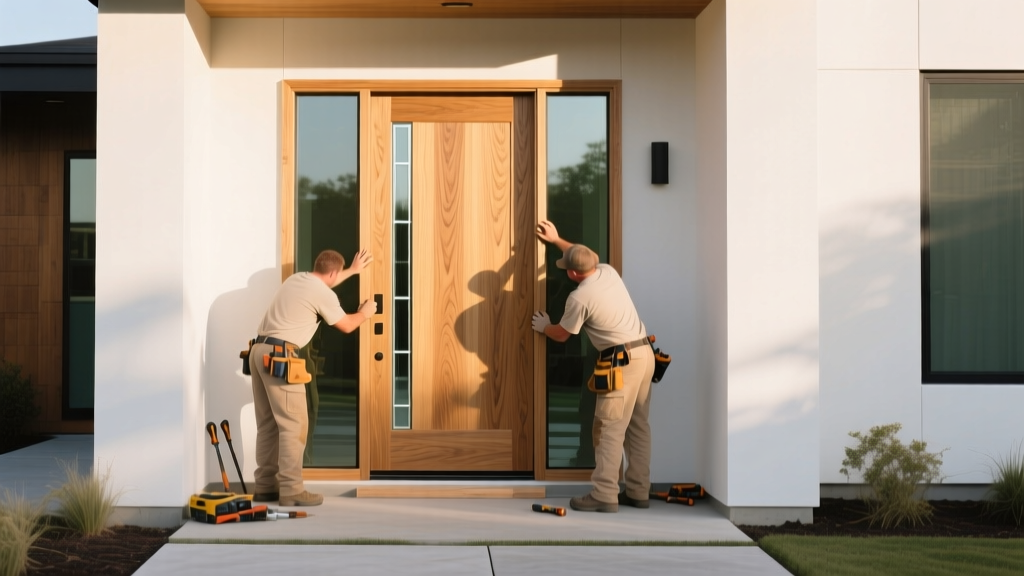
Even the most stable wood species will fail if the door is fabricated or installed incorrectly. The Window and Door Manufacturers Association (WDMA) outlines strict tolerances for custom wood doors. Adhere to these non-negotiable fabrication and installation rules:
1. The Moisture Content (MC) Equilibrium Rule
Wood must be acclimated to the environment where it will be installed. For an interior door in a climate-controlled home (typically 30-50% relative humidity), the lumber MC should be between 6% and 8%. For exterior doors, target 10% to 12%. Installing an 8% MC door in a humid coastal environment without proper sealing will result in immediate swelling and hardware binding.
2. End-Grain Encapsulation
3. Hardware Mortising in Dense Hardwoods
When mortising hinges for species exceeding 1,500 lbf Janka (like Ipe or Cumaru, occasionally used for massive pivot doors), standard high-speed steel (HSS) bits will burn and dull instantly. Use solid carbide router bits, pre-drall all screw holes with a bit sized 85% of the screw's root diameter, and lubricate the stainless steel hinge screws with beeswax to prevent shearing during installation.
4. Clearance Tolerances
For standard 1-3/4" exterior doors, maintain a 1/8" gap on the strike side and top, and a 3/32" gap on the hinge side. For wider doors (over 42 inches), increase the strike side gap to 3/16" to account for the increased arc of seasonal expansion across the wider panel.
Written by
Priya KapoorPriya Kapoor is a real estate market analyst and construction economics researcher with expertise in housing affordability, development feasibility, and infrastructure investment. She holds a Master of Regional Planning from Cornell University and previously worked as a senior analyst at CBRE's Investment Properties group, where she modeled returns for $4B in mixed-use development pipelines. Priya now runs an independent research practice advising developers, municipalities, and REITs on construction cost forecasting and market timing. She publishes the quarterly "BuildMat Market Pulse" report tracking material price indices across 12 commodity categories. Based in Austin, TX, Priya serves on the board of Habitat for Humanity Austin and is a marathon runner.
More from Priya Kapoor
View all
Construction Cost
Cost to Build a 1600 Sq Ft Home in 2026: Full Breakdown
Accurate 2026 cost to build a 1600 sq ft home—material, labor, and regional pricing breakdowns included. Plan your budget with real-time estimates.
Aug 11, 2026

Wood & Lumber
Name the Types of Wood for Pressure Treatment and Preservation
Learn how to name the types of wood best suited for pressure treatment. Compare species treatability, chemical retention levels, and 2026 preservation costs.
Aug 4, 2026

Stone & Masonry
Stone Veneer Suppliers Lindenhurst: 2026 Cost Analysis
Analyze 2026 stone veneer costs in Lindenhurst, NY. Compare local supplier pricing, delivery fees, and Suffolk County installation labor rates.
Aug 4, 2026