Preservation Strategies for Different Types of Wood Doors
Discover species-specific preservation treatments for different types of wood doors. Learn end-grain sealing, UV protection, and moisture defense protocols.

The Anatomy of Exterior Door Failure
Understanding the distinct preservation needs of various types of wood doors is the difference between a century-long lifespan and a rotted bottom rail in five years. Exterior wood doors fail primarily through two mechanisms: ultraviolet (UV) degradation of lignin and capillary moisture ingress. When UV rays break down the wood's lignin, the surface turns gray and becomes hydrophilic, absorbing water at an accelerated rate. Simultaneously, unsealed end-grain at the top and bottom rails acts like a bundle of microscopic straws, wicking moisture directly into the door's core.
The most common hidden failure point on panel doors is the glass rabbet (the groove holding the glass). Condensation runs down the interior glass, pools in the bottom rabbet, and rots the wood from the inside out. Always apply a continuous bead of flexible, paintable polyurethane sealant (like OSI Quad) at the interior glass-to-wood joint during installation.
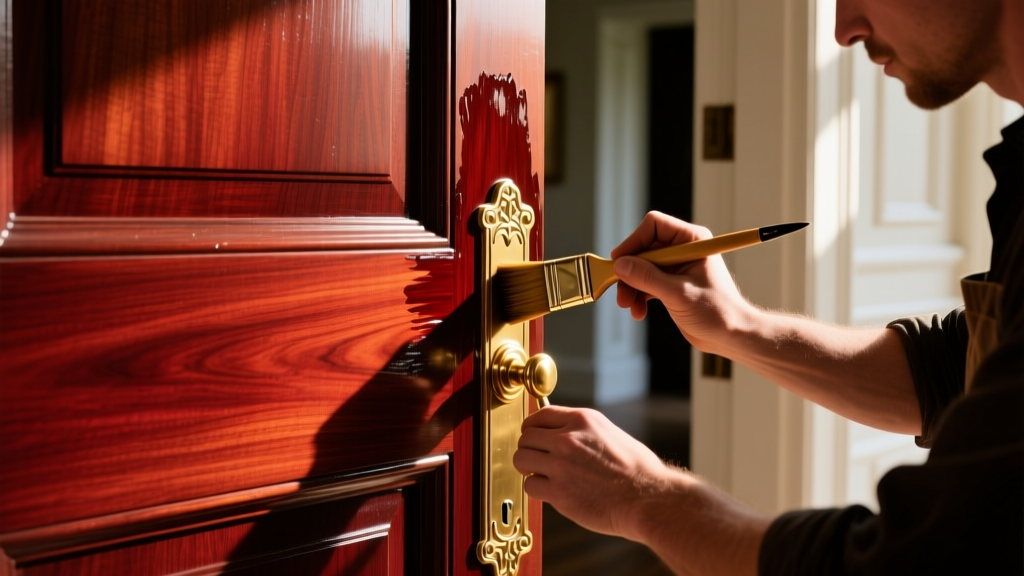
Species-Specific Treatment Matrix
Not all timber reacts to finishes identically. The cellular structure, natural extractives, and density of the wood dictate the preservation strategy. Below is a technical matrix for the most common types of wood doors used in residential and commercial construction.
| Wood Species | Cellular Traits & Extractives | Recommended Finish System | Recoat Interval |
|---|---|---|---|
| True Mahogany | High dimensional stability; low pitch; interlocked grain. | Film-forming marine spar varnish (e.g., Epifanes High Gloss) with UV inhibitors. | 3–5 years (South/West exposure: 2 years) |
| White Oak | Closed-cell tyloses (water-resistant); high tannin content. | Penetrating oil-based alkyd stains. Avoid water-based primers (causes tannin bleed). | 2–4 years |
| Douglas Fir | Prominent early/late wood contrast; prone to surface checking. | Alkyd-oil penetrating finishes (e.g., PPG ProLuxe Cetol 1 RE) to flex with checking. | 2–3 years |
| Pine (Clear) | Soft; high resin/pitch content; uneven stain absorption. | Acrylic-urethane paint system over stain-blocking primer (e.g., Zinsser BIN). | 5–7 years (Paint) |
| Accoya (Modified) | Acetylated radiata pine; virtually zero swelling/shrinkage. | Specialized acetylated-wood coatings (e.g., Teknos Aquatop) or penetrating oils. | 5–8 years |
Penetrating Oils vs. Film-Forming Marine Varnishes
When preserving exterior types of wood doors, the choice between penetrating oils and film-forming finishes dictates your long-term maintenance burden. According to research on wood weathering and finishes by UMass Building Construction Technology, no single finish is universally superior; the choice depends on the door's exposure and the owner's maintenance tolerance.
Film-Forming Finishes (Spar Varnishes & Polyurethanes)
Marine spar varnishes, such as Epifanes or System Three, build a hard, continuous shell on the wood surface. They contain high levels of UV absorbers and flexible resins (like alkyds and polyurethanes) designed to expand and contract with thermal cycling.
- Pros: Unmatched depth of gloss; superior physical barrier against driving rain; highlights deep wood figure.
- Cons: When the film eventually micro-cracks from UV exposure, water gets trapped behind the finish, leading to black rot. Removal requires aggressive chemical stripping or heat guns, risking damage to the wood substrate and glass seals.
Penetrating Oil-Alkyd Blends
Products like PPG ProLuxe (formerly Sikkens Cetol) penetrate the first 1/16-inch of the wood fibers rather than sitting on top. They protect via water repellency and trans-oxide pigments that block UV rays.
- Pros: Never peel or flake. Maintenance involves a light scuff-sanding with 120-grit aluminum oxide paper and applying a fresh coat. No stripping required.
- Cons: Lower initial gloss; requires more frequent reapplication (every 2-3 years on south-facing elevations); offers less physical abrasion resistance.
If using a translucent penetrating system on a new door, the industry standard is one coat of a penetrating base (like Cetol 1 RE) followed by two coats of a UV-resistant topcoat (like Cetol 23 Plus). Skipping the base coat leaves the wood's deeper capillaries unprotected against lateral moisture migration.
The Critical End-Grain Sealing Protocol
The top and bottom rails of a door consist entirely of exposed end-grain. Standard brush-applied finishes do not penetrate end-grain deeply enough to prevent capillary action. To permanently waterproof these zones, follow this structural preservation protocol:
- Moisture Verification: Use a pin-type moisture meter to ensure the door's moisture content is between 8% and 12%. Applying sealants over wood with >14% moisture will trap water and guarantee internal rot.
- Borate Pre-Treatment: For doors in high-humidity or termite-prone regions, apply a liquid borate preservative (such as Tim-bor or Bora-Care) to the bottom 12 inches of the door. Borates are recognized by the EPA as highly effective, low-toxicity wood preservatives that halt fungal decay and deter wood-destroying insects.
- Epoxy End-Grain Saturation: Mix a low-viscosity, penetrating epoxy (e.g., System Three RotFix or TotalBoat Clear Penetrating Epoxy). Flood the bottom rail end-grain until it stops absorbing (usually 15-20 minutes). This physically glues the wood fibers together, creating an impenetrable moisture barrier.
- Top Rail Capping: While the bottom rail needs maximum protection, the top rail must also be sealed to prevent humidity exchange. Apply two heavy coats of your chosen exterior finish to the top edge before hanging the door.
Painted vs. Stained Preservation Systems
For opaque preservation, 100% acrylic or acrylic-urethane exterior paints remain the gold standard for pine and fir doors. Paint provides the highest level of UV protection because the titanium dioxide (TiO2) pigments completely reflect ultraviolet radiation, preventing lignin breakdown entirely.
The Paint System Breakdown
To achieve a 10-year lifespan on a painted pine door, the coating system must be engineered to block tannins and resist micro-cracking:
- Primer: Shellac-based primer (Zinsser B-I-N) is mandatory for knotty pine or fir to prevent resin bleed-through. For clear pine, an alkyd-oil exterior primer provides better penetration into the wood pores.
- Caulking: Use a high-performance elastomeric sealant (like OSI Quad Max) at all stile-to-rail joints. Do not use standard silicone, which cannot be painted and will cause fisheyes in the topcoat.
- Topcoats: Apply two coats of a premium acrylic-urethane enamel (e.g., Sherwin-Williams Emerald Urethane Trim Enamel). The urethane cross-linking provides a harder surface that resists the physical abrasion of weather-stripping friction.
Modern Considerations: Thermally Modified and Engineered Doors
The market for alternative types of wood doors has expanded significantly to include thermally modified timber (TMT) and engineered veneer-core doors. Thermally modified ash or poplar is baked at 400°F+ in a low-oxygen environment, altering its cellular hemicellulose. While TMT is incredibly stable and rot-resistant, the thermal process makes the wood highly brittle and prone to surface checking if exposed to direct, unfiltered UV light.
For TMT doors, pigmented penetrating oils are strictly required to shield the degraded surface fibers from UV radiation. Film-forming varnishes often fail prematurely on TMT because the wood's reduced surface energy prevents proper mechanical adhesion of the resin. Always consult the American Wood Protection Association (AWPA) standards when selecting chemical treatments for modified or engineered wood substrates, as traditional borate pressure-treatments cannot penetrate the dense, altered cell walls of acetylated or thermally modified lumber.
Quick-Reference Maintenance Schedule
Annually: Wash door with mild detergent (no pressure washers >500 PSI). Inspect bottom weather-sweep and glass rabbet sealant.
Bi-Annually (South/West Exposure): Perform the "water drop test." Flick water onto the mid-rail. If it beads, the finish is intact. If it absorbs and darkens the wood within 60 seconds, a maintenance coat of penetrating oil or varnish is overdue.
Every 5 Years: Inspect hinge screws for galvanic corrosion, which can introduce iron-tannin black streaks down oak and mahogany door faces. Replace standard steel screws with 304 or 316 stainless steel equivalents.
Written by
Sarah WhitfieldSarah Whitfield is a chartered quantity surveyor (MRICS) and construction cost analyst with 15 years of experience in material pricing, procurement strategy, and project budgeting. She earned her degree in Construction Management from the University of Reading (UK) and has worked on projects ranging from $2M custom homes to $180M mixed-use developments across North America and Europe. Sarah currently leads cost estimating for BuildMat Insight, maintaining a proprietary database of 4,000+ material price points updated quarterly. She is a frequent contributor to RSMeans cost data panels and has presented at the International Cost Engineering Council (ICEC) congress. Based in Denver, CO, Sarah is an avid trail runner and volunteer mentor for Women in Construction.
More from Sarah Whitfield
View all
Wood & Lumber
What Are the Different Types of Wood? A Builder's Guide
Compare structural softwoods, finish hardwoods, and engineered lumber. Analyze Janka ratings, MOE values, and 2026 pricing for construction.
Aug 4, 2026

Walls & Panels
Steel Framing vs Wood Framing: Corrosion and Moisture Defense
Compare steel framing vs wood framing for moisture resistance. Learn about galvanized coatings, condensation risks, and corrosion protection strategies.
Jul 21, 2026

Stone & Masonry
How to Cut Stone Veneer: Wet Saw vs Grinder Comparison
Compare the best tools for cutting stone veneer. We review wet saws, angle grinders, and chop saws to help you achieve clean, chip-free cuts.
Jul 21, 2026