Types of Wood Varnish for Structural Timber and Exposed Beams
Discover the best types of wood varnish for structural timber, glulam, and CLT. Learn fire-rated, UV-resistant, and moisture-managing coatings.

The Intersection of Varnish and Structural Timber Integrity
When specifying finishes for exposed structural wood systems—such as Glued Laminated Timber (Glulam), Cross-Laminated Timber (CLT), and heavy timber beams—the coating must do far more than enhance the grain. In structural applications, the wrong finish can trap moisture, accelerate internal checking, and compromise the load-bearing capacity of the member. Conversely, the correct varnish acts as a critical environmental barrier, managing moisture ingress, providing UV stabilization, and in some cases, delivering passive fire protection.
Understanding the specific types of wood varnish engineered for structural applications requires a shift from aesthetic thinking to building physics. Structural timber moves, breathes, and responds to hygrothermal changes. According to guidelines from APA - The Engineered Wood Association, finishes applied to engineered wood products must possess sufficient elasticity to accommodate dimensional changes without micro-cracking, which would otherwise allow water infiltration and subsequent decay.
Critical Types of Wood Varnish for Structural Applications
Not all varnishes are created equal. The following categories represent the specialized coatings required for load-bearing and architectural structural wood.
1. Intumescent Varnishes (Fire-Rated Structural Protection)
In commercial and multi-family construction, exposed structural timber must often meet stringent fire-resistance ratings (FRR). Intumescent varnishes are clear, reactive coatings that remain transparent under normal conditions but undergo a chemical transformation when exposed to temperatures exceeding 200°C (392°F). The coating expands up to 50 times its original thickness, forming a dense, insulating carbon char that protects the structural core of the beam from combustion, thereby maintaining its load-bearing capacity for 30 to 60 minutes.
2. Aliphatic Polyurethane and Marine Spar Varnishes (Exterior Load-Bearing)
For exterior structural elements like cantilevered glulam beams, timber trusses, and pergola headers, UV degradation and moisture cycling are the primary threats. Aliphatic polyurethanes and high-oil marine spar varnishes (such as Epifanes or Sikkens Cetol) are formulated with UV absorbers and high-elasticity resins. Unlike rigid interior varnishes that shatter when exterior timber expands and contracts, spar varnishes possess a high oil-to-resin ratio, allowing the film to stretch with the wood's seasonal movement.
These varnishes are critical for preventing the photo-degradation of lignin on the surface of structural beams, which can lead to surface erosion and the eventual exposure of the underlying wood fibers to fungal decay.
3. Penetrating Oil-Varnish Hybrids (Interior CLT and Glulam)
Mass timber interiors, particularly exposed CLT ceiling panels and Glulam columns, require finishes that do not form a surface film. Film-forming varnishes can trap construction moisture inside the mass timber panels, leading to delamination or internal checking as the wood attempts to reach Equilibrium Moisture Content (EMC). Penetrating oil-varnish hybrids (like Osmo Polyx-Oil or Rubio Monocoat) bond at the molecular level within the wood pores. They provide exceptional stain and wear resistance while maintaining the vapor permeability of the wood, allowing the structural elements to 'breathe' and safely off-gas residual moisture over the first few years of the building's life.
Comparative Matrix: Structural Varnish Selection
Selecting the correct coating requires balancing fire codes, vapor permeability, and environmental exposure. Use the following matrix to guide your specification:
| Varnish Type | Best Structural Use | Vapor Permeability | Key Standard / Rating | Est. Cost (Installed) |
|---|---|---|---|---|
| Intumescent Clear | Interior commercial beams, egress corridors | Low (Film-forming) | ASTM E84 Class A / NFPA 703 | $5.50 - $9.00 / sq.ft. |
| Aliphatic Polyurethane | Exterior glulam, covered timber trusses | Very Low | AWPA E1 (Moisture exclusion) | $3.00 - $5.50 / sq.ft. |
| Marine Spar Varnish | Fully exposed exterior structural headers | Low (High elasticity) | UV Stabilization / Salt Spray | $4.00 - $7.00 / sq.ft. |
| Oil-Varnish Hybrid | Interior CLT panels, architectural columns | High (Microporous) | VOC Compliance / LEED | $3.50 - $6.00 / sq.ft. |
| Epoxy Varnish/Sealer | End-grain sealing, bearing point isolation | Impermeable | Moisture Barrier / Rot prevention | $2.00 - $4.00 / sq.ft. |
Moisture Dynamics and Critical Application Failures
The most common cause of structural timber failure related to finishes is not the degradation of the wood itself, but the improper application of a film-forming varnish over wood with high moisture content.
Applying a rigid, low-permeability polyurethane varnish to Glulam or CLT that has not reached its Equilibrium Moisture Content (typically 12-15% for interior applications) will trap water inside the member. As the building's HVAC system dries the interior air, the wood attempts to release moisture. Trapped by the varnish, this moisture creates internal hydrostatic pressure, resulting in severe longitudinal checking, delamination of glulam laminations, and potential fungal growth.
Furthermore, structural end-grains require specialized attention. The end-grain of a timber beam absorbs moisture 10 to 15 times faster than the face-grain. According to the American Wood Protection Association (AWPA), unsealed end-grains on exterior structural beams are the primary entry points for moisture and decay fungi. Standard decorative varnishes are insufficient here; structural engineers specify two-part epoxy varnishes or dedicated end-sealants to completely encapsulate the end-grain, preventing capillary action from drawing water into the beam's core.
Step-by-Step Protocol for Coating Exposed Structural Glulam
To ensure the longevity and structural integrity of exposed timber, follow this rigorous application protocol:
- Moisture Verification: Use a pin-type moisture meter to test the timber at multiple depths. Do not apply any varnish if the moisture content (MC) exceeds 18% for exterior applications or 15% for interior applications.
- Surface Preparation: Sand the glulam to a maximum of 120-grit. Finer grits burnish the wood, closing the pores and preventing adequate varnish penetration. Remove all dust using a HEPA vacuum and a tack cloth dampened with mineral spirits.
- End-Grain Isolation: Apply a penetrating epoxy sealer to all exposed end-grains and bearing points where the timber rests on steel or concrete. This prevents moisture wicking from adjacent building materials.
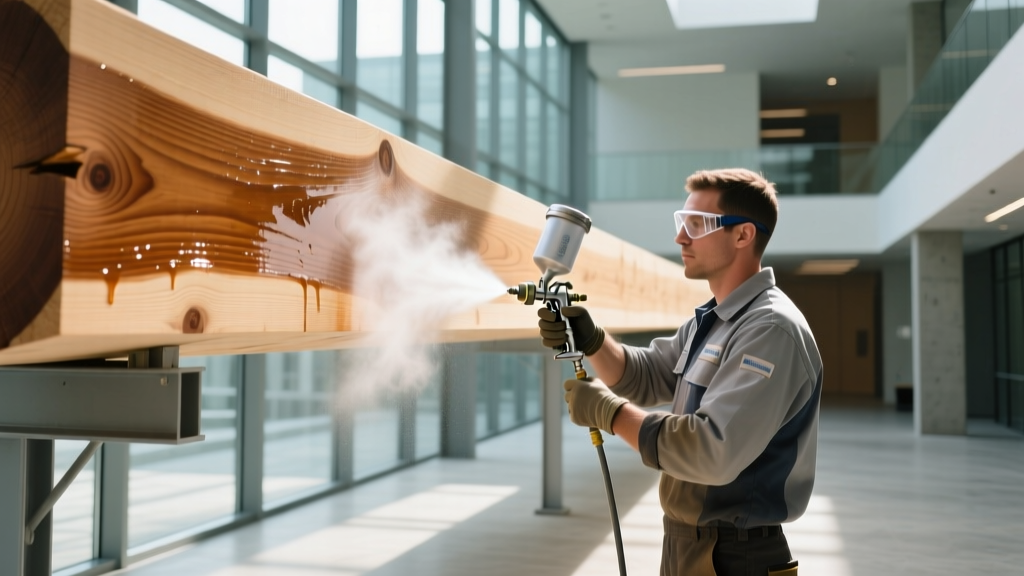
- Primary Varnish Application: Apply the specified varnish (e.g., Aliphatic Polyurethane for exterior) using an HVLP (High Volume Low Pressure) sprayer to ensure an even mil thickness. Brush application on rough-sawn structural timber often results in uneven buildup and micro-voids.
- Intercoat Sanding and Inspection: Allow the first coat to cure according to the manufacturer's technical data sheet (TDS). Lightly scuff-sand with 180-grit paper to remove raised grain and ensure mechanical adhesion for the subsequent coat.
- UV-Topcoat (If Required): For exterior intumescent systems or specific oil-varnishes, apply the mandatory sacrificial UV topcoat to protect the underlying functional layers from photodegradation.
FAQ: Structural Wood Finishing
Can I use standard floor polyurethane on structural timber beams?
No. Standard floor polyurethanes are highly rigid and designed for high-traffic abrasion resistance, not for the significant dimensional movement of structural beams. When a structural beam expands or contracts due to seasonal humidity changes, rigid floor polyurethane will micro-crack, allowing moisture ingress while trapping existing moisture inside the wood.
How often must exterior structural varnish be maintained?
Exterior spar varnishes and aliphatic polyurethanes on structural timber typically require a maintenance scuff-sand and recoat every 3 to 5 years, depending on UV exposure and local climate. Failure to maintain the coating will result in the varnish peeling, which requires a complete, costly chemical or mechanical stripping process before reapplication.
Does varnish affect the structural engineering calculations of a beam?
The varnish itself does not alter the modulus of elasticity (MOE) or the bending strength (Fb) of the timber. However, by preventing moisture ingress and subsequent decay, the varnish ensures the timber maintains its engineered design values over its 50+ year lifespan. For fire engineering, the use of certified intumescent varnish directly impacts the calculated fire-resistance rating (FRR) of the structural assembly.
Written by
David NakamuraDavid Nakamura is a licensed architect (AIA) and construction technology writer focused on sustainable building methods, mass timber engineering, and high-performance building envelopes. He holds a Master of Architecture from the University of Washington and is a certified Passive House Consultant (CPHC). David spent eight years at the Seattle firm Mithun, where he led the design of three LEED Platinum projects, before founding his own practice specializing in net-zero residential design. He serves on the editorial advisory board of GreenBuilder Magazine and has authored peer-reviewed papers on cross-laminated timber (CLT) connections for the Journal of Structural Engineering. In his spare time, David teaches woodworking at Pratt Fine Arts Center and kayaks the Puget Sound.
More from David Nakamura
View all
Construction Cost
Labor Cost to Build a Deck Per Sq Ft: 2026 Installation Guide
Discover the exact labor cost to build a deck per sq ft in 2026. This installation guide breaks down contractor rates, complexity factors, and hidden fees.
Aug 4, 2026

Construction Cost
How Much Does It Cost to Build a 3 Bedroom House? Financing Guide
Learn exactly how much it costs to build a 3 bedroom house and explore 2026 financing options, construction loan types, and budget frameworks for your build.
Aug 4, 2026

Construction Cost
Cost to Build a Tennis Court: 2026 Guide
How much does it cost to build a tennis court in 2026? Breakdowns for asphalt, concrete, and synthetic surfaces plus fencing and lighting.
Jul 30, 2026