Types of Wooden Fence Compared: Costs, Wood Species, and Lifespan
Compare the top types of wooden fence by species, cost per linear foot, and lifespan. Expert guide to cedar, redwood, pine, and tropical hardwoods.

The Material Matrix: Evaluating Types of Wooden Fence
Choosing between the various types of wooden fence requires balancing initial capital expenditure against long-term structural integrity, maintenance cycles, and aesthetic degradation. A fence is a micro-climate structure; the side facing the sun bakes and checks, while the ground-contact posts face fungal decay and moisture wicking. The wood species you select dictates the fastener compatibility, the required post-setting depth, and the ultimate lifespan of the installation.
Below is a direct comparison of the four primary lumber categories used in modern residential and commercial fencing. Costs reflect 2026 market averages for a standard 6-foot-tall privacy fence, including materials and professional installation.
| Wood Species / Type | Material Cost (per LF) | Installed Cost (per LF) | Expected Lifespan | Rot & Insect Resistance |
|---|---|---|---|---|
| Pressure-Treated Southern Yellow Pine | $8 - $14 | $18 - $28 | 15 - 20 Years | High (Chemical) |
| Western Red Cedar (STK Grade) | $14 - $22 | $28 - $45 | 20 - 30 Years | High (Natural Tannins) |
| Coastal Redwood (Heartwood) | $22 - $35 | $40 - $60 | 25 - 35 Years | Very High |
| Tropical Hardwood (Ipe / Cumaru) | $35 - $55 | $65 - $95 | 40 - 50+ Years | Extreme |
Pressure-Treated Southern Yellow Pine: The Budget Standard
Pressure-treated (PT) pine dominates the market for standard stockade and dog-ear fence styles. Southern Yellow Pine (SYP) is used because its cellular structure readily absorbs chemical preservatives. Modern PT lumber utilizes Micronized Copper Azole (MCA) or Alkaline Copper Quaternary (ACQ) treatments, replacing the older, highly toxic CCA (chromated copper arsenate) formulations.
Technical Specifications & Failure Modes
- Shrinkage & Warping: PT pine is sold wet. As it dries in the sun, it shrinks unevenly. Expect up to 1/4-inch shrinkage in board width and significant twisting if the boards are not properly kiln-dried after treatment (KDAT). KDAT lumber costs roughly 15% more but drastically reduces callback rates for warped pickets.
- Checking: Deep longitudinal cracks (checks) will appear on PT posts within the first 12 months. While structurally harmless if they do not penetrate the heartwood, they create moisture pockets that accelerate localized decay.
- Ground Contact Ratings: For fence posts, you must specify UC4A (Ground Contact) or UC4B (Heavy Duty Ground Contact) retention levels. Standard above-grade (UC3B) lumber will rot at the soil line within 5 to 7 years.
Western Red Cedar: The Premium All-Rounder
When evaluating types of wooden fence for high-end residential projects, Western Red Cedar (Thuja plicata) is the default upgrade. Its natural resistance to decay comes from extractives, primarily thujaplicins and water-soluble phenols, which act as organic fungicides. The Western Red Cedar Lumber Association emphasizes that these natural tannins also repel carpenter ants and termites without the need for chemical leaching into the soil.
Grading Matters: STK vs. Clear
Not all cedar fencing is created equal. The grade you purchase dictates both the aesthetic and the structural lifespan:
- Select Tight Knot (STK): The most common grade for privacy fencing. Knots are present but 'tight' (not falling out). STK offers the best balance of rustic aesthetics and structural stability. The interlocking grain around the knots actually resists splitting better than clear wood.
- Clear Vertical Grain (CVG): Premium, knot-free boards cut perpendicular to the growth rings. CVG is exceptionally stable and resists cupping, but it is typically reserved for horizontal slat fences or modern architectural applications where budget is secondary to flawless aesthetics.
The Tannin Bleed Problem
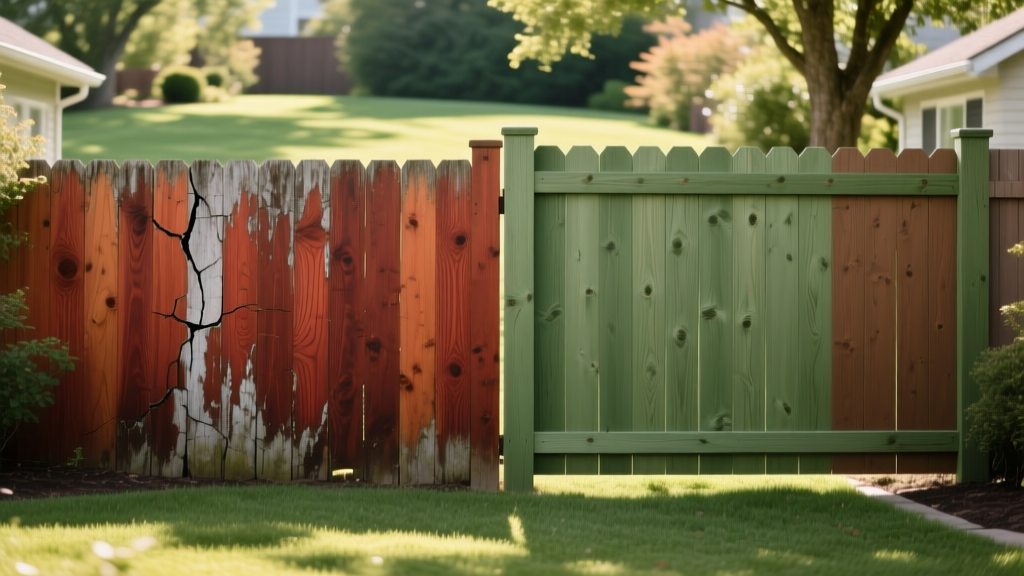
Cedar's tannins are water-soluble. If you use standard zinc-plated or electro-galvanized nails and screws, the moisture in the air will react with the tannins and the zinc, creating ugly black streaks running down the face of the pickets. You must use hot-dipped galvanized (HDG) or 304-grade stainless steel fasteners for all cedar fence assemblies.
Coastal Redwood: The Luxury Coastal Choice
Redwood (Sequoia sempervirens) is dimensionally stable, resisting shrinking and swelling better than almost any other domestic softwood. It is the premier choice for coastal environments where salt spray and high humidity rapidly destroy lesser woods.
Heartwood vs. Sapwood: A Critical Distinction
When buying redwood fencing, you must verify the ratio of heartwood to sapwood.
- All-Heart / Heartwood Clear: Cut from the center of the tree. Contains the highest concentration of decay-resistant extractives. Rated for up to 35 years of above-ground exposure. Costs $35+ per linear foot (material only).
- Construction Common / B-Grade: Contains a mix of heartwood and sapwood. The sapwood (the lighter, outer rings) has no natural rot resistance and will decay rapidly if exposed to moisture. If using common grades, the sapwood edges must be sealed with a high-quality penetrating oil or the boards must be kept entirely above the soil line.
According to data published by the USDA Forest Products Laboratory, the natural decay resistance of redwood heartwood is comparable to pressure-treated lumber, but without the environmental concerns associated with chemical preservatives leaching into surrounding landscaping.
Tropical Hardwoods (Ipe & Cumaru): The Fortress Option
For horizontal slat fences, estate perimeter walls, or commercial applications, tropical hardwoods like Ipe (Handroanthus spp.) and Cumaru (Dipteryx odorata) represent the absolute pinnacle of durability. These woods are so dense they sink in water.
Installation Realities for Hardwood Fencing
Building with Ipe is not like building with pine. It requires specialized tooling and techniques:
- Janka Hardness: Ipe boasts a Janka hardness rating of roughly 3,680 lbf (compared to cedar at 350 lbf). Standard carbide-tipped saw blades will dull after a few dozen cuts. Use specialized polycrystalline diamond (PCD) blades.
- Pre-Drilling is Mandatory: You cannot nail or screw directly into Ipe without pre-drilling clearance holes. Attempting to do so will snap the fastener or strip the head.
- Hidden Fastener Systems: Because face-screwing hardwoods requires plugging every hole with a wood dowel (a massive labor expense), modern hardwood fences utilize hidden clip systems routed into the edges of the boards, similar to composite decking.
- End-Grain Sealing: Hardwoods check (crack) aggressively at the ends when exposed to UV. Every single cut end must be immediately sealed with a commercial anchor seal (wax-based emulsion) to prevent end-splitting.
Decision Framework: Which Type is Right for Your Project?
Use this quick diagnostic flow to finalize your material selection:
- Choose PT Pine if: You are fencing large perimeters (150+ LF) on a strict budget, plan to paint or stain the fence a solid opaque color, and accept that some picket warping is inevitable over a 15-year lifecycle.
- Choose Cedar if: You want a natural, unstained wood aesthetic that weathers to a silvery-gray, need moderate rot resistance, and want a material that is easy for standard carpentry crews to work with without specialized tools.
- Choose Redwood if: You live in a coastal or high-humidity zone, require maximum dimensional stability for tight-tolerance modern fence designs, and have the budget for premium heartwood grades.
- Choose Tropical Hardwood if: You are building a modern horizontal-slat privacy screen, require a 50-year structural lifespan, and are willing to pay the premium for specialized installation labor.
Frequently Asked Questions
Do I need to seal or stain a cedar or redwood fence?
No, but it depends on your aesthetic preference. Left untreated, cedar and redwood will oxidize and turn a silvery-gray within 12 to 18 months due to UV degradation. This gray layer is purely cosmetic and does not compromise the structural rot resistance of the heartwood. If you want to maintain the original warm red/brown hues, you must apply a UV-inhibiting penetrating oil (not a film-forming polyurethane, which will peel) every 2 to 3 years.
What is the best post-setting method for wooden fences?
For all wood species, the post is the weakest link. Setting wood posts directly in concrete creates a 'bathtub' effect, trapping water against the wood and accelerating rot at the collar. The superior method is to set the post in a crushed gravel base for drainage, backfill with more gravel or a dry-tamped soil/gravel mix, and slope the top of the concrete collar away from the wood to shed surface water. Alternatively, use galvanized steel post anchors embedded in concrete, keeping the wood entirely above grade.
Can I mix wood species in a single fence build?
Yes, and it is a common cost-saving strategy. Many contractors use pressure-treated pine or steel C-posts for the structural framework and posts (where ground contact and sheer strength are paramount), while attaching cedar or redwood pickets for the visible aesthetic surfaces. If doing this, ensure you use a physical barrier (like a rubberized membrane or stainless steel spacer) between the PT pine frame and the cedar pickets to prevent the chemical preservatives in the pine from staining the cedar.
Written by
James ThorntonJames Thornton is a construction industry veteran with 25 years of hands-on experience in wood framing, lumber grading, and residential building codes. He started as a framing carpenter in rural Oregon, earned his ICC Residential Building Inspector certification, and eventually became a senior plan reviewer for the City of Portland Bureau of Development Services. James holds a B.S. in Wood Science & Technology from Oregon State University and is a certified lumber grader through the West Coast Lumber Inspection Bureau (WCLIB). He has inspected over 3,000 residential construction sites and authored the city's internal guide on advanced framing techniques (2x6 at 24" O.C.). James lives in Bend, OR, where he builds custom timber-frame cabins and competes in lumberjack sports.
More from James Thornton
View all
Insulation
Best Home Insulation Materials: Complete 2026 Guide
Compare top home insulation materials for 2026. Find R-values, installed costs per square foot, and best uses for fiberglass, spray foam, and mineral wool.
Aug 4, 2026

Sustainable Building
Certify Your Green Building Material for LEED and WELL
Step-by-step guide to certifying a green building material for LEED v5 and WELL v2. Master EPDs, HPDs, and VOC limits for 2026 project specifications.
Aug 4, 2026

Stone & Masonry
Veneer Stacked Stone Panels: Interior Design & Style Showcase
Discover how veneer stacked stone panels transform interiors. Explore modern design profiles, material pairings, and technical installation specs.
Aug 4, 2026