Types of Exotic Wood: The Ultimate Grade & Quality Guide
Master grading standards for various types of exotic wood. Learn FAS rules, Janka ratings, moisture targets, and FSC certification for premium lumber.
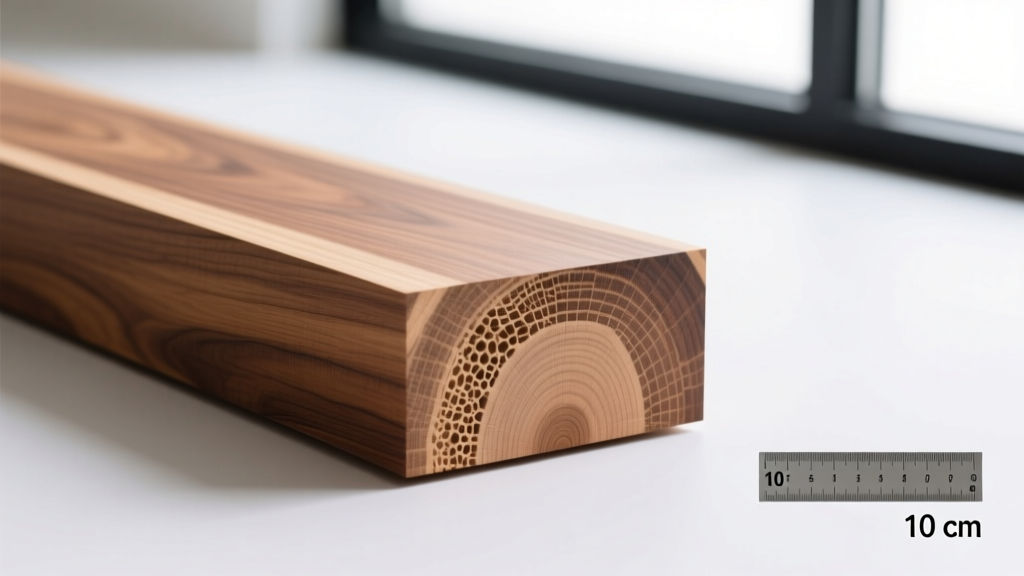
Decoding NHLA Grading for Exotic Hardwoods
When sourcing types of exotic wood for high-end architectural millwork, decking, or structural accents, understanding the National Hardwood Lumber Association (NHLA) grading system is non-negotiable. Unlike domestic softwoods graded by structural stress values, exotic hardwoods are graded primarily by the yield of clear, defect-free cuttings. According to the National Hardwood Lumber Association, the highest tiers dictate both the aesthetic superiority and the structural reliability of the milled product.
FAS: Requires a minimum board size of 4 inches wide by 5 feet long. The board must yield 83-1/3% to 100% clear-face cuttings. This is the mandatory grade for long, uninterrupted runs of exotic flooring or solid slab tabletops.
Select: Identical clear-cutting percentage requirements as FAS, but permits a smaller minimum board size (4 inches wide by 4 feet long). Ideal for cabinetry and shorter millwork profiles where maximum length is not critical.
For highly figured exotic species like Bubinga or Zebrawood, grading can become subjective due to the natural interlocking grain. Buyers must explicitly request "FAS One Face" (F1F) if only one side of the board will be visible, which halves the cost compared to full FAS while maintaining the required visual quality on the exposed surface.
The Janka Hardness Matrix: Species vs. Structural Integrity
The Janka hardness test measures the force required to embed a 0.444-inch steel ball halfway into the wood. When evaluating different types of exotic wood for high-traffic flooring or heavy-load decking, Janka ratings dictate fastener requirements, milling tooling, and long-term dent resistance. The USDA Forest Products Laboratory provides standardized testing metrics that inform these structural decisions.
| Exotic Species | Janka Hardness (lbf) | Density (lbs/ft³) | Primary Architectural Application |
|---|---|---|---|
| Ipe (Brazilian Walnut) | 3,684 | 65-75 | Commercial decking, boardwalks, exterior cladding |
| Cumaru (Brazilian Teak) | 3,330 | 63-70 | High-traffic residential flooring, heavy timber framing |
| Tigerwood (Goncalo Alves) | 2,160 | 52-60 | Accent flooring, custom stair treads, veneers |
| Burmese Teak | 1,000 - 1,155 | 40-45 | Marine applications, luxury exterior furniture, wet-area millwork |
| Honduran Mahogany | 800 - 900 | 35-40 | Interior paneling, custom doors, intricate millwork and carving |
Tooling Note: Species exceeding 2,500 lbf (like Ipe and Cumaru) will rapidly dull standard high-speed steel (HSS) saw blades. Procurement specs must mandate that suppliers use carbide-tipped blades with a negative hook angle to prevent tear-out and burning during the initial milling phase.
Moisture Content and Kiln-Drying Standards
Exotic woods are notoriously reactive to humidity fluctuations. Improper moisture content (MC) at the time of installation guarantees catastrophic failure, including cupping, checking, and joint separation. The target MC depends entirely on the Equilibrium Moisture Content (EMC) of the installation environment.
- Interior Climate-Controlled Environments: Target MC of 6% to 8%. This requires a rigorous kiln-drying process followed by a resting period in a climate-controlled warehouse.
- Exterior and Semi-Exposed Environments: Target MC of 12% to 15%. Over-drying exterior decking (like Ipe) to interior standards will cause the boards to rapidly absorb ambient moisture and expand, leading to buckled fasteners.
Visual Defect Tolerances by Grade
Even within FAS grade, minor defects are mathematically permitted. Understanding these tolerances prevents unjustified load rejections and sets accurate expectations for architects and clients.
Acceptable Defects in FAS Exotic Lumber
- Wane (Bark Edge):strong> Permitted on one edge, provided it does not exceed 1/6th of the board's width and does not penetrate the required clear-cutting zone.
- Knots: Sound, tight knots are permitted if they measure less than 1 inch in diameter and do not interfere with the structural integrity of the clear cutting. Pin knots (under 1/4 inch) are generally unlimited in FAS grade.
- Checks (Surface Cracks):strong> Surface checks are allowed if they do not exceed 1/8th of the board's length and are confined to the ends. End-checks are typically sealed with anchor wax by the supplier to prevent further propagation.
- Sapwood: For species like Walnut or Wenge, sapwood is technically a visual defect but not a structural one. FAS grading allows sapwood if it falls outside the primary clear-face cutting area, though premium buyers often specify "90% heartwood" as an addendum to the FAS grade.
FSC Certification and Lacey Act Compliance
Procuring types of exotic wood carries significant legal and environmental risks. The U.S. Lacey Act strictly prohibits the importation of illegally harvested timber. Relying solely on supplier verbal assurances is a massive liability. According to the Forest Stewardship Council (FSC), verifying the Chain of Custody (CoC) is the only legally defensible procurement method.
Importing or purchasing exotic wood without verifiable legal documentation can result in felony charges, massive fines, and confiscation of the entire lumber shipment. Always demand the supplier's active FSC CoC certificate number and verify it directly on the FSC global database before issuing a purchase order.
Verification Steps:
- Request the supplier's FSC Chain of Custody certificate number.
- Navigate to the FSC certificate database (info.fsc.org/certificate.php).
- Input the code to verify the certificate is "Valid" and covers the specific species and product category (e.g., rough sawn lumber vs. finished flooring).
- Ensure the invoice explicitly states the FSC claim (e.g., "FSC 100%" or "FSC Mix Credit") and matches the certificate scope.
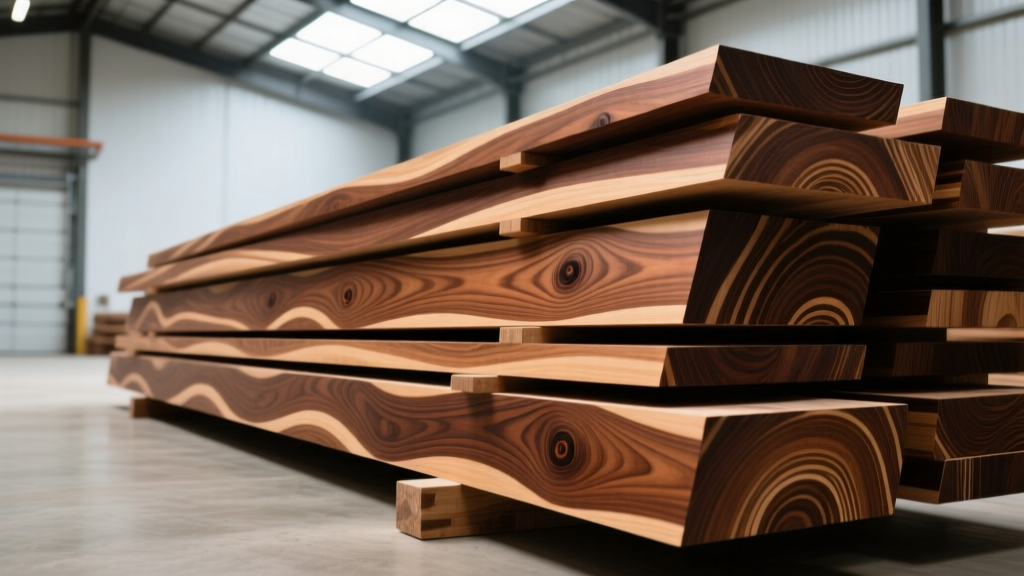
Pricing Tiers and Board Foot Calculations
Exotic lumber pricing is highly volatile, driven by international shipping costs, export quotas, and forestry regulations. Below is a baseline pricing matrix for FAS-grade material as of current market conditions. Note that prices are per Board Foot (BF) for rough-sawn lumber; S4S (surfaced on four sides) milling adds 15% to 25% to the base cost due to material waste and machining labor.
| Species | FAS Rough-Sawn (per BF) | FAS S4S (per BF) | Primary Price Driver |
|---|---|---|---|
| Ipe | $12.00 - $16.00 | $15.00 - $20.00 | Brazilian export quotas, high density shipping weight |
| Cumaru | $7.00 - $10.00 | $9.50 - $13.00 | Alternative to Ipe, more abundant supply |
| Burmese Teak | $35.00 - $50.00 | $45.00 - $65.00 | Strict Myanmar export bans, plantation vs. old-growth origin |
| Honduran Mahogany | $14.00 - $22.00 | $18.00 - $28.00 | CITES Appendix II restrictions, limited legal harvesting |
Board Foot Formula: Thickness (inches) × Width (inches) × Length (feet) ÷ 12. Always calculate waste factors: add 10% for straight flooring runs, and up to 20% for complex diagonal patterns or custom stair building where offcuts cannot be reused.
Expert Procurement Checklist
Execute this checklist before finalizing any purchase order for exotic hardwoods to ensure grade compliance, legal sourcing, and structural viability.
- Specify the Exact Grade: Write "NHLA FAS Grade" explicitly on the PO. Do not accept vague terms like "Premium" or "Cabinet Grade," which have no standardized legal definition in the hardwood industry.
- Mandate Moisture Content: Include a clause stating: "Material must be kiln-dried to 6-8% MC for interior use (or 12-15% for exterior), verified by pin-type moisture meter upon delivery. Loads exceeding this range are subject to rejection."
- Verify FSC Chain of Custody: Attach the supplier's valid FSC CoC certificate to the PO and require the FSC claim to be printed on the final commercial invoice.
- Define Visual Tolerances: If sapwood or specific grain patterns (e.g., quarter-sawn only) are unacceptable, add a custom addendum to the NHLA grade restricting these visual characteristics.
- Confirm Milling Specs: If ordering S4S or T&G (tongue and groove), specify the exact finished dimensions (e.g., "S4S to 3/4" x 3-1/4"") and require a 1/8" eased edge to prevent splintering during installation.
Written by
Marcus ChenMarcus Chen is a licensed structural engineer (PE) and building materials analyst with over 12 years of experience across residential, commercial, and industrial construction. He holds a Master of Science in Civil Engineering from UC Berkeley and spent six years at Thornton Tomasetti before transitioning to independent consulting and technical writing. Marcus specializes in material selection for seismic-prone regions, concrete reinforcement strategies, and lifecycle cost analysis. His work has been cited by the American Concrete Institute (ACI) and the Structural Engineers Association of California (SEAOC). When he is not on a job site or at his desk, you will find him hiking the Sierra Nevada or restoring a 1920s craftsman bungalow in Oakland, CA.
More from Marcus Chen
View all
Construction Cost
How Much Did the Eiffel Tower Cost to Build?
How much did the Eiffel Tower cost to build in 1889? We adjust for inflation and compare its budget to modern skyscraper construction.
Aug 4, 2026

Fire Resistance
What Is a Fire Resistant Material? Testing & Certification Guide
Discover what is a fire resistant material through ASTM and UL testing. Learn how fire ratings, certifications, and assemblies work in construction.
Aug 4, 2026

Construction Cost
How Much Did the Burj Khalifa Cost to Build?
How much did the Burj Khalifa cost to build? We break down the $1.5B project and extract 5 money-saving strategies for your next build.
Jul 30, 2026