Types of Wood Moulding: A Complete Species & Cost Guide
Compare the best types of wood moulding species. Expert guide to poplar, pine, MDF, and mahogany with 2026 pricing, Janka ratings, and finish tips.
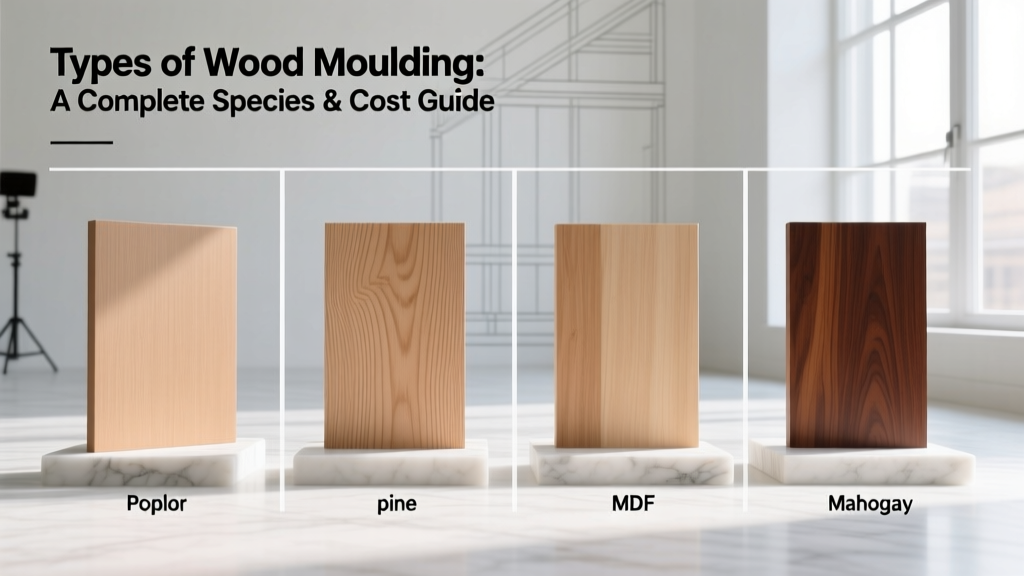
The Material Matrix: Matching Wood Species to Moulding Profiles
Selecting the correct material for architectural millwork dictates both the longevity of the installation and the quality of the final finish. While profile shapes (crown, baseboard, casing) define the aesthetic, the underlying wood species determines dimensional stability, paint adhesion, and resistance to mechanical damage. The Architectural Woodwork Institute (AWI) sets stringent standards for millwork tolerances, and meeting these requires understanding the cellular structure of your chosen timber.
| Species / Material | Janka Hardness (lbf) | Optimal Finish | Tangential Shrinkage | Best Application |
|---|---|---|---|---|
| Yellow Poplar | 540 | Paint | 8.2% | Painted crown, casing, base |
| Eastern White Pine | 380 | Stain / Paint | 6.8% | Stained baseboards, rustic trim |
| MDF (Engineered) | N/A (Density-based) | Paint | 0.0% (Swells instead) | Budget painted trim, flat stock |
| Basswood | 410 | Paint / Carved | 9.3% | Custom carved profiles, rosettes |
| Honduran Mahogany | 900 | Clear Stain | 4.1% | Premium stain-grade millwork |

Paint-Grade Champions: Poplar, MDF, and Finger-Jointed Pine
When the final design calls for a solid painted finish, the grain pattern becomes irrelevant, and dimensional stability and surface smoothness take priority.
Yellow Poplar (Liriodendron tulipifera)
Poplar is the undisputed industry standard for paint-grade solid wood moulding. According to the Wood Database, poplar machines exceptionally well, holding sharp, intricate profile details without tear-out. However, it contains green, brown, and purple mineral streaks. Critical Finish Tip: Never apply water-based latex primer directly to raw poplar; the tannins and mineral streaks will bleed through. Always use a high-hide, shellac-based primer like Zinsser B-I-N as the first coat to seal the wood and block stains.
Medium Density Fiberboard (MDF)
While not a solid wood species, MDF dominates the economy paint-grade market. It offers zero grain telegraphing and perfectly uniform profiles. The fatal flaw of MDF is moisture ingress. If an MDF baseboard is installed in a bathroom or over a concrete slab without a vapor barrier, capillary action will draw moisture into the exposed bottom edge, causing the fibers to swell irreversibly. Always seal the back and bottom edges of MDF trim with a solvent-based sealer before installation in high-humidity zones.
Finger-Jointed (FJ) Pine
FJ Pine is manufactured by gluing short pine offcuts together using zig-zag finger joints. It is straighter and more stable than solid pine, but the glue joints and varying wood densities can 'telegraph' through the paint over time as the wood expands and contracts. To prevent this, specify a heavy acrylic or shellac primer and avoid high-gloss topcoats, which highlight surface imperfections.
Stain-Grade Showpieces: Pine, Mahogany, and Walnut
Stain-grade moulding requires species with tight, attractive grain patterns and high natural durability. The wood must be graded 'Clear' or 'Select' to ensure no structural knots or sap pockets ruin the visual continuity.
Eastern White Pine
For budget-friendly stain-grade trim, Eastern White Pine offers a pale, uniform canvas. The primary challenge with pine is pitch bleed. Knots, even if tight and sound, will exude resin when exposed to sunlight or interior heat. This resin will destroy standard polyurethane finishes. You must seal pine knots with dewaxed shellac before applying any stain or clear coat.
Genuine Mahogany and Walnut
For high-end residential and commercial projects, Honduran Mahogany (Swietenia macrophylla) and Black Walnut (Juglans nigra) are the premier choices. Mahogany boasts incredible dimensional stability (tangential shrinkage of just 4.1%), meaning outside miter joints on mahogany crown moulding are far less likely to open up during seasonal humidity shifts compared to pine. Walnut provides a rich, dark heartwood that requires only a clear oil finish to achieve a luxurious depth, though its higher hardness (1010 lbf) requires slower router feed rates to prevent burning during the milling process.
Dimensional Stability and Failure Modes in Wood Moulding
The most common failure in wood moulding is not the wood rotting, but the joints separating. Wood is hygroscopic; it absorbs and releases moisture from the ambient air. As detailed in extensive wood movement studies, timber shrinks and swells primarily across the grain (tangentially and radially), with negligible movement along the grain (longitudinally).
⚠️ The Miter vs. Cope Rule
Because wood moves across its width, an inside corner miter joint will almost always open up as the moulding shrinks in width during dry winter months. Never miter inside corners. Always 'cope' inside joints—cutting the profile of one piece to nest perfectly over the face of the other. This allows the wood to shrink longitudinally without revealing a gap. Outside corners, however, must be mitered and reinforced with wood glue and 23-gauge micro-pins.
2026 Cost Breakdown: Pricing by Species and Profile
Material costs fluctuate based on timber yields and milling complexity. The table below reflects average 2026 wholesale-to-retail pricing per linear foot (LF) for standard profiles. Custom router bits and specialized species will command a 30-50% premium.
| Material Species | Baseboard (3.25'') | Crown Moulding (4.5'') | Door Casing (2.25'') |
|---|---|---|---|
| MDF (Primed) | $0.95 - $1.40 / LF | $1.80 - $2.50 / LF | $0.85 - $1.20 / LF |
| Finger-Jointed Pine | $1.30 - $1.80 / LF | $2.40 - $3.10 / LF | $1.10 - $1.60 / LF |
| Solid Poplar | $2.10 - $3.00 / LF | $3.80 - $5.50 / LF | $1.90 - $2.60 / LF |
| Clear Stain Pine | $2.80 - $3.90 / LF | $5.00 - $7.20 / LF | $2.50 - $3.40 / LF |
| Honduran Mahogany | $9.50 - $14.00 / LF | $16.00 - $24.00 / LF | $8.50 - $12.00 / LF |
Pro-Tips for Installation and Acclimation
To ensure your millwork survives its first year without catastrophic joint failure or finish cracking, adhere to these site-specific protocols:
- Acclimation Period: Deliver solid wood moulding to the job site at least 72 hours before installation. The HVAC system must be operational, maintaining an interior relative humidity (RH) between 35% and 50%.
- Fastener Selection: Use 15-gauge finish nails for securing the thick, structural bottom of baseboards and casings into wall studs. Switch to 18-gauge brads for the thinner top edges. For delicate crown moulding details and return miters, use 23-gauge micro-pins with a dab of cyanoacrylate (CA) wood glue.
- Caulking Strategy: Only caulk the top edge of baseboards and crown moulding where it meets the drywall. Never caulk the bottom edge of baseboards to the floor; if the floor flexes or the wood shrinks, the caulk will tear, creating an unsightly ragged line.
By matching the specific cellular properties of the wood species to the environmental demands of the room and the intended finish, contractors and homeowners can guarantee architectural millwork that remains flawless for decades.
Written by
Sarah WhitfieldSarah Whitfield is a chartered quantity surveyor (MRICS) and construction cost analyst with 15 years of experience in material pricing, procurement strategy, and project budgeting. She earned her degree in Construction Management from the University of Reading (UK) and has worked on projects ranging from $2M custom homes to $180M mixed-use developments across North America and Europe. Sarah currently leads cost estimating for BuildMat Insight, maintaining a proprietary database of 4,000+ material price points updated quarterly. She is a frequent contributor to RSMeans cost data panels and has presented at the International Cost Engineering Council (ICEC) congress. Based in Denver, CO, Sarah is an avid trail runner and volunteer mentor for Women in Construction.
More from Sarah Whitfield
View all
Wood & Lumber
What Are the Different Types of Wood? A Builder's Guide
Compare structural softwoods, finish hardwoods, and engineered lumber. Analyze Janka ratings, MOE values, and 2026 pricing for construction.
Aug 4, 2026

Walls & Panels
Steel Framing vs Wood Framing: Corrosion and Moisture Defense
Compare steel framing vs wood framing for moisture resistance. Learn about galvanized coatings, condensation risks, and corrosion protection strategies.
Jul 21, 2026

Stone & Masonry
How to Cut Stone Veneer: Wet Saw vs Grinder Comparison
Compare the best tools for cutting stone veneer. We review wet saws, angle grinders, and chop saws to help you achieve clean, chip-free cuts.
Jul 21, 2026