Selecting the Best Types of Fake Wood Flooring: A 2026 Framework
Compare the top types of fake wood flooring for 2026. Use our selection framework to choose between SPC, WPC, and laminate based on cost and durability.

The 2026 Faux Wood Selection Matrix
The market for synthetic timber has evolved far beyond early-generation peel-and-stick vinyl. Today, specifying the right types of fake wood flooring requires balancing core density, wear layer chemistry, and subfloor tolerances. The following decision matrix provides a baseline framework for material selection based on project constraints.
| Material Type | Core Composition | Ideal Subfloor Condition | Moisture Tolerance | Avg. Installed Cost (2026) |
|---|---|---|---|---|
| SPC (Stone Plastic Composite) | Limestone powder + PVC | Uneven, concrete, existing tile | 100% Waterproof | $5.50 - $8.50 / sq.ft. |
| WPC (Wood Plastic Composite) | Wood flour + foaming agent + PVC | Flat, dry plywood or concrete | 100% Waterproof | $6.50 - $10.00 / sq.ft. |
| Flexible LVP (Luxury Vinyl Plank) | Solid vinyl / PVC | Perfectly smooth, self-leveled | Waterproof surface, vulnerable seams | $3.50 - $6.00 / sq.ft. |
| Water-Resistant Laminate | HDF (High-Density Fiberboard) | Flat, dry wood subfloors | Water-resistant (not proof) | $4.50 - $7.50 / sq.ft. |
Breaking Down the Core Technologies
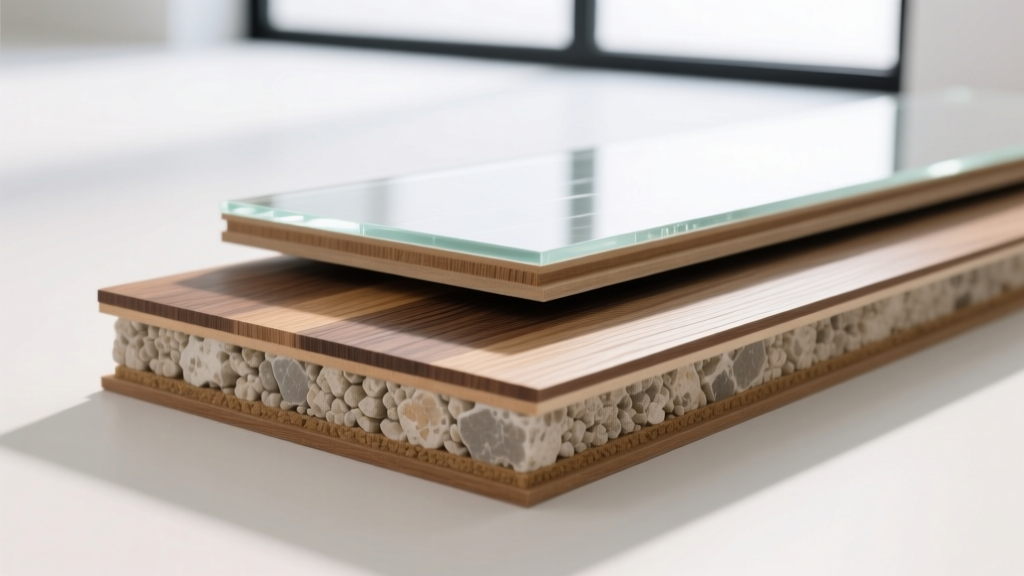
Understanding the structural anatomy of faux wood is critical for predicting long-term performance. The core layer dictates dimensional stability, while the wear layer dictates surface longevity.
SPC (Stone Plastic Composite): The High-Density Standard
SPC has captured the majority of the commercial and high-traffic residential market. The core is extruded from a mixture of limestone powder (calcium carbonate) and polyvinyl chloride. This results in a rigid plank that resists denting from point-loads (e.g., heavy furniture legs, appliance casters). SPC can bridge minor subfloor imperfections, tolerating deviations up to 3/16-inch over a 10-foot radius. However, its high density makes it unforgiving underfoot and acoustically reflective unless paired with a high-density attached pad.
WPC (Wood Plastic Composite): The Acoustic Upgrade
WPC utilizes a foaming agent within the PVC matrix, creating a micro-cellular structure. This makes WPC planks thicker (often 8mm to 10mm overall) and significantly softer underfoot than SPC. The expanded core provides superior sound dampening, frequently achieving IIC (Impact Insulation Class) ratings of 55+ without secondary underlayment, making it the preferred choice for multi-family residential buildings and second-story installations. The trade-off is lower point-load resistance; heavy static loads can cause permanent indentation over time.
Flexible LVP: The Budget and Glue-Down Contender
Traditional flexible LVP lacks a rigid core, relying entirely on the thickness of the vinyl mass (typically 2.0mm to 3.0mm). While floating flexible LVP is largely being replaced by rigid core alternatives, glue-down LVP remains highly relevant for commercial spaces requiring zero floor-height transition. The critical failure mode for flexible LVP is telegraphing: any debris, trowel marks, or subfloor divots will visibly mirror through the surface within months of installation.
Water-Resistant Laminate: The Scratch-Proof Alternative
Modern laminate utilizes a High-Density Fiberboard (HDF) core topped with a decorative paper layer and an aluminum oxide wear layer. While vinyl excels in dent resistance, laminate dominates in scratch resistance. For high-traffic areas with large pets or abrasive grit, specify an AC4 (moderate commercial) or AC5 (heavy commercial) abrasion rating. Despite "water-resistant" marketing claims, the HDF core will swell if moisture penetrates the locking mechanism, making it unsuitable for wet areas or below-grade basements.
Manufacturers frequently obfuscate wear layer thickness. Always specify the wear layer in mils (1 mil = 0.001 inches), not millimeters. A standard residential floor requires a minimum 12-mil wear layer, while 20-mil to 22-mil is mandatory for commercial or heavy-residential use. Furthermore, verify the finish chemistry: UV-cured urethane with ceramic bead additives offers significantly higher scuff resistance than standard polyurethane topcoats.
Subfloor Realities and Moisture Vapor Transmission
The most common cause of faux wood flooring failure is not surface wear, but subfloor-induced stress and moisture entrapment. Before procuring materials, contractors and homeowners must evaluate the installation environment against strict industry thresholds.
- Moisture Vapor Emission Rates (MVER): For concrete slabs, conduct an ASTM F1869 calcium chloride test or an ASTM F2170 in-situ relative humidity test. Most floating rigid core floors tolerate up to 5 lbs/1000 sq.ft./24 hours, but if readings exceed this, a topical moisture mitigation system (like a two-part epoxy sealer) is mandatory before laying a vapor barrier.
- Locking Mechanism Integrity: Rigid core floors utilize either Unilin (angle-angle) or Välinge (drop-lock) CNC-milled profiles. If the subfloor exceeds the 3/16-inch tolerance, the vertical sheer stress will snap the brittle SPC locking lips, leading to joint peaking and gapping.
- Expansion Margins: Despite being marketed as dimensionally stable, SPC and WPC expand and contract with temperature fluctuations. Maintain a strict 1/4-inch expansion gap at all vertical obstructions (walls, cabinets, pipes). Failure to do so will result in thermal buckling, particularly in sunrooms or spaces with floor-to-ceiling glazing.
Certifications and Indoor Air Quality
With building codes increasingly targeting indoor environmental quality, specifying third-party certified products is non-negotiable for commercial bids and LEED-certified residential projects. Ensure your selected flooring carries FloorScore certification, administered by SCS Global Services. This standard tests for emissions of volatile organic compounds (VOCs), including formaldehyde and plasticizers, ensuring compliance with stringent California Section 01350 requirements.
Additionally, consult the Resilient Floor Covering Institute (RFCI) guidelines for approved adhesive lists and underlayment compatibilities. Using non-approved vapor barriers can trap alkaline moisture against the concrete, degrading the adhesive on glue-down LVP or promoting mold growth beneath floating floors.
Final Procurement Checklist
Use this framework to finalize your material selection before issuing purchase orders:
- Test the Subfloor: Verify flatness (3/16" over 10') and concrete moisture (ASTM F2170 RH < 75%).
- Match the Core to the Load: Select SPC for heavy static loads and uneven slabs; select WPC for upper-level acoustic requirements and comfort.
- Verify the Wear Layer: Confirm a minimum 20-mil urethane wear layer for high-traffic zones, ignoring overall plank thickness as a proxy for durability.
- Demand Documentation: Require FloorScore certificates and ASTM test reports from the manufacturer prior to delivery.
Written by
Priya KapoorPriya Kapoor is a real estate market analyst and construction economics researcher with expertise in housing affordability, development feasibility, and infrastructure investment. She holds a Master of Regional Planning from Cornell University and previously worked as a senior analyst at CBRE's Investment Properties group, where she modeled returns for $4B in mixed-use development pipelines. Priya now runs an independent research practice advising developers, municipalities, and REITs on construction cost forecasting and market timing. She publishes the quarterly "BuildMat Market Pulse" report tracking material price indices across 12 commodity categories. Based in Austin, TX, Priya serves on the board of Habitat for Humanity Austin and is a marathon runner.
More from Priya Kapoor
View all
Construction Cost
Cost to Build a 1600 Sq Ft Home in 2026: Full Breakdown
Accurate 2026 cost to build a 1600 sq ft home—material, labor, and regional pricing breakdowns included. Plan your budget with real-time estimates.
Aug 11, 2026

Wood & Lumber
Name the Types of Wood for Pressure Treatment and Preservation
Learn how to name the types of wood best suited for pressure treatment. Compare species treatability, chemical retention levels, and 2026 preservation costs.
Aug 4, 2026

Stone & Masonry
Stone Veneer Suppliers Lindenhurst: 2026 Cost Analysis
Analyze 2026 stone veneer costs in Lindenhurst, NY. Compare local supplier pricing, delivery fees, and Suffolk County installation labor rates.
Aug 4, 2026