2026 Cost to Build a Wood Fence: Structural Pricing Guide
Analyze the 2026 cost to build a wood fence with a focus on structural integrity, lumber grades, wind-load post spacing, and material pricing.

The Structural Reality of Fence Pricing
Most online estimators calculate the cost to build wood fence projects based purely on linear footage and cosmetic picket styles. This approach fundamentally ignores the primary driver of long-term value: structural engineering. According to the USDA Forest Products Laboratory Wood Handbook, over 80% of wood fence failures within the first decade are not due to picket degradation, but rather post rot, frost heave, and wind shear at the structural joints. In 2026, with lumber stabilization and updated International Building Code (IBC) wind-load requirements, builders and homeowners must budget for subterranean structural integrity just as heavily as above-ground aesthetics.
This guide deconstructs the true cost to build wood fence systems that meet modern structural demands, detailing exact lumber grades, preservative retention levels, concrete volumes, and wind-engineered post spacing.
Lumber Grade and Species Selection Matrix
Selecting the right lumber is a structural decision, not just a visual one. Using #2 grade Southern Yellow Pine (SYP) for pickets is wasteful, while using Construction-grade Western Red Cedar for load-bearing corner posts invites premature sagging. Below is the 2026 structural lumber matrix for a standard 6-foot privacy fence.
| Component | Recommended Species & Grade | Structural Rationale | 2026 Material Cost (Per LF) |
|---|---|---|---|
| Line Posts (4x4) | #2 SYP (Pressure-Treated, UC4B) | High bending strength (Fb = 1,100 psi); UC4B ensures 0.40 pcf preservative retention for ground contact. | $3.50 - $4.80 |
| Corner/Gate Posts | #1 SYP or Select Structural (PT) | Must resist biaxial bending and torsional loads from gate swing and bi-directional wind. | $5.50 - $7.20 |
| Horizontal Rails (2x4) | #2 SYP (PT, UC3B) or Cedar | UC3B (0.25 pcf) is sufficient for above-ground rails; resists sagging over 8-foot spans. | $2.10 - $3.00 |
| Pickets (1x6) | WRC (Western Red Cedar) No. 2 Clear | Dimensional stability; minimal cupping or twisting under thermal expansion. | $4.50 - $6.50 |
Preservative Chemistry and Fastener Corrosion
A hidden cost that frequently derails fence budgets is fastener failure due to chemical reactions with modern wood preservatives. Since the phase-out of CCA (Chromated Copper Arsenate), the industry standard for ground-contact SYP is ACQ (Alkaline Copper Quaternary) or CA-C (Copper Azole). These copper-heavy preservatives are highly corrosive to standard electroplated galvanized nails.
Standard electro-galvanized fasteners will corrode and snap inside ACQ-treated posts within 3 to 5 years, causing rails to detach. You must specify Hot-Dipped Galvanized (HDG) nails meeting ASTM A153 or Type 304/316 Stainless Steel. Budget an additional $0.45 to $0.85 per linear foot for structural-grade fasteners (e.g., 2-1/2" HDG ring-shank nails for rails, 1-1/2" for pickets).
Wind Load Engineering and Post Spacing
The American Wood Council (AWC) provides span tables that dictate how far apart structural posts can be placed based on local wind speed maps. A fence acts as a massive sail; a 6-foot solid privacy fence in a 115 mph wind zone generates roughly 25 pounds of lateral force per square foot.
Spacing Adjustments by Wind Zone
- Standard Zones (90-115 mph): 8-foot on-center (O.C.) post spacing is structurally viable using 4x4 posts set 36 inches deep.
- High-Velocity Hurricane Zones (HVHZ - 130+ mph): Post spacing must be reduced to 6-foot O.C., and posts must be upgraded to 6x6 or reinforced with steel pipe sleeves. This increases the cost to build wood fence lines by approximately 18% due to the higher post density and deeper excavation (48 inches).
Frost Line Considerations: In northern climates (e.g., IBC Zone 5), the frost depth can reach 42 inches. If a post is set above the frost line in a concrete bell, winter ice lenses will grip the concrete and heave the post upward. Structural posts must bear on undisturbed soil or gravel at least 6 inches below the local frost line.
Hidden Structural Costs: Concrete and Anchoring
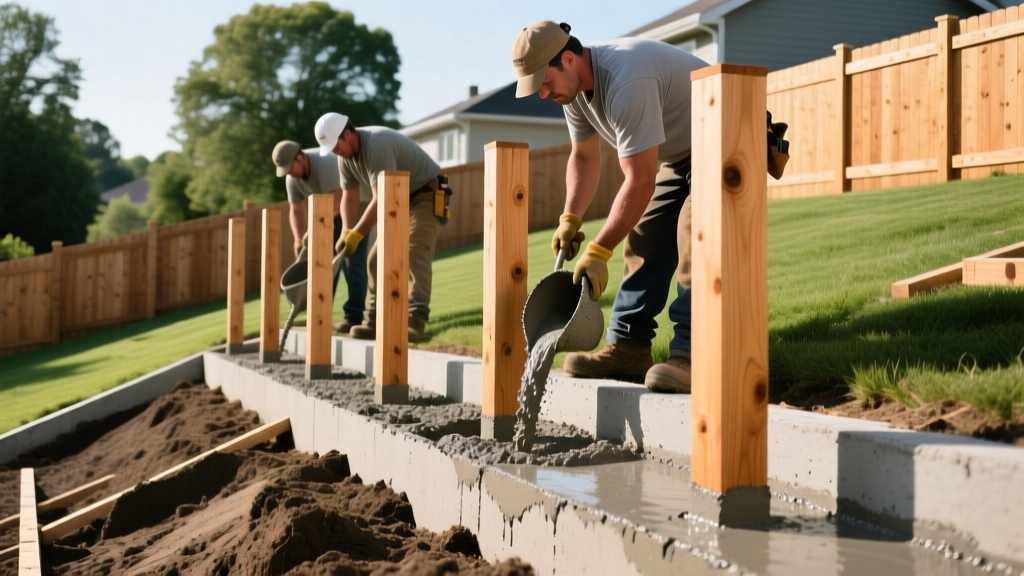
Digging the hole is only half the battle; the material used to lock the post in place dictates the fence's lifespan. While some contractors use dry-pack gravel for rapid installation, high-wind and heavy-gate applications require wet-set concrete.
For a 4x4 post in a 10-inch diameter hole, dug to 36 inches (with 6 inches of base gravel), you need to fill 30 inches of depth with concrete. This requires approximately 1.4 bags of 50lb concrete mix per post. At $6.50 per bag in 2026, budget $9.10 per post strictly for concrete material. For a 150-foot fence with 20 posts, that is $182 just in bagged concrete, excluding the labor to mix it.
2026 Comprehensive Cost Breakdown
When calculating the total cost to build wood fence systems that survive extreme weather and pass municipal structural inspections, labor and site prep dominate the budget. The following table outlines a 150-linear-foot, 6-foot-tall privacy fence project in a moderate wind zone (115 mph) with a 36-inch frost depth.
| Cost Category | Specifics & Quantities | Estimated 2026 Cost |
|---|---|---|
| Structural Lumber (Posts & Rails) | #2 SYP PT (20 posts, 60 rails) | $850 - $1,100 |
| Finish Lumber (Pickets) | WRC No. 2 Clear (approx. 320 1x6s) | $900 - $1,250 |
| Concrete & Gravel | 30 bags 50lb mix, 10 bags pea gravel | $250 - $300 |
| Fasteners & Hardware | HDG Ring-shank nails, heavy-duty T-hinges | $150 - $220 |
| Labor (Excavation & Setting) | Augering 20 holes below frost line, mixing | $1,200 - $1,600 |
| Labor (Framing & Picketing) | String-line leveling, nailing, gate assembly | $1,100 - $1,500 |
| Total Project Cost (150 LF) | Blended Rate: $29.66 - $39.80 per LF | $4,450 - $5,970 |
Engineering the Weak Points: Gates and Corners
A structural fence is only as strong as its weakest joint. The two highest failure points in any wood fence are the gate hinge posts and the 90-degree corners.
Gate Post Anti-Sag Framing
A standard 4-foot wide wood gate weighs between 75 and 110 pounds. The constant dynamic load of opening and closing, combined with the lever-arm effect, will pull a standard 4x4 hinge post out of plumb within a single season. To prevent this, structural builders utilize a steel pipe sleeve method: a 2-3/8" OD galvanized steel fence post is set in concrete to the full depth, and the 4x4 wood post is bolted to it using structural lag screws. Alternatively, installing a 4x6 or 6x6 PT post with a diagonal compression brace anchored to the adjacent line post transfers the dynamic load back into the fence line.
Corner Post H-Bracing
For long fence runs or agricultural-style structural perimeters, corner posts experience immense bi-directional tension from the rails pulling in two directions. The American Fence Association recommends H-bracing for corners on runs exceeding 150 feet. This involves setting two vertical posts and connecting them with a horizontal cross-member and a tension wire or diagonal wood brace. While this adds roughly $85 to $120 per corner in material and labor, it mathematically eliminates corner lean.
Final Decision Framework for Homeowners
Do not accept a contractor's bid that simply lists "4x4 posts and 1x6 pickets." Demand a specification sheet that details the preservative retention level (UC4B for ground contact), the fastener coating (ASTM A153 HDG or Stainless), and the exact post depth relative to your local frost line. Paying a 15% premium upfront for structurally engineered materials and deep-set concrete footings will extend the functional lifespan of your wood fence from 7 years to over 20 years, ultimately lowering the lifecycle cost of your property's perimeter.
Written by
Sarah WhitfieldSarah Whitfield is a chartered quantity surveyor (MRICS) and construction cost analyst with 15 years of experience in material pricing, procurement strategy, and project budgeting. She earned her degree in Construction Management from the University of Reading (UK) and has worked on projects ranging from $2M custom homes to $180M mixed-use developments across North America and Europe. Sarah currently leads cost estimating for BuildMat Insight, maintaining a proprietary database of 4,000+ material price points updated quarterly. She is a frequent contributor to RSMeans cost data panels and has presented at the International Cost Engineering Council (ICEC) congress. Based in Denver, CO, Sarah is an avid trail runner and volunteer mentor for Women in Construction.
More from Sarah Whitfield
View all
Wood & Lumber
What Are the Different Types of Wood? A Builder's Guide
Compare structural softwoods, finish hardwoods, and engineered lumber. Analyze Janka ratings, MOE values, and 2026 pricing for construction.
Aug 4, 2026

Walls & Panels
Steel Framing vs Wood Framing: Corrosion and Moisture Defense
Compare steel framing vs wood framing for moisture resistance. Learn about galvanized coatings, condensation risks, and corrosion protection strategies.
Jul 21, 2026

Stone & Masonry
How to Cut Stone Veneer: Wet Saw vs Grinder Comparison
Compare the best tools for cutting stone veneer. We review wet saws, angle grinders, and chop saws to help you achieve clean, chip-free cuts.
Jul 21, 2026