Best Types of Wood for Smoking: A Complete Species Guide
Master the best types of wood for smoking with our complete species guide. Compare density, BTU, flavor profiles, and moisture content for perfect BBQ.

The Botany and Chemistry of Smoking Wood
Selecting the right wood for smoking is not merely a culinary preference; it is an exercise in applied wood science and thermodynamics. When wood combusts, its structural polymers break down at specific temperatures, releasing volatile organic compounds that flavor and preserve meat. The two primary polymers responsible for smoke flavor are cellulose and lignin.
The Chemistry of Flavor
Cellulose and Hemicellulose: These carbohydrates caramelize when heated, producing sweet, fruity, and toasty flavor compounds like furans.
Lignin: This complex organic polymer binds wood fibers together. When lignin burns (typically between 390°F and 450°F), it produces guaiacol (responsible for the classic 'smoky' taste) and syringol (responsible for the smoky aroma). Hardwoods possess a higher lignin density than softwoods, making them the only viable choice for culinary smoking.
Softwoods like pine, fir, and cedar contain high levels of terpenes and resin. When burned, these compounds produce a harsh, sooty smoke that coats food in bitter creosote and can cause physical illness. According to The Wood Database, the fundamental anatomical difference between hardwoods (angiosperms) and softwoods (gymnosperms) dictates their resin content and combustion behavior, rendering softwoods strictly prohibited for low-and-slow smoking.
Moisture Content: The Metric That Makes or Breaks Your Smoke
The most critical physical property of smoking wood is its Moisture Content (MC). Wood that is too wet will smolder rather than burn, while wood that is too dry will incinerate before releasing adequate flavor compounds.
- Green Wood (40% - 60% MC): Freshly cut. The fire's thermal energy is wasted boiling off water, resulting in a low combustion temperature, thick white smoke, and heavy creosote buildup.
- Kiln-Dried Wood (8% - 12% MC): Often used for furniture or indoor firewood. It ignites instantly and burns exceptionally hot, but combusts too rapidly to produce a sustained, flavorful smoke profile.
- Ideal Smoking Wood (15% - 20% MC): Air-dried or 'cured' for 6 to 12 months. This moisture sweet spot allows the wood to maintain a steady smoldering combustion (around 500°F - 600°F at the coal bed), producing the highly desirable 'thin blue smoke' composed of microscopic flavor particles rather than large soot particulates. Research from the Michigan State University Extension confirms that maintaining proper moisture content is vital for clean combustion and preventing hazardous particulate emissions.
Comprehensive Species Matrix: Hardwoods for Smoking
The following matrix compares the most prominent hardwood species used in barbecue, detailing their physical density, heat output, and culinary applications.
| Wood Species | Density (lbs/ft³) | Flavor Profile | BTU per Cord | Best Meat Pairings |
|---|---|---|---|---|
| Post Oak | 47 | Medium, robust, balanced | 28.0 Million | Beef brisket, beef ribs |
| Shagbark Hickory | 51 | Strong, pungent, bacon-like | 30.6 Million | Pork shoulder, ribs, ham |
| Mesquite | 43 | Earthy, sharp, intense | 28.0 Million | Quick-cook steaks, fajitas |
| Apple | 41 | Mild, sweet, fruity | 25.0 Million | Poultry, pork chops, fish |
| Cherry | 35 | Mild, tart, sweet | 20.0 Million | Poultry, game birds, pork |
Detailed Species Profiles and Application Strategies
Post Oak (Quercus stellata)
The undisputed king of Central Texas barbecue. Post oak has a lower tannin content than red oak, preventing the bitter, astringent flavors that can ruin a 14-hour brisket smoke. It burns evenly, produces a consistent coal bed, and provides a medium-strength smoke that enhances beef without overpowering it. Pro Tip: Always source post oak that has been air-dried for at least 9 months. If the bark slips off easily when you pick up a split log, it is properly cured.
Hickory (Carya ovata)
Hickory is the most popular smoking wood in the American South due to its aggressive, bacon-like flavor profile. Because of its high density (51 lbs/ft³) and high BTU output, it burns hot and long. However, hickory is unforgiving. Using too much hickory, or using it on delicate proteins like chicken, will result in an acrid, bitter taste. It is best utilized in small chunks mixed with a milder base wood like oak or apple.
Mesquite (Prosopis glandulosa)
Mesquite burns exceptionally hot and fast, often exceeding 800°F at the coal bed. It contains high levels of natural oils that produce a sharp, earthy smoke. Because it combusts so rapidly, mesquite is generally unsuited for low-and-slow smoking (225°F - 250°F) unless heavily restricted by airflow. It excels in high-heat offset grilling, Santa Maria-style tri-tip, and quick-cooking beef cuts.
Fruitwoods: Apple and Cherry
Fruitwoods are less dense and contain less lignin, resulting in a milder, sweeter smoke. Cherry wood is unique in its ability to react with the myoglobin in meat, accelerating the Maillard reaction and imparting a rich, mahogany-red color to the bark of pork ribs and poultry. Apple wood requires a longer exposure time to penetrate dense meats, making it ideal for whole turkeys or pork loins.
Failure Modes: Creosote, Bitterness, and Soot
The most common failure in wood smoking is the development of creosote—a black, oily, bitter-tasting residue that forms on the surface of the meat. According to food safety guidelines outlined by the University of Minnesota Extension, improper smoking techniques not only ruin flavor but can introduce polycyclic aromatic hydrocarbons (PAHs) to the food surface.
⚠️ Warning: The 'Thick White Smoke' Trap
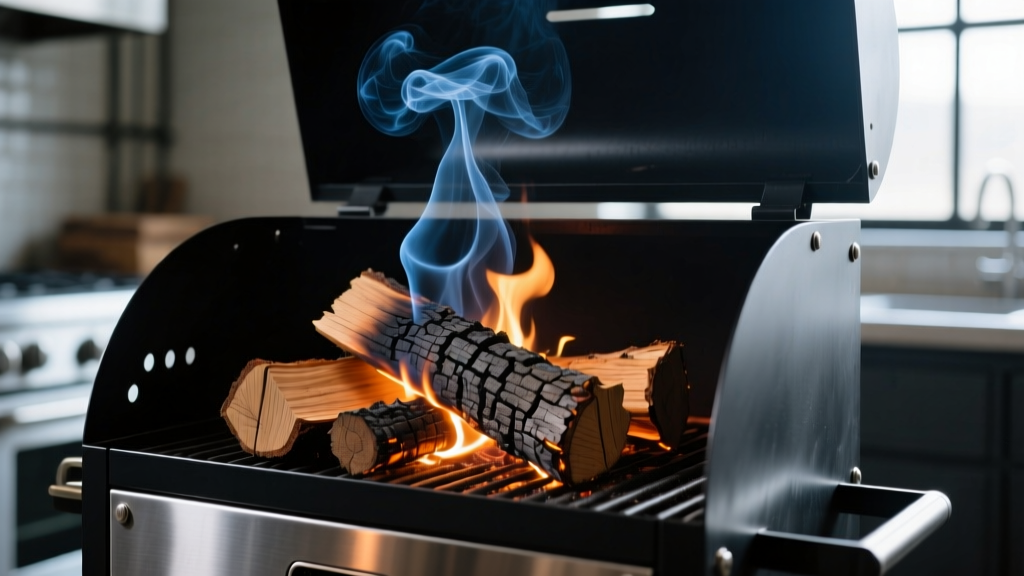
Thick, billowing white smoke is a sign of incomplete combustion. It consists of large, unburnt carbon particulates and water vapor. If your smoker looks like a steam train, your meat is actively accumulating creosote. You must increase your exhaust ventilation (open the chimney cap fully) and ensure your intake vents are providing enough oxygen to achieve thin blue smoke—a nearly transparent, faint blue haze that indicates complete, clean combustion.
Debunking the Wood Soaking Myth
A pervasive myth in backyard barbecue is that soaking wood chunks in water before adding them to the fire prevents them from burning up too quickly. This is physically inaccurate. Due to the cellular structure of hardwood, liquid water penetrates no more than 1/16th of an inch into the surface of a wood chunk, regardless of how long it soaks.
When you place soaked wood onto hot coals, the surface water instantly vaporizes into steam. This steam lowers the temperature of your fire, delays combustion, and creates the exact smoldering, oxygen-deprived environment that generates bitter white smoke and creosote. Actionable Advice: Always use dry, cured wood chunks. If you need to slow down the combustion rate, bury the dry wood chunks deep within the unlit charcoal bed before lighting, allowing them to ignite gradually as the fire burns down.
Frequently Asked Questions
Can you mix different types of wood for smoking?
Yes, blending woods is a standard professional technique. A common framework is the 70/30 rule: use 70% mild base wood (like Post Oak or Pecan) for consistent heat and baseline smoke, and 30% strong flavor wood (like Hickory or Mesquite) to introduce specific aromatic notes. This prevents palate fatigue and bitter over-smoking.
Should I remove the bark from my smoking wood?
Bark contains high concentrations of tannins, dirt, and environmental pollutants. While a small amount of bark left on well-cured oak will not ruin a cook, the bark on hickory and mesquite can burn erratically and impart an astringent flavor. For competition-level barbecue or when using wood from unknown sources, splitting the logs and removing the bark is recommended to ensure a clean combustion profile.
Written by
Sarah WhitfieldSarah Whitfield is a chartered quantity surveyor (MRICS) and construction cost analyst with 15 years of experience in material pricing, procurement strategy, and project budgeting. She earned her degree in Construction Management from the University of Reading (UK) and has worked on projects ranging from $2M custom homes to $180M mixed-use developments across North America and Europe. Sarah currently leads cost estimating for BuildMat Insight, maintaining a proprietary database of 4,000+ material price points updated quarterly. She is a frequent contributor to RSMeans cost data panels and has presented at the International Cost Engineering Council (ICEC) congress. Based in Denver, CO, Sarah is an avid trail runner and volunteer mentor for Women in Construction.
More from Sarah Whitfield
View all
Wood & Lumber
What Are the Different Types of Wood? A Builder's Guide
Compare structural softwoods, finish hardwoods, and engineered lumber. Analyze Janka ratings, MOE values, and 2026 pricing for construction.
Aug 4, 2026

Walls & Panels
Steel Framing vs Wood Framing: Corrosion and Moisture Defense
Compare steel framing vs wood framing for moisture resistance. Learn about galvanized coatings, condensation risks, and corrosion protection strategies.
Jul 21, 2026

Stone & Masonry
How to Cut Stone Veneer: Wet Saw vs Grinder Comparison
Compare the best tools for cutting stone veneer. We review wet saws, angle grinders, and chop saws to help you achieve clean, chip-free cuts.
Jul 21, 2026