Types of Oak Wood: A Complete Species Guide for Builders
Discover the distinct types of oak wood, from white to red oak. Compare Janka hardness, pricing, and structural uses for your next building project.
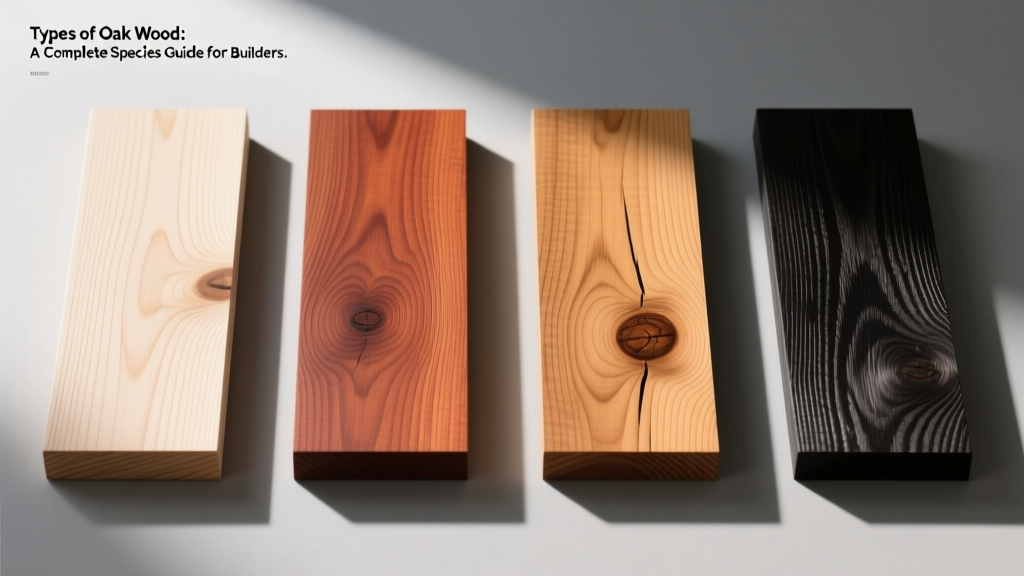
The Botanical Divide: White Oak vs. Red Oak
Specifying oak for architectural millwork, structural timber, or exterior cladding requires a precise understanding of its botanical classification. The commercial lumber market broadly categorizes oak into two distinct groups: White Oak and Red Oak. This distinction is not merely about heartwood color; it dictates the wood's cellular structure, moisture resistance, and structural viability.
The critical differentiator is the presence of tyloses—cellular growths that plug the xylem vessels (capillaries) in the White Oak group. According to comprehensive anatomical studies detailed by the Wood Database, these tyloses make White Oak virtually impermeable to liquids. Conversely, Red Oak lacks tyloses, leaving its capillaries open. If you place the end grain of a Red Oak board in water and blow through the top, bubbles will emerge; White Oak will not pass air or water. This single anatomical fact governs where each type of oak wood can be safely deployed in construction.
Comprehensive Matrix of Commercial Oak Species
The following matrix outlines the primary commercial species, their mechanical properties, and current market pricing for FAS (First and Seconds) grade lumber. Pricing reflects North American wholesale averages for 4/4 (1-inch) thickness, surfaced two sides (S2S).
| Species | Group | Janka Hardness (lbf) | Specific Gravity (Basic) | Avg FAS Price ($/BF) | Primary Application |
|---|---|---|---|---|---|
| American White Oak (Quercus alba) | White | 1,360 | 0.60 | $8.50 - $11.00 | Exterior cladding, marine, flooring |
| Northern Red Oak (Quercus rubra) | Red | 1,290 | 0.56 | $6.00 - $8.00 | Interior millwork, cabinetry, flooring |
| European Oak (Quercus robur) | White | 1,120 | 0.56 | $14.00 - $18.00 | High-end architectural millwork, timber framing |
| Southern Live Oak (Quercus virginiana) | Live | 2,680 | 0.88 | $15.00+ (Specialty) | Heavy structural beams, marine, turnery |
White Oak Group: Heavyweights of Structural & Marine Use
American White Oak (Quercus alba)
American White Oak is the benchmark for durability in North American hardwoods. Its high tannin content, combined with its impermeable cellular structure, provides exceptional resistance to decay and insect attack. When specifying White Oak for exterior applications, architects must mandate quarter-sawn or rift-sawn milling for dimensional stability.
Quarter-sawn White Oak exhibits a tangential-to-radial (T/R) shrinkage ratio of approximately 1.9, meaning it shrinks nearly equally in both directions, drastically reducing the tendency to cup or warp compared to plain-sawn boards (T/R ratio of 2.4). Furthermore, quarter-sawing exposes the medullary rays, producing the highly prized 'ray fleck' pattern essential for Arts & Crafts and Mission-style architectural millwork.
Fastener Specification: White Oak is highly acidic. Standard zinc-plated or electro-galvanized fasteners will react with the tannic acid, causing severe black staining (iron gall reaction) and rapid fastener corrosion. Always specify 304 or 316 stainless steel, or hot-dipped galvanized hardware for White Oak installations.
European Oak (Quercus robur & Quercus petraea)
European Oak is generally slightly softer and lighter than its American counterpart but offers a tighter, more uniform grain pattern. It is the premier choice for heavy timber framing and high-end interior paneling. European Oak responds exceptionally well to fuming (ammonia treatment), which reacts with the high tannin levels to produce a deep, rich, permanent brown patina without the use of surface stains.
Red Oak Group: The Interior & Millwork Standard
Northern Red Oak (Quercus rubra)
Northern Red Oak is the most abundant and economically viable hardwood in the United States. It machines beautifully, glues well, and takes a heavy finish. However, its open capillary structure makes it strictly an interior species. Red Oak is the default choice for painted or stained interior doors, baseboards, and stair treads where extreme moisture resistance is not required.
Because of its large, open pores, Red Oak requires a dedicated grain filler if a glass-smooth, closed-pore finish is desired for high-end cabinetry. When staining, the open pores can lead to blotchy absorption; applying a pre-stain wood conditioner or utilizing a water-popping technique is mandatory for achieving uniform dark stain colors.
Never specify Red Oak for exterior siding, decking, or marine applications. The open xylem vessels act like a bundle of drinking straws. When exposed to rain, end-grain wicking will draw moisture deep into the core of the board, bypassing surface sealants. This leads to internal rot, structural failure, and severe blackening from tannin-iron reactions within months of installation.
Specialty Species: Southern Live Oak
Southern Live Oak (Quercus virginiana) is an anomaly among commercial oaks. It is an evergreen species with a specific gravity of 0.88, making it so dense that it sinks in water. With a Janka hardness of 2,680 lbf, it is nearly twice as hard as White Oak. Historically used to build the hull of the USS Constitution ('Old Ironsides'), Live Oak is incredibly resistant to rot and shock.
Today, Live Oak is rarely milled for standard dimensional lumber due to its irregular, sprawling growth habit and extreme density, which breaks standard planer blades. It is primarily sourced by specialty sawmills for heavy structural beams, custom marine hardware, and high-end turnery. Carbide-tipped tooling is an absolute requirement when machining Live Oak.
NHLA Grading and Yield Realities
When purchasing types of oak wood for large-scale projects, understanding the National Hardwood Lumber Association (NHLA) grading rules is essential for calculating true material costs and yield. The Wood Database and NHLA standards define the clear-face cutting requirements that dictate grade:
- FAS (First and Seconds): Requires a minimum clear-face cutting yield of 83-1/3%. Boards must be at least 6 inches wide and 8 feet long. This grade is mandatory for long, uninterrupted runs of stair handrails, long flooring planks, and wide architectural casing.
- Select: Similar to FAS but allows for smaller minimum board sizes (4 inches wide, 6 feet long). Excellent for cabinet face frames and shorter millwork components.
- #1 Common: Requires a 66-2/3% clear-face yield. This is the most economical grade for cabinet shops and flooring manufacturers who can cut around defects (knots, wane, sapwood) to yield smaller, clear parts.
Pro-Tip: Buying #1 Common Red Oak instead of FAS can reduce material costs by 30-40%, provided your shop has the labor and optimization software to efficiently cut around defects for smaller components like drawer fronts and cabinet stiles.
Specification Framework: Selecting the Right Oak
Use this decision matrix to specify the correct oak species and milling method for your project parameters:
- Is the application exterior or exposed to high moisture?
Action: Specify Quarter-Sawn White Oak. Reject Red Oak entirely. Ensure all fasteners are 316 stainless steel. - Is the application interior flooring requiring high dimensional stability?
Action: Specify Quarter-Sawn or Rift-Sawn White Oak or Red Oak. The lower T/R shrinkage ratio prevents seasonal gapping and cupping over wide plank widths (5 inches or greater). - Is the application painted interior millwork?
Action: Do not use Oak. Specify Poplar or Maple. Oak's deep, open grain will telegraph through paint over time, requiring expensive grain-filling labor to hide. - Is the application heavy timber framing?
Action: Specify European Oak or White Oak in large dimensional timbers (8x8 or larger). Ensure the timber is graded by a certified timber grader, as standard NHLA board rules do not apply to structural beams.
Frequently Asked Questions
Why does White Oak cost more than Red Oak?
White Oak commands a 25% to 40% premium over Red Oak due to higher global demand (particularly from the cooperage industry for whiskey and wine barrels, which exclusively require White Oak), slower growth rates, and its versatility in both interior and exterior applications.
Can I use Red Oak for a bathroom vanity top?
It is highly discouraged. Even with a high-quality marine varnish or epoxy topcoat, the ambient humidity and frequent water pooling in a bathroom environment will eventually breach the finish. Once water enters the open end-grain capillaries of Red Oak, it will cause irreversible black staining and structural swelling.
What is the difference between plain-sawn and quarter-sawn oak?
Plain-sawn oak is cut tangentially to the growth rings, producing a 'cathedral' grain pattern but resulting in higher tangential shrinkage, which causes cupping. Quarter-sawn oak is cut radially, intersecting the rings at 60-90 degrees. This exposes the medullary rays (fleck), drastically reduces cupping, and provides superior dimensional stability, though it yields less lumber per log, increasing the cost.
Written by
James ThorntonJames Thornton is a construction industry veteran with 25 years of hands-on experience in wood framing, lumber grading, and residential building codes. He started as a framing carpenter in rural Oregon, earned his ICC Residential Building Inspector certification, and eventually became a senior plan reviewer for the City of Portland Bureau of Development Services. James holds a B.S. in Wood Science & Technology from Oregon State University and is a certified lumber grader through the West Coast Lumber Inspection Bureau (WCLIB). He has inspected over 3,000 residential construction sites and authored the city's internal guide on advanced framing techniques (2x6 at 24" O.C.). James lives in Bend, OR, where he builds custom timber-frame cabins and competes in lumberjack sports.
More from James Thornton
View all
Insulation
Best Home Insulation Materials: Complete 2026 Guide
Compare top home insulation materials for 2026. Find R-values, installed costs per square foot, and best uses for fiberglass, spray foam, and mineral wool.
Aug 4, 2026

Sustainable Building
Certify Your Green Building Material for LEED and WELL
Step-by-step guide to certifying a green building material for LEED v5 and WELL v2. Master EPDs, HPDs, and VOC limits for 2026 project specifications.
Aug 4, 2026

Stone & Masonry
Veneer Stacked Stone Panels: Interior Design & Style Showcase
Discover how veneer stacked stone panels transform interiors. Explore modern design profiles, material pairings, and technical installation specs.
Aug 4, 2026