What Type of Wood for a Raised Garden Bed? A Selection Framework
Discover the definitive selection framework for raised garden bed wood. Compare cedar, redwood, and treated lumber for durability, cost, and soil safety.

The 4-Pillar Wood Selection Framework
Choosing the right lumber for a raised garden bed requires balancing biological decay resistance, chemical safety, structural load capacity, and lifecycle cost. Wet soil is a highly corrosive, biologically active environment that exerts immense lateral pressure. According to the USDA Forest Products Laboratory, wood in ground contact or continuous high-moisture environments degrades rapidly unless specific heartwood extractives or preservative treatments are present. Use this four-pillar framework to evaluate your options.
- Biological Durability: Presence of natural fungicides (thujaplicins, tannins) in the heartwood.
- Chemical Leaching: Compliance with USDA National Organic Program (NOP) standards for edible crops.
- Hydro-Mechanical Load: Ability to resist bowing under wet soil weight (approx. 100-120 lbs per cubic foot).
- Lifecycle Cost: Initial material cost amortized over the expected structural lifespan.
Tier 1: Premium Untreated Hardwoods & Softwoods
Untreated, naturally rot-resistant woods are the gold standard for organic gardening. However, durability is strictly tied to the wood grade and the ratio of heartwood to sapwood.
Western Red Cedar (Thuja plicata)
Cedar relies on thujaplicins to resist fungal decay. The critical mistake builders make is buying low-grade cedar with high sapwood content. Sapwood lacks these extractives and will rot within 3 to 5 years in wet soil.
- Required Grade: Select Tight Knot (STK) or Clear. Avoid 'Construction' or 'Standard' grades, which contain excessive sapwood.
- Lifespan: 10 to 15 years (STK); 15 to 20+ years (Clear/100% Heartwood).
- Cost (2x8): $9.00 to $14.00 per linear foot.
Coast Redwood (Sequoia sempervirens)
Redwood contains high levels of tannins and lacks resin canals, making it exceptionally stable and resistant to moisture cycling. Like cedar, sapwood is vulnerable.
- Required Grade: Construction Heart or Deck Heart. 'Heart' designations guarantee the board is cut from the decay-resistant core of the tree.
- Lifespan: 15 to 25 years.
- Cost (2x8): $12.00 to $18.00 per linear foot.
Black Locust (Robinia pseudoacacia)
Black Locust is a domestic hardwood with a Janka hardness rating of 1,700 lbf, making it virtually impervious to rot and insect damage. It outlasts almost all other domestic species.
- Workability Warning: The extreme density requires pre-drilling every fastener hole with a carbide-tipped bit to prevent shearing screws.
- Lifespan: 40 to 60+ years in direct soil contact.
- Cost (2x8): $16.00 to $24.00 per linear foot (often sourced from specialty regional mills).
Tier 2: Modified and Budget Alternatives
Thermally Modified Wood
Thermal modification involves baking wood (usually Ash or Pine) in a low-oxygen environment at temperatures exceeding 400°F. This process permanently alters the cellular structure, caramelizing the hemicellulose that fungi feed on. Thermally modified ash offers 20+ years of ground-contact durability without chemical preservatives, though it becomes brittle and requires specialized structural screws rather than nails.
Pressure-Treated Lumber (MCA and ACQ)
Modern pressure-treated lumber no longer uses Chromated Copper Arsenate (CCA). Today's treatments rely on Micronized Copper Azole (MCA-C) or Alkaline Copper Quaternary (ACQ). While the EPA and the USDA Agricultural Marketing Service restrict certain synthetic preservatives in certified organic operations, copper-based treatments are generally considered safe for residential vegetable gardens by environmental agencies. To eliminate any leaching anxiety, line the interior walls of treated beds with 6-mil polyethylene sheeting before adding soil.
Decision Matrix: Matching Wood to Your Garden Profile
Use this matrix to select the optimal material based on your specific constraints and certification requirements.
| Wood Species / Type | Expected Lifespan | Organic Certified? | Best Application | Cost Tier |
|---|---|---|---|---|
| Clear Western Red Cedar | 15–20 Years | Yes | Permanent residential beds, high-visibility landscapes | $$$ |
| STK Cedar | 10–15 Years | Yes | Standard vegetable beds, budget-conscious organic growers | $$ |
| Redwood (Heart Grade) | 15–25 Years | Yes | Wet climates, premium architectural landscapes | $$$ |
| Black Locust | 40+ Years | Yes | Multi-generational homesteads, commercial farms | $$$$ |
| Thermally Modified Ash | 20–25 Years | Yes | Modern urban gardens, eco-conscious builds | $$$ |
| MCA Pressure-Treated Pine | 15–20 Years | No (Restricted) | Large-scale utility beds, non-edible flower borders | $ |
Engineering the Bed: Dimensional Requirements and Fasteners
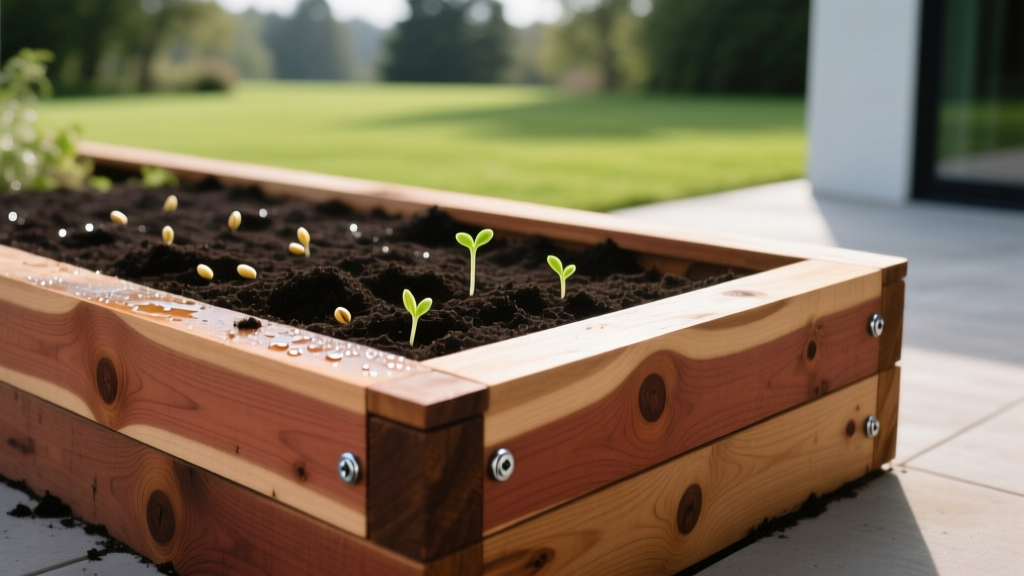
Wood selection is only half the equation. Structural failure in raised beds rarely occurs from rot alone; it usually stems from improper span engineering and fastener corrosion. Wet soil exerts immense lateral hydrostatic pressure. A standard 2x6 or 2x8 board will bow outward and split fasteners if unsupported over long spans.
Span Limits and Bracing
According to landscaping engineering guidelines referenced by University of Wisconsin-Madison Extension, structural integrity requires mid-span bracing. For beds constructed with 2-inch nominal lumber (1.5 inches actual thickness):
- Under 4 feet long: No mid-span bracing required. Corner joints are sufficient.
- 4 to 8 feet long: Drive a 2x4 wooden stake or 1.5-inch steel rebar into the ground at the exact midpoint of the long side, and screw the bed wall into this stake.
- Over 8 feet long: Install mid-span braces every 4 feet. Consider adding a cross-brace (a 2x4 spanning the width of the bed) to prevent the long walls from bowing outward in the center.
Fastener Compatibility Chart
Cedar and Redwood contain high levels of tannins and natural acids. When these react with standard zinc-plated or galvanized fasteners, they cause severe black streaking (tannin bleed) and accelerate fastener corrosion. You must select fasteners based on the wood species.
| Fastener Material | Compatibility with Cedar/Redwood | Corrosion Resistance in Wet Soil | Recommended Use Case |
|---|---|---|---|
| Standard Zinc-Plated | Poor (Causes black tannin bleed) | Poor (Fails in 2-3 years) | Do not use for garden beds |
| Hot-Dipped Galvanized (HDG) | Fair (May streak initially) | Good (Thick zinc coating) | Budget builds, treated lumber |
| Polymer/Ceramic Coated | Excellent (No chemical reaction) | Excellent (E.g., GRK RSS, Simpson SDWS) | Standard cedar/redwood beds |
| 304 Stainless Steel | Excellent (Zero bleed) | Excellent | Premium builds, coastal environments |
| 316 Marine Stainless | Excellent | Superior (Salt-air resistance) | Oceanfront properties |
Final Procurement Checklist
Before purchasing materials for your raised garden bed, verify the following specifications at the lumber yard:
- Grade Verification: Inspect the end-grain of Cedar or Redwood boards. Ensure the growth rings are tight and the board is predominantly dark heartwood, not white/yellow sapwood.
- Moisture Content: Avoid 'green' or heavily saturated lumber. Kiln-dried (KD) or heat-treated (HT) dimensional lumber will shrink less and resist immediate warping upon assembly.
- Fastener Match: Confirm your fastener box explicitly states compatibility with cedar, redwood, or treated lumber. Look for ASTM A153 (HDG) or ASTM F593 (Stainless) designations.
- Interior Liner (Optional): If using treated lumber or wanting to extend the life of cedar by preventing direct soil contact, purchase 6-mil poly sheeting and a staple gun to line the interior walls before backfilling.
Written by
James ThorntonJames Thornton is a construction industry veteran with 25 years of hands-on experience in wood framing, lumber grading, and residential building codes. He started as a framing carpenter in rural Oregon, earned his ICC Residential Building Inspector certification, and eventually became a senior plan reviewer for the City of Portland Bureau of Development Services. James holds a B.S. in Wood Science & Technology from Oregon State University and is a certified lumber grader through the West Coast Lumber Inspection Bureau (WCLIB). He has inspected over 3,000 residential construction sites and authored the city's internal guide on advanced framing techniques (2x6 at 24" O.C.). James lives in Bend, OR, where he builds custom timber-frame cabins and competes in lumberjack sports.
More from James Thornton
View all
Insulation
Best Home Insulation Materials: Complete 2026 Guide
Compare top home insulation materials for 2026. Find R-values, installed costs per square foot, and best uses for fiberglass, spray foam, and mineral wool.
Aug 4, 2026

Sustainable Building
Certify Your Green Building Material for LEED and WELL
Step-by-step guide to certifying a green building material for LEED v5 and WELL v2. Master EPDs, HPDs, and VOC limits for 2026 project specifications.
Aug 4, 2026

Stone & Masonry
Veneer Stacked Stone Panels: Interior Design & Style Showcase
Discover how veneer stacked stone panels transform interiors. Explore modern design profiles, material pairings, and technical installation specs.
Aug 4, 2026