Cost Analysis of Popular Types of Wood Fence Styles
Compare the installed costs, structural requirements, and property ROI of popular types of wood fence styles to maximize your landscaping budget.

The True Cost of Wood Fencing: Beyond the Price Tag
When evaluating fencing options, homeowners and contractors often fixate on the per-linear-foot material cost. However, the true financial footprint of a wood fence encompasses structural reinforcement, soil-specific installation labor, long-term maintenance, and ultimate property value recovery. Different configurations dictate vastly different wind loads, concrete requirements, and labor hours. Understanding the structural economics behind various designs is critical for accurate budgeting and maximizing return on investment (ROI).
Cost & Value Matrix: Comparing Types of Wood Fence Styles
The following matrix breaks down the 2026 national average costs for standard 6-foot-tall configurations, utilizing pressure-treated Southern Yellow Pine as the baseline material. Labor rates reflect a national average of $65 to $95 per hour for professional fencing crews.
| Fence Style | Material Cost (per LF) | Installed Cost (per LF) | Wind Load Profile | Expected Lifespan |
|---|---|---|---|---|
| Solid Privacy | $12 - $18 | $28 - $42 | High (Sail Effect) | 15 - 20 Years |
| Shadowbox (Board-on-Board) | $16 - $24 | $35 - $52 | Moderate (20% Pass-through) | 15 - 20 Years |
| Traditional Picket | $10 - $16 | $25 - $40 | Low (High Pass-through) | 12 - 15 Years |
| Horizontal Slat | $18 - $28 | $40 - $65 | Moderate to High | 15 - 25 Years |
| Split Rail (3-Rail) | $8 - $14 | $18 - $28 | Negligible | 20 - 30 Years |
Note: According to HomeAdvisor's Wood Fence Cost Guide, regional labor variations and site accessibility can shift these installed prices by up to 30% in either direction.
Structural & Financial Deep Dives by Style
Solid Privacy vs. Shadowbox: The Wind Load Factor
A solid privacy fence (butted pickets on one side of the rail) acts as a massive sail. In regions with sustained winds exceeding 40 mph or frequent microbursts, this "sail effect" transfers immense lateral torque to the fence posts. To prevent structural failure, solid privacy fences require deeper post holes (minimum 36 inches) and higher concrete volumes (typically 2.5 bags of 50lb fast-setting concrete per hole).
Conversely, a shadowbox style alternates pickets on both sides of the horizontal rails, creating a 1-inch gap between boards. This design allows roughly 20% to 30% of wind to pass through, drastically reducing lateral stress. While shadowbox requires roughly 30% more pickets (driving material costs up by $4 to $6 per linear foot), contractors can often reduce post-hole depth to 30 inches and use only 2 bags of concrete per hole. In high-wind coastal or plains regions, the shadowbox style actually yields a lower total lifecycle cost due to reduced structural repairs and concrete savings.
Picket & Spaced Picket: Curb Appeal Economics
Traditional picket fences (usually 3.5 to 4 feet tall) use significantly less lumber than privacy fences. However, their installed cost per linear foot remains surprisingly high. The labor intensity of measuring, marking, and aligning individual pickets with precise 2-inch to 3-inch gaps using spacer blocks slows crew progress by up to 25% compared to nailing up solid privacy panels. For modern horizontal slat fences, the cost premium is driven by the requirement for heavier, warp-resistant dimensional lumber (like 1x6 or 2x6 cedar) and the use of specialized hidden fastener systems or stainless steel face nails to prevent rust streaking.
Split Rail & Ranch: The Acreage Solution
For properties exceeding one acre, enclosing the perimeter with privacy fencing is financially prohibitive. Split rail or post-and-ranch styles utilize rough-sawn, rot-resistant timbers (often Western Red Cedar or Black Locust). The material cost is low, and the labor is highly efficient because rails are simply dropped into pre-routed mortises in the posts. A 3-rail configuration costs only about 15% more in materials than a 2-rail setup, but provides a much more finished aesthetic that contains larger dogs and clearly delineates property lines without triggering the strict height and setback restrictions often applied to solid fences by local HOAs.
Wood Species Cost Multipliers & Decay Resistance
The baseline costs above assume Pressure-Treated (PT) Southern Yellow Pine. Upgrading your wood species fundamentally alters both the upfront budget and the maintenance schedule. The USDA Forest Products Laboratory Wood Handbook categorizes heartwood decay resistance, which directly correlates to fence lifespan.
- Pressure-Treated Pine (Base Cost): Treated with copper-based preservatives (like ACQ or MCA). Highly resistant to rot and insects, but prone to warping, checking, and twisting as it dries. Requires annual sealing.
- Western Red Cedar (+40% to +55% Premium): Contains natural thujaplicins that resist fungal decay. Dimensionally stable with minimal warping. Must be stained or it will weather to a silvery gray.
- Redwood (+70% to +90% Premium): Exceptionally stable and naturally insect-resistant. Primarily sourced in the Western US; shipping premiums make it cost-prohibitive for East Coast projects.
- Tropical Hardwoods / Ipe (+200%+ Premium): Rarely used for full fence runs due to extreme weight and cost, but frequently utilized for gate frames and accent pillars where maximum structural rigidity and rot resistance are required.
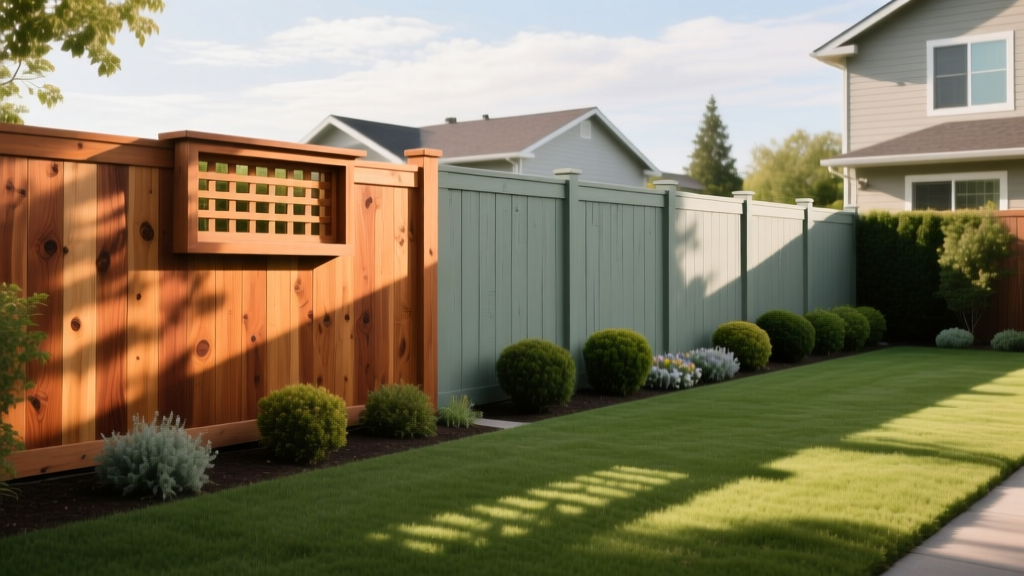
Hidden Cost Variables: Terrain and Soil Mechanics
A flat, loamy yard represents the best-case scenario for fencing contractors. Deviations from this baseline introduce compounding costs that are rarely reflected in initial per-foot estimates.
- Sloped Terrain (Stepping vs. Racking): On grades exceeding 10%, solid privacy fences must be "stepped" (installed in distinct, level descending panels), which leaves triangular gaps at the bottom that require custom lattice or masonry kickboards to close. Stepping increases labor time by 15% to 20%. Picket fences can be "racked" (parallelogrammed to follow the slope), which is faster but requires custom-cut pickets at every post.
- Expansive Clay Soils: Clay retains water and expands/contracts with freeze-thaw cycles, causing severe frost heave that pushes fence posts out of the ground. In clay-heavy regions, contractors must bell-out the bottom of the post hole and add a 6-inch base of crushed gravel for drainage, adding $3 to $5 per linear foot to the excavation labor.
- Utility Locates and Obstructions: Hand-digging around shallow irrigation lines, tree roots, or buried electrical conduits slows mechanical auger use to a halt. Expect a "hand-dig surcharge" of $50 to $85 per hole when utilities are marked within the fence line.
ROI and Property Value: Which Style Pays Off?
Fencing is one of the few exterior improvements that directly influences a property's functional utility, particularly for families with pets or children. According to data from the National Association of Realtors' Remodeling Impact Report, exterior projects that enhance outdoor living spaces consistently yield high cost recovery rates at resale.
Value Recovery Insight: A well-maintained, 6-foot cedar privacy or shadowbox fence in a suburban neighborhood typically recovers 65% to 80% of its installed cost at resale. In markets where fenced yards are a strict buyer prerequisite (due to high dog ownership rates or busy arterial roads), a premium wood fence can push past 100% cost recovery by preventing the home from stagnating on the market.
To maximize ROI, avoid overly customized or highly stylized fences (like intricate lattice-topped or multi-colored horizontal slats) that might clash with a future buyer's aesthetic preferences. Stick to classic, high-quality shadowbox or clean-line privacy designs in natural, stainable wood species. The financial sweet spot lies in balancing the moderate upfront premium of Western Red Cedar or high-grade PT Pine against the long-term savings in structural repairs and the undeniable curb appeal that drives buyer demand.
Written by
Elena RodriguezElena Rodriguez is a civil engineer and technical writer specializing in concrete technology, masonry systems, and ASTM/ACI compliance. She earned her B.S. in Civil Engineering from Texas A&M University and spent a decade at a materials testing laboratory, performing over 2,000 concrete compressive strength tests and masonry prism evaluations. Elena is an ACI-certified Field Testing Technician (Grade I) and a member of ASTM Committee C12 on Natural Building Stone. She currently consults on forensic engineering cases involving concrete failures and moisture intrusion. Based in San Antonio, TX, Elena is a proud member of the Society of Women Engineers (SWE) and coaches her daughter's FIRST Robotics team.
More from Elena Rodriguez
View all
Walls & Panels
Cost Analysis: Light Gauge Steel Framing Advantages and Disadvantages
Evaluate light gauge steel framing advantages and disadvantages through a strict cost analysis lens, comparing material, labor, and lifecycle expenses.
Aug 4, 2026

Walls & Panels
Gypsum Board Types: Exact Specifications, Thickness & Dimensions
Compare standard, Type X, and moisture-resistant gypsum board types. Get exact specifications, thicknesses, dimensions, and ASTM standards for your project.
Aug 4, 2026

Fire Resistance
Best Fire-Resistant Outdoor Decking Materials: 2026 Buyer Guide
Discover the best fire-resistant outdoor decking materials for 2026. Compare Class A PVC, aluminum, and hardwood options for WUI compliance and safety.
Aug 4, 2026