How Different Types of Wood Grain Affect Lumber Grade and Quality
An expert guide to the different types of wood grain, detailing how grain orientation impacts structural grading, machining, and hardwood selection.

Wood grain is not merely an aesthetic characteristic; it is the fundamental structural matrix that dictates a board's mechanical strength, dimensional stability, and machining behavior. For structural engineers, framers, and architectural millworkers, understanding the different types of wood grain is mandatory for ensuring code compliance, preventing structural failure, and achieving premium finishes. The orientation of wood fibers relative to the longitudinal axis of the timber directly influences load-bearing capacity, fastener withdrawal resistance, and seasonal movement.
The Anatomy of Wood Grain: Why It Dictates Lumber Grade
Wood grain refers to the longitudinal alignment of wood fibers (tracheids in softwoods, vessel elements and fibers in hardwoods). In living trees, these fibers generally grow parallel to the trunk's axis, but environmental stressors, wind, and branching cause deviations. When a log is milled, the angle at which these fibers intersect the cut surface is known as the slope of grain (SOG).
According to the American Wood Council's National Design Specification (NDS), the slope of grain is one of the most critical strength-reducing characteristics evaluated during visual and machine stress-rated (MSR) lumber grading. A deviation of just a few degrees from the longitudinal axis can drastically reduce the modulus of rupture (MOR) and modulus of elasticity (MOE), making grain analysis a cornerstone of structural quality assurance.
Classifying the Different Types of Wood Grain in Structural Timber
When evaluating the different types of wood grain in structural softwoods (like Douglas Fir-Larch or Southern Pine), inspectors categorize fiber alignment into three primary structural classifications.
1. Straight Grain (Edge and Flat)
Straight grain occurs when wood fibers run parallel to the longitudinal axis of the board. This is the ideal condition for structural framing. Edge grain (vertical grain) and flat grain (plain sawn) both exhibit straight longitudinal fibers, though their tangential and radial shrinkage rates differ. Straight-grained lumber yields the highest allowable bending stress (Fb) and shear parallel to grain (Fv) values.
2. Diagonal and Spiral Grain
Diagonal grain occurs when fibers slope uniformly across the face or edge of a board, usually due to the log being off-center in the sawmill or the tree exhibiting a natural spiral growth pattern. Spiral grain is a genetic trait where fibers twist around the trunk as the tree grows. Both types introduce cross-grain tension and compression, severely reducing the timber's resistance to bending and increasing the likelihood of twisting during kiln-drying.
3. Interlocked and Wavy Grain
Interlocked grain features fibers that alternate their spiral direction every few years of growth. While rare in structural softwoods, it is common in hardwoods like Sapele and Mahogany. Wavy grain features a short, undulating fiber pattern. Structurally, both types create localized weak points and drastically complicate machining, but they are highly prized for their decorative chatoyancy in architectural veneers.
⚠️ Critical Warning: Slope of Grain (SOG) Limits
Never use lumber with a slope of grain steeper than 1:8 (1 inch of vertical rise over 8 inches of horizontal run) for primary load-bearing beams or rafters. At a 1:4 slope, the bending strength of Southern Pine drops by over 50% compared to straight-grained stock, creating a severe risk of catastrophic shear failure under live loads.
Grain Orientation vs. NLGA / SPIB Grading Rules
Grading agencies like the National Lumber Grades Authority (NLGA) and the Southern Pine Inspection Bureau (SPIB) enforce strict slope of grain limits for visually graded dimension lumber. The table below outlines the maximum allowable SOG and the corresponding structural penalties for standard framing lumber.
| Lumber Grade | Max Allowable SOG | Approx. Bending Strength Retention | Primary Application |
|---|---|---|---|
| Select Structural | 1:16 | ~95% | Heavy trusses, engineered headers |
| No. 1 | 1:12 | ~85% | Rafters, joists, primary framing |
| No. 2 | 1:8 | ~70% | Standard wall studs, plates |
| No. 3 | 1:4 | ~45% | Blocking, bracing, temporary works |
Aesthetic Grading: Hardwood Grain Patterns for Architectural Millwork
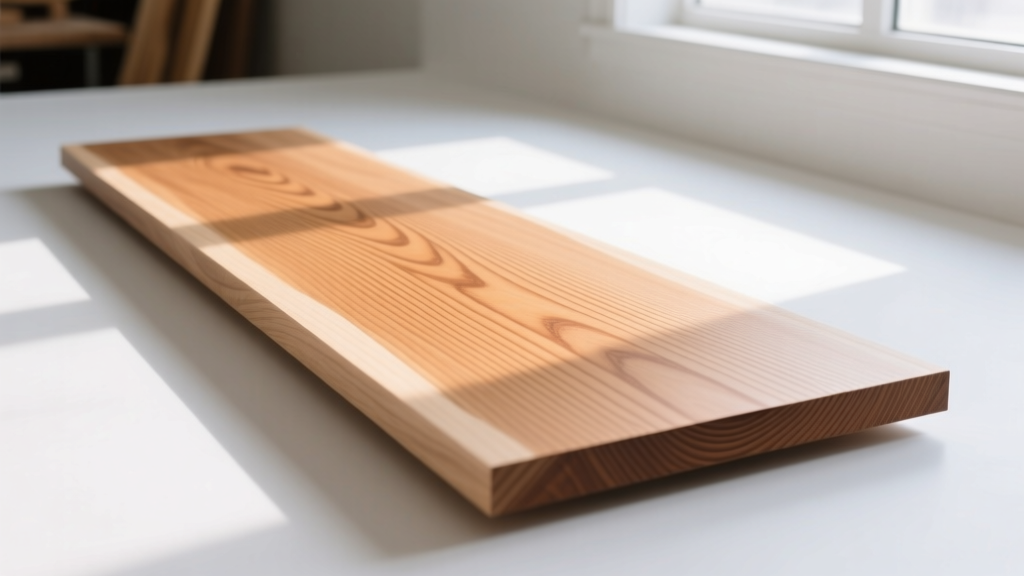
While structural grading focuses on fiber deviation, architectural millwork and flooring rely on the visual presentation of grain, dictated by how the log is sliced at the sawmill. The Wood Database highlights that sawing method directly controls the angle of the growth rings to the board face, which in turn dictates seasonal movement.
- Plain Sawn (Flat Sawn): Growth rings intersect the face at 0 to 30 degrees. Produces the classic "cathedral" grain pattern. It is the most cost-effective method but exhibits the highest tangential shrinkage (up to 8-10%), making it prone to cupping in wide panels and flooring.
- Quarter Sawn: Growth rings intersect the face at 60 to 90 degrees. Yields a straight, linear grain and exposes medullary rays (producing the prized "fleck" figure in White Oak). Radial shrinkage is roughly half that of tangential shrinkage (3-5%), providing superior dimensional stability for wide tabletops and stair treads.
- Rift Sawn: Growth rings intersect the face at 30 to 60 degrees. Produces a tight, straight grain with no cathedral pattern and no ray fleck. It offers the absolute highest dimensional stability but generates massive waste at the mill, typically adding 15% to 25% to the material cost compared to plain sawn stock.
Machining and Fastening: Adjusting for Grain Direction
The physical orientation of the grain dictates how tools and fasteners interact with the wood matrix. Ignoring grain direction during fabrication leads to compromised joints and ruined finishes.
📊 Data Highlight: Fastener Withdrawal & Tear-Out Thresholds
Withdrawal Resistance: A 10d common nail driven perpendicular to the grain (into the side of a stud) has a baseline withdrawal resistance. If driven parallel to the grain (into the end grain of a post), withdrawal resistance drops by 60% to 75%. End-grain fastening should never be relied upon for structural tension loads.
Tear-Out Thresholds: When planing boards with interlocked or wavy grain, standard straight-knife cutterheads will tear the fibers if the depth of cut exceeds 1/16". Switching to a helical (spiral) cutterhead with carbide inserts shears the wood at an angle, allowing clean surfacing of difficult grain at depths up to 1/32" per pass.
Expert Troubleshooting: Grain-Related Failure Modes in the Field
Even with properly graded lumber, misinterpreting grain behavior during installation or finishing leads to costly callbacks. Use this diagnostic matrix to identify and resolve grain-induced defects.
| Field Symptom | Grain-Related Root Cause | Expert Fix / Prevention |
|---|---|---|
| Wide hardwood panels cup severely after seasonal humidity shifts. | Flat-sawn (tangential) grain orientation; differential shrinkage between the bark side and pith side. | Specify quarter-sawn or rift-sawn lumber for panels over 5 inches wide. If using flat-sawn, rip into 3-inch strips, joint, and glue up alternating the growth ring orientation (smile/frown pattern). |
| Severe, fuzzy tear-out during final planing or routing. | Interlocked grain or localized reaction wood (compression/tension wood) causing fiber reversal. | Reduce planer depth of cut to 1/32". Lightly mist the surface with water 5 minutes before machining to soften lignin. Use a shear-cut router bit or helical planer head. |
| Lag bolts split the timber near the connection point. | Diagonal grain intersecting the edge of the timber near the end, creating a natural wedge plane. | Pre-drill clearance holes 1/16" oversized. Increase edge distance to 1.5x the standard code requirement. Apply end-grain sealer to prevent moisture ingress that exacerbates checking. |
Mastering the identification and application of wood grain patterns separates standard builders from expert craftsmen. By aligning material selection with the specific structural and aesthetic demands of the project, you ensure long-term stability, code compliance, and superior visual results.
Written by
Marcus ChenMarcus Chen is a licensed structural engineer (PE) and building materials analyst with over 12 years of experience across residential, commercial, and industrial construction. He holds a Master of Science in Civil Engineering from UC Berkeley and spent six years at Thornton Tomasetti before transitioning to independent consulting and technical writing. Marcus specializes in material selection for seismic-prone regions, concrete reinforcement strategies, and lifecycle cost analysis. His work has been cited by the American Concrete Institute (ACI) and the Structural Engineers Association of California (SEAOC). When he is not on a job site or at his desk, you will find him hiking the Sierra Nevada or restoring a 1920s craftsman bungalow in Oakland, CA.
More from Marcus Chen
View all
Construction Cost
How Much Did the Eiffel Tower Cost to Build?
How much did the Eiffel Tower cost to build in 1889? We adjust for inflation and compare its budget to modern skyscraper construction.
Aug 4, 2026

Fire Resistance
What Is a Fire Resistant Material? Testing & Certification Guide
Discover what is a fire resistant material through ASTM and UL testing. Learn how fire ratings, certifications, and assemblies work in construction.
Aug 4, 2026

Construction Cost
How Much Did the Burj Khalifa Cost to Build?
How much did the Burj Khalifa cost to build? We break down the $1.5B project and extract 5 money-saving strategies for your next build.
Jul 30, 2026