Preservation Guide for Types of Common Wood in Construction
Master the preservation of different types of common wood. Learn pressure treatment protocols, AWPA standards, and fastener compatibility for modern builds.

Understanding Wood Treatability and Natural Decay Resistance
When evaluating the types of common wood used in structural framing, exterior cladding, and ground-contact applications, a one-size-fits-all approach to preservation guarantees premature failure. Wood preservation is not merely about applying chemicals; it is about matching the cellular anatomy of specific timber species with the correct preservative chemistry and penetration method. Understanding how different types of common wood interact with preservative chemicals is the difference between a 15-year deck and a 50-year structural timber frame.
The American Wood Protection Association (AWPA) categorizes wood preservation requirements based on Use Categories (UC), ranging from UC1 (interior, dry) to UC4C (heavy ground contact). However, the ability of a wood species to achieve the required preservative retention levels—measured in pounds per cubic foot (pcf)—varies drastically based on its heartwood-to-sapwood ratio and pit structure.
Species Treatability and Natural Durability Matrix
| Wood Species | Natural Decay Resistance (Heartwood) | Pressure Treatability | Incising Required? | Primary AWPA Use Category |
|---|---|---|---|---|
| Southern Yellow Pine (SYP) | Low | Excellent (Deep penetration) | No | UC4A / UC4B (Ground Contact) |
| Douglas Fir | Moderate | Difficult (Closed pits) | Yes (Mandatory for UC4A) | UC3B / UC4A (If incised) |
| Spruce-Pine-Fir (SPF) | Low | Moderate to Difficult | Yes (For structural ground contact) | UC2 / UC3A (Above ground) |
| Western Red Cedar | High | Poor (Extractives block penetration) | N/A (Rarely pressure treated) | UC3B (Above ground, natural) |
| Redwood | High | Poor | N/A | UC3B (Above ground, natural) |
Pressure Treatment Protocols by Wood Species
Southern Yellow Pine (SYP): The Treatment Champion
Southern Yellow Pine dominates the pressure-treated lumber market because its anatomical structure features open bordered pits in the sapwood, allowing preservative solutions to penetrate deeply and uniformly. For ground-contact applications (AWPA UC4A), SYP must achieve a minimum retention level of 0.25 pcf when treated with Micronized Copper Azole (MCA) or 0.25 pcf for Alkaline Copper Quaternary (ACQ). The preservative effectively transforms the highly susceptible sapwood into a biocidal barrier against Formosan subterranean termites and brown-rot fungi.
Douglas Fir and Hem-Fir: The Incising Requirement
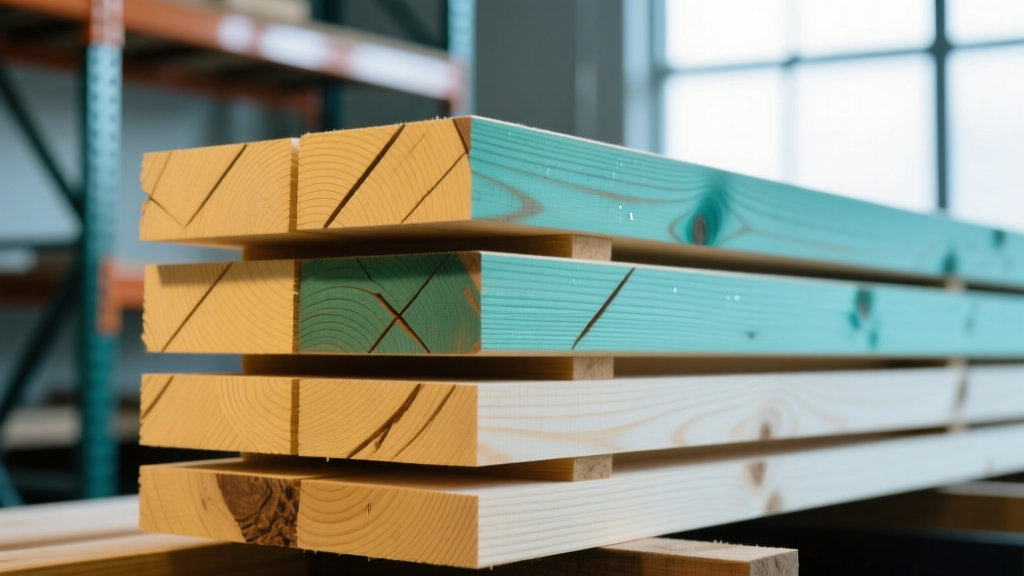
Douglas Fir possesses a closed-cell structure; during the drying process, the bordered pits aspirate (seal shut), effectively locking preservative chemicals out of the heartwood and limiting sapwood penetration to a mere 1/16 of an inch. To meet AWPA U1 standards for UC4A ground contact, Douglas Fir lumber must be mechanically incised before treatment.
Incising involves passing the lumber through rollers equipped with teeth that create slits typically 3/8-inch to 1/2-inch deep, at a density of at least 11 incisions per square foot. This mechanical bypass forces the copper-based preservatives into the wood matrix. Builder Warning: Never use non-incised Douglas Fir for ground contact or concrete embedment, even if it bears a treatment stamp. If the stamp does not explicitly state "INCISED," it is only rated for above-ground use (UC3B).
Western Red Cedar and Redwood: Preserving Natural Tannins
Cedar and Redwood rely on natural extractives (tannins, thujaplicins, and phenols) for decay resistance rather than synthetic biocides. Pressure treating these species is generally avoided because the chemicals fail to penetrate the heartwood and can strip the natural oils that provide dimensional stability. Preservation for these woods focuses on moisture management and UV protection.
- Initial Weathering: Allow new Cedar or Redwood to weather for 30 to 45 days to open the wood pores and allow surface extractives to leach.
- Finish Selection: Use penetrating alkyd-oil or modified oil-based finishes (e.g., TWP 1500 Series or Cabot Australian Timber Oil) rather than film-forming acrylics, which will peel and trap moisture against the wood grain.
- Reapplication Cycle: Horizontal surfaces (decks) require re-oiling every 18 to 24 months, while vertical surfaces (siding) can go 4 to 6 years.
⚠️ Fastener Compatibility Warning
Modern copper-based preservatives (ACQ, CA-C, MCA) are highly corrosive to standard zinc and aluminum. When fastening treated SYP or incised Douglas Fir, you must use ASTM A153 Class D hot-dip galvanized (HDG) steel or Type 316 stainless steel. Electroplated zinc (bright silver nails) will corrode completely within 3 to 5 years when in contact with ACQ-treated wood, leading to catastrophic structural withdrawal failures.
Interior Framing and Borate Treatments
For interior framing in high-risk termite zones (such as the US Gulf Coast), builders are increasingly turning to borate-treated wood. According to the Environmental Protection Agency (EPA), borates are highly effective against termites and wood-destroying beetles while maintaining low mammalian toxicity.
Borate treatments (Disodium Octaborate Tetrahydrate) are water-diffusible. This means they can be applied to standing timber or raw framing via spray or brush, provided the wood moisture content is above 19%. The borate diffuses inward with the water as the wood dries. Products like Bora-Care or Tim-bor are standard for field-treating interior sill plates and rim joists. However, borates are strictly for UC1 and UC2 (interior, protected from weather) applications; if borate-treated wood gets wet, the preservative will leach out entirely.
Field-Applied Preservatives: Managing End-Cuts and Notches
A critical failure point in modern construction is the failure to field-treat cut ends of pressure-treated lumber. The AWPA mandates that any field cut, drilled hole, or routed notch in pressure-treated wood must be treated on-site to restore the biocidal envelope. The American Wood Protection Association standards explicitly outline the protocols for this remediation.
Step-by-Step Field Treatment Protocol
- Select the Right Chemistry: Use Copper Naphthenate (minimum 2% copper concentration) for ground contact cuts, or Copper Azole (e.g., Wolmanized) for above-ground cuts. Avoid zinc-based or clear water-repellent sprays for structural end-grain.
- Prep the Surface: Brush away sawdust from the end-grain. Do not sand the cut, as this closes the wood pores.
- Apply to Refusal: Liberally brush or spray the preservative onto the exposed end-grain. End-grain acts like a bundle of straws, wicking the chemical deep into the board.
- The Two-Coat Rule: Apply the first coat and wait 15 to 20 minutes. Apply a second coat. The wood must absorb the chemical until it reaches "refusal" (the point where it no longer absorbs the liquid and it begins to pool on the surface).
Troubleshooting Common Preservation Failures
Even with properly treated types of common wood, environmental and mechanical factors can compromise the preservation system. Below is a diagnostic framework for common field issues:
- Symptom: Deep longitudinal checking (cracking) on treated deck boards.
Cause: Rapid moisture loss post-treatment. Pressure-treated wood is saturated; if installed and immediately exposed to direct summer sun, the surface dries and shrinks faster than the wet core.
Fix: Apply a penetrating water-repellent sealer within 30 days of installation to slow the drying rate. Ensure boards are fastened with two screws per joist to restrict warp-induced checking. - Symptom: White, powdery residue on the surface of treated framing.
Cause: This is "blooming," a harmless reaction where unreacted amine carriers in ACQ or MCA treatments migrate to the surface and react with atmospheric carbon dioxide.
Fix: No structural action needed. Brush it off before installing vapor barriers or insulation to prevent moisture trapping. - Symptom: Black staining around fastener heads on Cedar or Redwood.
Cause: Iron reacting with the natural tannins in the wood, creating iron tannate.
Fix: Extract the standard steel fasteners and replace with Type 304 or 316 stainless steel. Clean existing stains with an oxalic acid-based wood brightener.
For comprehensive data on wood decay and structural degradation mechanics, the USDA Forest Products Laboratory provides extensive empirical research on how varying moisture contents and preservative retentions impact the long-term load-bearing capacity of timber. By aligning the specific anatomical traits of your chosen wood species with the correct chemical and mechanical preservation protocols, you ensure structural longevity that meets both code requirements and lifecycle expectations.
Written by
James ThorntonJames Thornton is a construction industry veteran with 25 years of hands-on experience in wood framing, lumber grading, and residential building codes. He started as a framing carpenter in rural Oregon, earned his ICC Residential Building Inspector certification, and eventually became a senior plan reviewer for the City of Portland Bureau of Development Services. James holds a B.S. in Wood Science & Technology from Oregon State University and is a certified lumber grader through the West Coast Lumber Inspection Bureau (WCLIB). He has inspected over 3,000 residential construction sites and authored the city's internal guide on advanced framing techniques (2x6 at 24" O.C.). James lives in Bend, OR, where he builds custom timber-frame cabins and competes in lumberjack sports.
More from James Thornton
View all
Insulation
Best Home Insulation Materials: Complete 2026 Guide
Compare top home insulation materials for 2026. Find R-values, installed costs per square foot, and best uses for fiberglass, spray foam, and mineral wool.
Aug 4, 2026

Sustainable Building
Certify Your Green Building Material for LEED and WELL
Step-by-step guide to certifying a green building material for LEED v5 and WELL v2. Master EPDs, HPDs, and VOC limits for 2026 project specifications.
Aug 4, 2026

Stone & Masonry
Veneer Stacked Stone Panels: Interior Design & Style Showcase
Discover how veneer stacked stone panels transform interiors. Explore modern design profiles, material pairings, and technical installation specs.
Aug 4, 2026