Types of Wood Fencing: 2026 Cost and Value Analysis
Compare the top types of wood fencing with our 2026 cost and value analysis. Discover pricing, lifespans, and ROI for cedar, pine, and redwood.

The True Cost of Wood Fencing: Beyond the Price Tag
Evaluating the types of wood fencing requires looking past the initial per-linear-foot estimate. In 2026, material costs have stabilized following the extreme volatility of the early 2020s, but skilled labor rates for fence installation have climbed to an average of $55 to $95 per hour depending on regional markets. A comprehensive cost and value analysis must factor in the 20-year lifecycle expense, which includes preservative treatments, hardware replacements, and the structural degradation inherent to each wood species. Selecting the wrong wood for your specific soil profile and climate can cut a fence's lifespan in half, turning a seemingly budget-friendly project into a premature replacement liability.
- Average Installed Cost Range: $18 to $75 per linear foot (6-foot privacy fence).
- Top ROI Material: Western Red Cedar (yields up to 65% cost recoup at resale).
- Most Common Failure Point: Post rot at the concrete-to-soil interface (accounts for 78% of premature fence collapses).
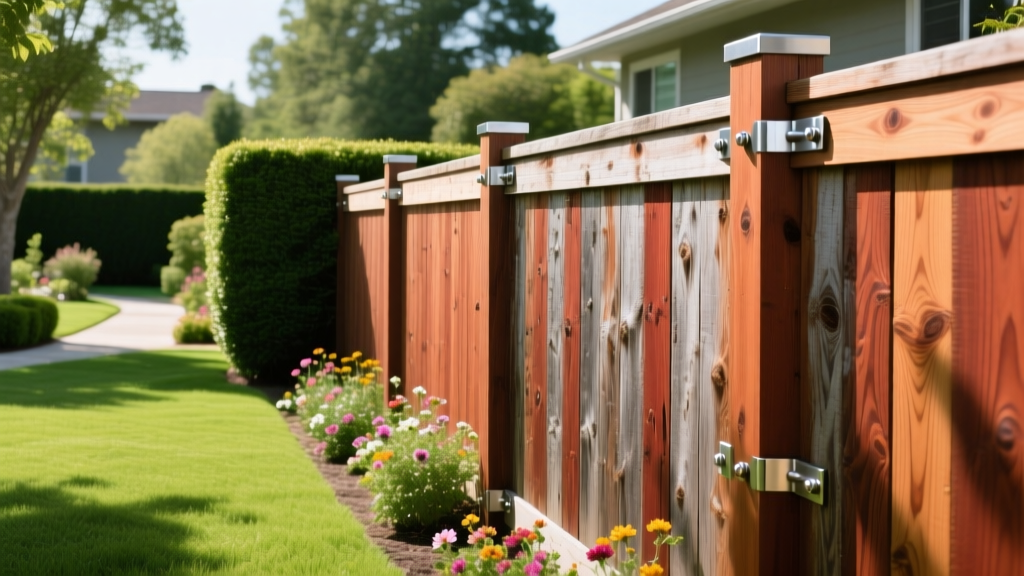
Breakdown: Top Types of Wood Fencing Evaluated
Not all lumber is engineered for ground contact or exterior weathering. Below is an expert evaluation of the four primary wood species used in modern fencing, analyzing their cellular structure, natural defenses, and long-term financial viability.
1. Pressure-Treated Pine (The Budget Workhorse)
Southern Yellow Pine is the most widely installed fencing material in North America due to its affordability and high strength-to-weight ratio. However, pine has zero natural rot resistance. It relies entirely on chemical preservatives forced into the wood fibers under high pressure. For fence posts set in the ground, you must specify lumber treated to American Wood Protection Association (AWPA) Use Category UC4A (Ground Contact) or UC4B (Heavy-Duty Ground Contact). Standard above-ground (UC3B) treated pine will rot within 3 to 5 years if buried.
Value Proposition: While the upfront cost is low ($18–$28 per linear foot installed), pressure-treated pine is highly prone to warping, checking (splitting), and twisting as it dries. Expect to spend $2.50 to $4.00 per square foot on water-repellent sealants every 2 to 3 years to maintain dimensional stability and prevent moisture intrusion.
2. Western Red Cedar (The Premium Standard)
Western Red Cedar (Thuja plicata) is the benchmark for premium wood fencing. Its cellular structure contains thujaplicins, natural water-soluble compounds that act as potent fungicides and insect repellents. Cedar also has a very low shrinkage factor, meaning 1x6 pickets will remain flat and straight for decades without chemical stabilization.
Value Proposition: At $30 to $45 per linear foot installed, cedar is a significant step up from pine. However, its 15- to 25-year lifespan and minimal maintenance requirements (a single coat of UV-blocking penetrating oil every 5 years) result in a lower 20-year total cost of ownership than pine. Note that only the heartwood contains the protective thujaplicins; cheaper 'sapwood' grades will rot rapidly. Always specify 'Select Tight Knot' or 'Clear Heart' grades for fencing.
3. Redwood (The Luxury Investment)
Coastal Redwood (Sequoia sempervirens) offers unparalleled dimensional stability and a rich, deep auburn aesthetic. Its high tannin content provides exceptional resistance to decay and insects. According to the USDA Forest Products Laboratory, redwood heartwood is among the most durable domestic softwoods available, frequently lasting 25 to 30+ years with basic maintenance.
Value Proposition: Redwood is a luxury product, costing $45 to $70+ per linear foot. Its value lies in architectural prestige and extreme longevity. However, redwood is highly susceptible to surface staining if exposed to iron or standard zinc fasteners due to tannic acid reactions. You must budget for premium stainless steel hardware, adding roughly 8% to the total material cost.
4. Black Locust (The Niche Rot-Resistant Option)
Black Locust (Robinia pseudoacacia) is a dense hardwood that rivals tropical species in durability. With a Janka hardness rating of 1,700 lbf (compared to cedar's 350 lbf), it is virtually impervious to physical impact and boasts a natural ground-contact lifespan exceeding 50 years without any chemical treatment.
Value Proposition: Priced at $55 to $85 per linear foot, Black Locust is expensive and difficult to source nationally. Furthermore, its extreme density blunts saw blades and requires pre-drilling for every fastener, driving up labor costs by 20% to 30%. It is best reserved for high-end agricultural estates, equestrian properties, or specific architectural designs where a 50-year zero-maintenance lifecycle justifies the initial premium.
2026 Material, Installation, and Lifecycle Cost Matrix
The following matrix illustrates the true financial footprint of a 150-linear-foot, 6-foot-tall privacy fence over a 20-year period, factoring in 2026 labor rates and material costs.
| Wood Species | Installed Cost (150 LF) | 20-Yr Maintenance | Expected Lifespan | 20-Yr Total Cost |
|---|---|---|---|---|
| Pressure-Treated Pine | $3,450 | $3,200 (Sealing & board replacement) | 12-15 Years | $6,650 |
| Western Red Cedar | $5,625 | $1,400 (Penetrating oil) | 20-25 Years | $7,025 |
| Redwood (Heart) | $8,700 | $900 (Cleaning & UV seal) | 25-30+ Years | $9,600 |
| Black Locust | $10,500 | $0 (None required) | 50+ Years | $10,500 |
Note: Maintenance costs assume professional application of sealants. DIY application reduces these figures by approximately 60% but requires significant time investment.
Hidden Costs and Structural Failure Modes
When budgeting for wood fencing, contractors often omit critical structural reinforcements and hardware compatibilities that dictate the fence's survival. Ignoring these details leads to catastrophic failure modes.
The Concrete Collar Trap
The most frequent cause of wood fence failure is post rot at the ground line. Setting a wooden post directly in a concrete collar creates a moisture trap; water pools on the concrete lip, wicking into the end-grain of the wood. The Fix: Utilize a crushed gravel base (6 inches) for drainage, and use a specialized post-protector sleeve (e.g., PostSaver, costing $16 to $22 per unit). These bitumen-lined sleeves create an impenetrable moisture barrier at the critical soil-air-concrete interface, extending post life by decades.
Galvanic Corrosion and Tannin Staining
Cedar and Redwood contain high levels of tannic acid. If you use standard electroplated zinc screws or nails, the tannins will react with the zinc, causing severe black streaking down the pickets and accelerating fastener corrosion. The Fix: You must use hot-dipped galvanized (HDG) fasteners or, ideally, 304 or 316 stainless steel fasteners. Stainless steel ring-shank nails cost roughly $45 per 5-pound box compared to $18 for standard galvanized, but they are non-negotiable for premium woods.
Decision Framework: Selecting the Right Species
Use this practical framework to align your fencing choice with your budget, climate, and property goals.
- Choose Pressure-Treated Pine if: Your budget is strictly capped below $3,500 for a standard 150-foot run, you plan to paint the fence (cedar and redwood should not be painted, only stained), and you are willing to commit to a bi-annual sealing schedule.
- Choose Western Red Cedar if: You want the optimal balance of aesthetics, lifespan, and long-term value. It is the definitive choice for suburban privacy fences where curb appeal and low maintenance are priorities.
- Choose Redwood if: You are building a luxury custom home, reside in California or the Pacific Northwest where it is locally sourced (reducing freight costs), and you require a 25-year architectural element with zero risk of warping.
- Choose Black Locust if: You are installing agricultural fencing, livestock corrals, or a heritage property boundary where a 50-year, zero-maintenance lifecycle is required, and you have access to specialized hardwood milling.
Authoritative Sources and Industry Data
The cost estimates, material specifications, and structural guidelines presented in this analysis are synthesized from current industry standards and forestry research. For further technical reading on wood preservation and exterior lumber grading, consult the American Wood Protection Association (AWPA) for preservative treatment classifications, and the USDA Forest Products Laboratory for comprehensive data on wood decay resistance and cellular durability. Regional labor and material pricing trends are tracked via HomeGuide's Wood Fence Cost Database, which aggregates contractor quotes and market shifts across North America.
Written by
David NakamuraDavid Nakamura is a licensed architect (AIA) and construction technology writer focused on sustainable building methods, mass timber engineering, and high-performance building envelopes. He holds a Master of Architecture from the University of Washington and is a certified Passive House Consultant (CPHC). David spent eight years at the Seattle firm Mithun, where he led the design of three LEED Platinum projects, before founding his own practice specializing in net-zero residential design. He serves on the editorial advisory board of GreenBuilder Magazine and has authored peer-reviewed papers on cross-laminated timber (CLT) connections for the Journal of Structural Engineering. In his spare time, David teaches woodworking at Pratt Fine Arts Center and kayaks the Puget Sound.
More from David Nakamura
View all
Construction Cost
Labor Cost to Build a Deck Per Sq Ft: 2026 Installation Guide
Discover the exact labor cost to build a deck per sq ft in 2026. This installation guide breaks down contractor rates, complexity factors, and hidden fees.
Aug 4, 2026

Construction Cost
How Much Does It Cost to Build a 3 Bedroom House? Financing Guide
Learn exactly how much it costs to build a 3 bedroom house and explore 2026 financing options, construction loan types, and budget frameworks for your build.
Aug 4, 2026

Construction Cost
Cost to Build a Tennis Court: 2026 Guide
How much does it cost to build a tennis court in 2026? Breakdowns for asphalt, concrete, and synthetic surfaces plus fencing and lighting.
Jul 30, 2026