White Oak Floors: Janka Ratings, Moisture Specs & Durability Data
Analyze white oak floors performance ratings, Janka hardness, moisture specs, and grading standards to ensure lasting durability.
Core Mechanical & Physical Properties
White oak (Quercus alba) serves as the industry baseline for hardwood flooring performance. When specifying white oak floors for high-traffic residential or commercial builds, understanding its exact mechanical thresholds is critical for predicting dent resistance, load-bearing capacity, and long-term wear. According to comprehensive testing data from The Wood Database, white oak exhibits a specific gravity and hardness profile that outperforms many domestic alternatives.
| Performance Metric | White Oak Specification | Industry Benchmark (Red Oak) |
|---|---|---|
| Janka Hardness | 1,360 lbf (6,050 N) | 1,290 lbf |
| Specific Gravity (12% MC) | 0.68 | 0.63 |
| Modulus of Rupture (MOR) | 15,230 lbf/in² (105.0 MPa) | 14,380 lbf/in² |
| Elastic Modulus (MOE) | 1.78 x 10⁶ lbf/in² (12.28 GPa) | 1.82 x 10⁶ lbf/in² |
| Crushing Strength | 7,440 lbf/in² (51.3 MPa) | 6,760 lbf/in² |
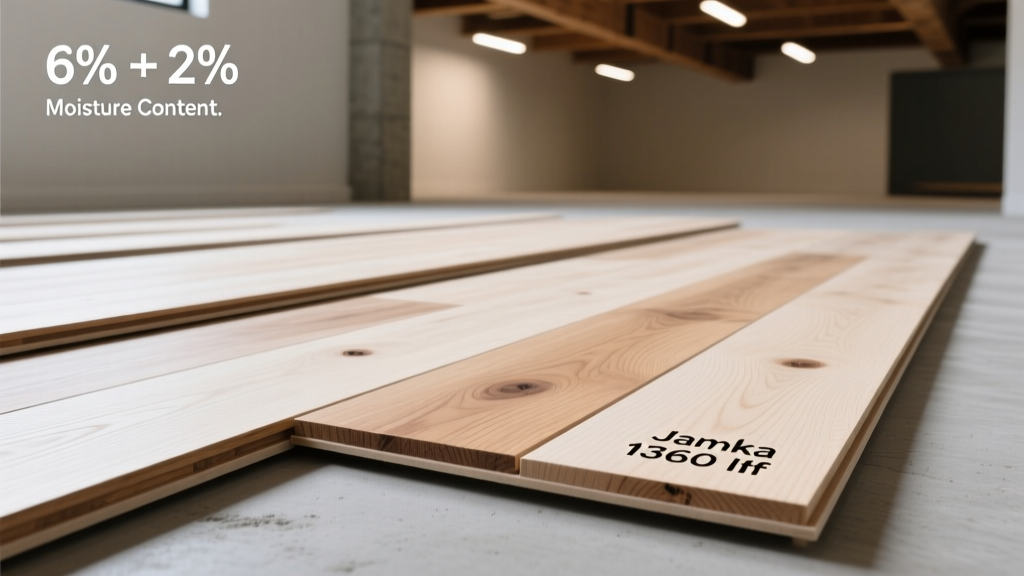
The 1,360 lbf Janka rating indicates the force required to embed a 0.444-inch steel ball halfway into the wood. In practical terms, white oak floors will resist denting from standard foot traffic and dropped household items (like a 3 lb cast iron pan dropped from waist height) better than black walnut (1,010 lbf) or cherry (950 lbf), though it remains slightly more susceptible to heavy point-loads than hard maple (1,450 lbf).
Dimensional Stability & Moisture Dynamics
The most critical performance advantage of white oak over red oak lies in its cellular structure. White oak contains tyloses—membranous growths that plug the cellular pores, rendering the heartwood virtually impervious to liquid penetration. This closed-pore structure makes white oak floors highly resistant to water ingress, making them a viable specification for kitchens, mudrooms, and powder rooms where red oak would rapidly wick moisture and stain.
Shrinkage & T/R Ratio Analysis
Dimensional stability is dictated by the Tangential-to-Radial (T/R) shrinkage ratio. A lower ratio indicates more uniform shrinkage, reducing the tendency to cup or warp.
- Radial Shrinkage: 5.6%
- Tangential Shrinkage: 10.5%
- Volumetric Shrinkage: 16.5%
- T/R Ratio: 1.9
A T/R ratio of 1.9 is exceptionally favorable for hardwood flooring. Because the tangential shrinkage is less than double the radial shrinkage, quarter-sawn and rift-sawn white oak planks exhibit near-zero cupping and minimal seasonal gapping compared to plain-sawn variants.
Solid vs. Engineered White Oak Specifications
As of 2026, engineered white oak floors dominate the market for wide-plank installations (over 5 inches) due to superior dimensional stability over radiant heat and concrete subfloors. Below is the structural comparison for procurement specifications.
| Specification Parameter | Solid White Oak | Engineered White Oak |
|---|---|---|
| Standard Thickness | 3/4" (19mm) | 5/8" (15mm) or 3/4" (19mm) |
| Maximum Recommended Width | 4" to 5" (without face-nailing) | 7" to 10" (depending on core) |
| Wear Layer Thickness | 5/16" (sandable 4-6 times) | 3mm to 6mm (sandable 2-4 times) |
| Core Construction | Solid Sawn Lumber | 9-ply to 11-ply Baltic Birch Cross-Banded |
| Subfloor Compatibility | Plywood/OSB (Wood joists) | Wood, Concrete (with vapor barrier), Radiant Heat |
NWFA Grading Standards & Visual Tolerances
The National Wood Flooring Association (NWFA) and NOFMA establish strict grading rules for white oak. Specifying the correct grade ensures the visual performance aligns with the architectural intent without compromising structural integrity.
- Clear Grade: Heartwood only. Minimum 95% clear of visual defects. No sapwood permitted. Knots limited to 1/4" diameter. Yields the most uniform, contemporary aesthetic but commands a 30-40% price premium.
- Select Grade: Allows up to 15% sapwood. Minor color variations and small pin knots (up to 1/2") are permitted. The standard for high-end residential builds seeking a clean look with natural character.
- #1 Common: Permits unlimited sapwood and heartwood mixing. Open knots up to 1", mineral streaks, and moderate color variation. Ideal for rustic or transitional designs.
- #2 Common (Tavern/Cabin): Highly rustic. Permits large open knots (up to 2"), deep mineral streaks, and significant wormholes. Requires epoxy filling during manufacturing to maintain a flat, splinter-free surface.
Finish Performance & Abrasion Ratings
The factory-applied or site-applied finish dictates the actual surface wear performance of white oak floors. Modern finish chemistry has evolved significantly, offering distinct performance profiles based on traffic loads.
UV-Cured Aluminum Oxide (Urethane)
Standard for pre-finished engineered white oak. These finishes incorporate microscopic aluminum oxide particles suspended in a urethane matrix, cured via ultraviolet light. They typically achieve a Taber Abrasion rating of 2,000 to 4,000 cycles before wearing through to the wood. They offer high scratch resistance but cannot be spot-repaired; deep scratches require a full screen-and-recoat.
Hardwax Oils (e.g., Rubio Monocoat, Osmo)
Penetrating finishes that bond with the cellulose in the top 1-2mm of the white oak. While their initial Taber abrasion resistance is lower than aluminum oxide, they offer a critical performance advantage: infinite spot-repairability. In high-traffic commercial applications or homes with large dogs, hardwax oils allow facility managers to buff out localized wear patterns and reapply oil without sanding the entire floor, drastically reducing lifetime maintenance costs.
Subfloor Tolerance & Fastening Specifications
Even the highest-grade white oak will fail if installation tolerances are ignored. Adhere to these strict parameters during the rough-in and installation phases:
- Moisture Testing: Subfloor moisture content (MC) must be within 2% to 4% of the white oak flooring MC. Use a pin-type moisture meter for wood subfloors and a calcium chloride test (MVER ≤ 3 lbs/1,000 sq ft/24 hrs) for concrete.
- Flatness Tolerance: The subfloor must not deviate more than 3/16" over a 10-foot radius or 1/8" over a 6-foot radius. Grind high spots in concrete and shim low spots in plywood.
- Fastener Schedule (Solid 3/4"): Use 16-gauge, 1.5" to 2" flooring cleats or staples. Fasten 1" to 2" from the ends of each board, and space fasteners every 8" to 10" along the tongue. Blind-nail at a 45-degree angle.
- Expansion Gap: Maintain a strict 1/2" expansion gap at all vertical obstructions (walls, pipes, cabinets) to accommodate the 10.5% tangential shrinkage/swelling potential during seasonal humidity shifts.