Selection Framework: Matching Types of Screws for Wood Projects
Master our 4-pillar selection framework for choosing the right types of screws for wood. Compare structural, decking, and finish screws for modern builds.
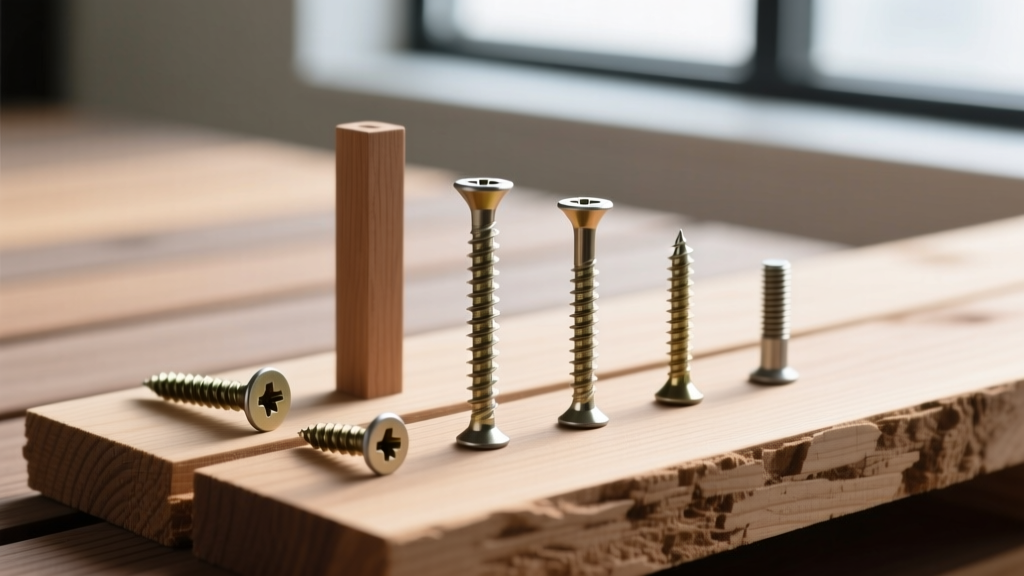
The Mechanics of Wood Fastening
Wood is an anisotropic, hygroscopic material. Its cellular structure means that fasteners behave entirely differently depending on grain orientation, species density (Janka rating), and ambient moisture content. Selecting the correct hardware is not merely about length and diameter; it requires matching the fastener's thread geometry, metallurgy, and head style to the specific mechanical and environmental demands of the joint. When evaluating the various types of screws for wood, professionals rely on a structured selection framework to prevent catastrophic shear failures, withdrawal creep, and accelerated corrosion.
The 4-Pillar Wood Screw Selection Matrix
To systematically choose the right fastener, evaluate your project against these four pillars:
1. Wood Density and Moisture Content
Softwoods (SPF, Cedar) allow aggressive, wide-pitch threads to bite deeply without pre-drilling. Hardwoods (Oak, Ipe, Hickory) require narrower thread pitches and often demand pre-drilled pilot holes to prevent the screw shank from snapping under torsional stress. Furthermore, green or pressure-treated lumber (moisture content >19%) will shrink as it cures, which can cause fasteners to lose withdrawal resistance if the thread length does not adequately penetrate the receiving member.
2. Load Type: Shear vs. Withdrawal
Lateral (shear) loads rely on the root diameter of the screw shank and the bearing strength of the wood fibers. Axial (withdrawal) loads rely on the thread pitch, thread depth, and the length of the threaded portion embedded in the receiving member. The USDA Forest Products Laboratory Wood Handbook provides exact withdrawal formulas, noting that screws inserted into the end grain of wood hold only 75% of the load capacity compared to side-grain insertion.
3. Corrosion and Tannin Environment
Modern wood treatments (ACQ, MCQ) and naturally acidic species (Cedar, Redwood) act as electrolytes that rapidly degrade standard zinc coatings. Selecting the wrong metallurgy leads to galvanic corrosion, staining, and eventual joint failure.
4. Head Style and Drive Geometry
Torx (Star) drives transfer torque significantly better than Phillips, reducing cam-out and allowing the driver to fully seat the head without stripping. Head styles dictate clamping force: washer heads distribute load over a wider area for structural framing, while flat/trim heads sink flush for finish carpentry.
Categorizing Types of Screws for Wood by Application
Structural Timber and Framing (Heavy Duty)
Structural screws replace traditional hex-head lag bolts, eliminating the need for pre-drilling while offering higher shear strength per pound.
- GRK RSS (Rugged Structural Screws): Feature a built-in washer head and a W-Cut thread that reduces driving torque by up to 50%. Ideal for ledger boards and beam hangers.
- Simpson Strong-Drive SDWS: Engineered specifically to meet IBC/IRC code requirements for joist hangers and shear walls. The 0.25" diameter #10 and #12 variants offer shear capacities ranging from 400 to 650 lbs depending on the wood species.
Decking and Exterior Cladding (Corrosion Resistance)
Exterior applications demand UV-stable coatings or stainless steel alloys.
- Polymer-Coated Carbon Steel: Screws like the Simpson Strong-Tie Quik Drive systems use proprietary ceramic/polymer coatings that resist ACQ and MCQ treatments without the cost of stainless steel.
- 305/316 Stainless Steel: Mandatory for coastal salt-air environments and highly acidic woods like Ipe and Cedar. 316 alloy provides superior molybdenum content to resist pitting from chlorides.
- Hidden Fasteners: Systems like CAMO drive screws at a 23-degree angle through the deck board edge, leaving the surface completely free of fastener heads.
Finish Carpentry and Trim (Aesthetics)
Finish screws prioritize minimal wood displacement to prevent splitting MDF or delicate trim profiles.
- GRK Finish Trim Screws: Feature a micro-head (approx. 0.25" diameter) that leaves a hole barely larger than a nail set. The Type 17 auger point clears sawdust from the hole, preventing the wood from bulging around the entry point.
Cabinetry and Particleboard (Thread Design)
Engineered woods lack the long cellulose fibers of solid timber, requiring specialized thread geometries.
- Confirmat Screws: Feature an ultra-wide, blunt thread pitch designed specifically to cut into particleboard and MDF without stripping the core.

Material Compatibility and Corrosion Matrix
Matching the screw coating to the wood treatment is non-negotiable for exterior longevity. Refer to Simpson Strong-Tie wood fastener technical guides for exact code compliance regarding galvanic corrosion.
| Wood Material / Treatment | Required Fastener Coating / Alloy | Failure Mode if Mismatched |
|---|---|---|
| Untreated Interior Pine/SPF | Standard Zinc or Clear Ceramic | None (Low risk) |
| ACQ / MCQ Pressure Treated | G185 Hot-Dipped Galvanized or Polymer | Rapid zinc depletion, shank snapping |
| Cedar / Redwood (Untreated) | 305 Stainless Steel or Polymer | Black tannin bleed streaks, surface rust |
| Coastal / Saltwater Exposure | 316 Stainless Steel | Severe pitting, hydrogen embrittlement |
| Fire-Retardant Treated (FRT) | 316 Stainless Steel or Hot-Dipped Galv | Chemical corrosion from FRT salts |
Failure Modes and Edge Cases
When joining two pieces of wood, the threads can bite into the top board and bottom board simultaneously, acting like a jackscrew and pushing the boards apart. Always use screws with a smooth, unthreaded shank section directly beneath the head, or use screws with serrated cutting threads under the head (like GRK's patented design) to sever the top fibers and allow the head to pull the boards tight.
Edge Case 1: Snapping in High-Density Hardwoods
Driving a standard #10 structural screw into 2-inch thick White Oak or Cumaru often results in torsional failure (the head twists off the shank). Fix: Pre-drill a pilot hole. The pilot hole diameter should match the root diameter (the solid core of the screw, excluding the threads), typically about 70% of the total shank diameter for hardwoods. Always use a Type 17 auger point screw to actively evacuate sawdust; trapped dust creates hydraulic pressure that splits the wood.
Edge Case 2: Withdrawal Creep in Green Timber
Timber framing with green Douglas Fir (moisture content 25%+) will shrink radially as it dries over the first 18 months. If a screw's threaded portion spans across the glue-line or joint-line of two members, the shrinkage will open a gap, and the screw will act as a cantilever, drastically reducing its shear capacity. Fix: Ensure the transition point between the threaded and unthreaded shank falls exactly at the joint line, allowing the unthreaded shank to bear the shear load while the threads grip only the receiving member.
Quick-Reference Decision Flowchart
Use this logical sequence to finalize your hardware selection on the job site:
- Is the connection load-bearing (structural)?
- Yes: Select a structural screw (GRK RSS, Simpson SDWS) with a published ICC-ES evaluation report. Ensure the unthreaded shank spans the shear plane.
- No: Proceed to step 2.
- Is the application exterior or exposed to high humidity?
- Yes: Identify the wood treatment. Use G185 or Polymer for treated pine; use 305/316 SS for Cedar, Redwood, or coastal zones.
- No: Standard zinc or ceramic-coated interior screws are sufficient.
- Is the wood species a high-density hardwood (Janka > 1,500 lbf)?
- Yes: Mandate pre-drilling to 70% of shank diameter. Use T-Star/Torx drives exclusively to handle the increased driving torque without cam-out.
- No: Self-drilling Type 17 points are acceptable.
- Is a flush, paintable finish required?
- Yes: Select a flat-head or trim-head screw with nibs under the head to score the wood fibers for a clean countersink.
- No: Washer or pan-head screws provide superior surface clamping force.
By treating fastener selection as an engineered system rather than an afterthought, builders eliminate structural vulnerabilities, prevent costly material damage, and ensure the longevity of the wood assembly.
Written by
David NakamuraDavid Nakamura is a licensed architect (AIA) and construction technology writer focused on sustainable building methods, mass timber engineering, and high-performance building envelopes. He holds a Master of Architecture from the University of Washington and is a certified Passive House Consultant (CPHC). David spent eight years at the Seattle firm Mithun, where he led the design of three LEED Platinum projects, before founding his own practice specializing in net-zero residential design. He serves on the editorial advisory board of GreenBuilder Magazine and has authored peer-reviewed papers on cross-laminated timber (CLT) connections for the Journal of Structural Engineering. In his spare time, David teaches woodworking at Pratt Fine Arts Center and kayaks the Puget Sound.
More from David Nakamura
View all
Construction Cost
Labor Cost to Build a Deck Per Sq Ft: 2026 Installation Guide
Discover the exact labor cost to build a deck per sq ft in 2026. This installation guide breaks down contractor rates, complexity factors, and hidden fees.
Aug 4, 2026

Construction Cost
How Much Does It Cost to Build a 3 Bedroom House? Financing Guide
Learn exactly how much it costs to build a 3 bedroom house and explore 2026 financing options, construction loan types, and budget frameworks for your build.
Aug 4, 2026

Construction Cost
Cost to Build a Tennis Court: 2026 Guide
How much does it cost to build a tennis court in 2026? Breakdowns for asphalt, concrete, and synthetic surfaces plus fencing and lighting.
Jul 30, 2026