Evaluating Wood as a Building Material vs Steel and Concrete
Compare wood as a building material against steel and concrete. Analyze structural performance, fire resistance, embodied carbon, and 2026 cost metrics.

The Core Debate: Why Material Selection Dictates Project Viability
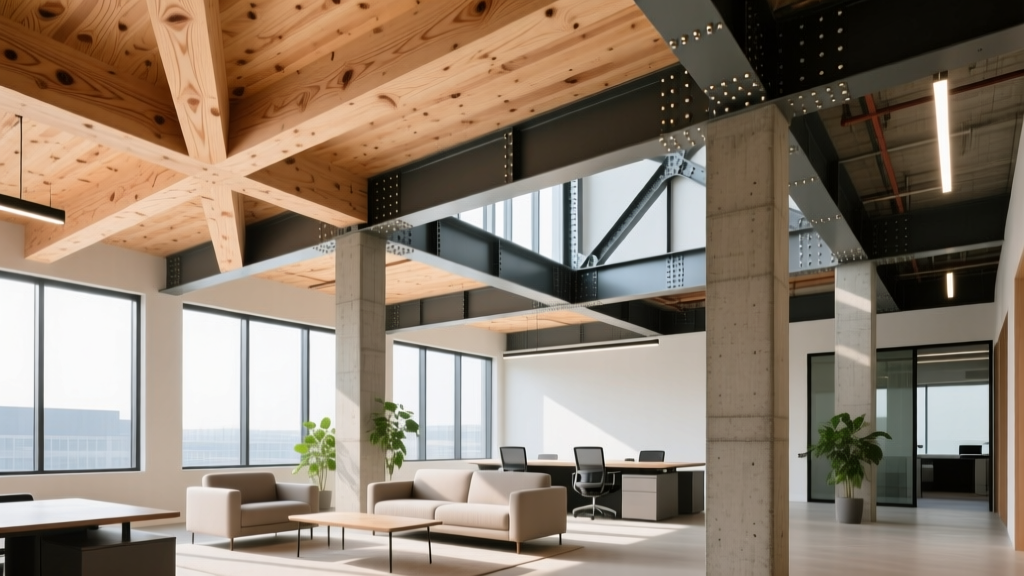
When architects and structural engineers evaluate wood as a building material for mid-rise and commercial projects, the decision extends far beyond aesthetics. The choice between mass timber, structural steel, and cast-in-place concrete fundamentally alters the project's capital expenditure, construction schedule, seismic resilience, and lifecycle carbon footprint. With the widespread adoption of the 2021 and 2024 International Building Code (IBC) mass timber provisions across North American jurisdictions in 2026, wood has transitioned from a niche alternative to a primary structural contender for buildings up to 18 stories.
This comparison review dissects the empirical data behind these three dominant structural systems, moving past surface-level assumptions to provide actionable specifications for modern construction.
Head-to-Head Matrix: Wood vs. Steel vs. Concrete
The following matrix compares Cross-Laminated Timber (CLT) and Glulam mass timber systems against conventional structural steel and cast-in-place concrete across critical performance metrics.
| Performance Metric | Mass Timber (CLT / Glulam) | Structural Steel | Cast-in-Place Concrete |
|---|---|---|---|
| Embodied Carbon | Lowest (Carbon negative/storing) | Highest (High heat smelting) | High (Cement calcination) |
| Structural Weight | ~15-20 lbs/cu ft | ~490 lbs/cu ft | ~145-150 lbs/cu ft |
| Seismic Base Shear | Lowest (High ductility, low mass) | Moderate | Highest (High mass requires larger foundations) |
| Acoustic STC (Bare) | Poor (Requires acoustic toppings) | Poor (Requires fireproofing & furring) | Excellent (Inherent mass blocks airborne noise) |
| Erection Speed | Fastest (Pre-cut, dry assembly) | Fast (Pre-fabricated, bolted/welded) | Slowest (Curing times, weather dependent) |
Structural Performance and Load-Bearing Realities
Mass Timber vs. Structural Steel in Seismic Zones
Wood as a building material excels in high seismic risk categories (SDC D, E, and F) due to its high strength-to-weight ratio. A 5-ply CLT panel (typically 6.875 inches thick) weighs approximately 20 pounds per square foot, compared to 45-50 pounds per square foot for a concrete slab of equivalent span capability. Because seismic base shear forces are directly proportional to the building's mass, mass timber structures experience significantly lower lateral forces during an earthquake.
However, steel remains superior for ultra-long, column-free spans. While Glulam beams can span up to 100 feet, steel trusses and moment frames offer greater stiffness-to-depth ratios for open-concept commercial spaces exceeding 40-foot bays. When specifying mass timber for lateral force-resisting systems, engineers must utilize specialized concealed steel connectors, such as the Rothoblaas MEPAC system or Simpson Strong-Tie mass timber yield links, to ensure ductile failure modes rather than brittle wood splitting.
Moisture Management and Enclosure Timelines
The Fire Resistance Paradox
The most common objection to specifying wood as a building material is fire performance. However, empirical testing reveals a counterintuitive reality: heavy timber and mass timber perform exceptionally well under American Wood Council (AWC) and ASTM E119 fire endurance standards.
- Mass Timber Charring: Exposed CLT and Glulam char at a predictable, slow rate of approximately 1.5 inches per hour (0.635 mm/min). This char layer acts as an insulating barrier, protecting the structural core. A 6.875-inch 5-ply CLT panel can easily achieve a 1-hour fire rating without any gypsum encapsulation, and a 2-hour rating with a single layer of 5/8-inch Type X gypsum board.
- Steel Vulnerability: Unprotected structural steel loses 50% of its yield strength at 1,100°F (593°C), a temperature easily reached within 10 minutes of a standard flashover. Steel requires bulky spray-applied fire-resistive materials (SFRM) or intumescent coatings to achieve equivalent ratings.
- Concrete Spalling: While concrete is non-combustible, the moisture trapped within the matrix can turn to steam under extreme heat, causing explosive spalling that exposes the internal rebar to rapid oxidation and failure.
Embodied Carbon and the 2026 Regulatory Landscape
With municipal mandates like New York's Local Law 97 and California's Buy Clean Act enforcing strict embodied carbon limits in 2026, the environmental profile of structural materials directly impacts permitting and tax incentives. According to lifecycle assessments published by the USDA Forest Products Laboratory, mass timber structures can reduce global warming potential (GWP) by 26% to 44% compared to concrete equivalents.
Wood is the only primary structural material that sequesters carbon. One cubic meter of CLT stores approximately 700 to 900 kilograms of CO2. However, to claim these carbon offsets, architects must source wood certified by the Sustainable Forestry Initiative (SFI) or Forest Stewardship Council (FSC) and demand Environmental Product Declarations (EPDs) from the mill. Untreated, locally sourced Southern Pine or Douglas Fir glulam offers the lowest transportation-related carbon penalty.
Cost Breakdown: Material Premium vs. Schedule Savings
Evaluating the cost of wood as a building material requires separating raw material costs from total installed costs. As of 2026, mass timber materials carry a 5% to 15% premium over structural steel on a per-square-foot basis. However, the total project economics often favor wood due to secondary savings.
| Cost Category (5-Story Mid-Rise) | Mass Timber | Structural Steel | Cast-in-Place Concrete |
|---|---|---|---|
| Structural Frame Material | $32 - $38 / sq ft | $28 - $34 / sq ft | $30 - $36 / sq ft |
| Foundation Costs | Lowest (Reduced dead load) | Moderate | Highest (Heavy dead load) |
| Crane & Hoisting Time | Low (Large panels, fewer picks) | Moderate (Many individual beams) | N/A (Pump trucks used) |
| Schedule Duration | Fastest (20-25% faster) | Baseline | Slowest (Curing delays) |
Because CLT panels are CNC-milled off-site to 1/16th-inch tolerances, they arrive with pre-cut chases for MEP (mechanical, electrical, plumbing) routing. This eliminates the need for on-site core drilling required in concrete, drastically reducing labor hours and accelerating the dry-in schedule. For developers, finishing a project 3 to 4 months earlier generates substantial carrying cost savings and earlier rental income, easily offsetting the initial material premium.
Acoustic and Vibration Mitigation Strategies
The primary structural weakness of wood as a building material is its low mass, which results in poor low-frequency impact noise isolation (IIC) and susceptibility to footfall-induced vibrations. To meet the IBC minimum STC 50 / IIC 50 requirements for multi-family residential buildings, mass timber floors require specialized assemblies.
Standard Mitigation Protocol:
- Apply a 1.5-inch to 2-inch layer of lightweight gypsum concrete or acoustic mat (e.g., Mason Industries Acoustic Underlayments) over the CLT subfloor.
- Install a decoupled ceiling system using resilient channels and sound isolation clips to prevent flanking noise transmission through the structural fasteners.
- For long-span CLT floors, increase the panel thickness by one ply or introduce secondary Glulam ribs to raise the natural frequency above 8 Hz, preventing resonant vibration from human walking cadences.
Decision Framework: When to Specify Wood
Use the following operational framework to determine if wood is the optimal structural choice for your specific project parameters:
- Choose Mass Timber IF: The project is located in a high seismic zone, the site has poor soil bearing capacity (requiring expensive deep pile foundations for heavy concrete), or the developer's primary financial model relies on accelerating the construction schedule to capture early occupancy revenue.
- Choose Structural Steel IF: The architectural design demands long, column-free spans exceeding 40 feet, complex geometric curves that are difficult to achieve with rectilinear CLT panels, or the building exceeds 18 stories (where Type IV-A mass timber code limits are reached).
- Choose Concrete IF: The project requires high acoustic privacy (e.g., luxury condominiums or recording studios) without the budget for decoupled assemblies, or the building features heavy industrial vibration loads that require the inherent damping mass of concrete.
By aligning the material properties with the specific structural, financial, and regulatory constraints of the project, stakeholders can leverage wood as a building material not just for its environmental benefits, but for its distinct advantages in modern construction economics.
Written by
Priya KapoorPriya Kapoor is a real estate market analyst and construction economics researcher with expertise in housing affordability, development feasibility, and infrastructure investment. She holds a Master of Regional Planning from Cornell University and previously worked as a senior analyst at CBRE's Investment Properties group, where she modeled returns for $4B in mixed-use development pipelines. Priya now runs an independent research practice advising developers, municipalities, and REITs on construction cost forecasting and market timing. She publishes the quarterly "BuildMat Market Pulse" report tracking material price indices across 12 commodity categories. Based in Austin, TX, Priya serves on the board of Habitat for Humanity Austin and is a marathon runner.
More from Priya Kapoor
View all
Construction Cost
Cost to Build a 1600 Sq Ft Home in 2026: Full Breakdown
Accurate 2026 cost to build a 1600 sq ft home—material, labor, and regional pricing breakdowns included. Plan your budget with real-time estimates.
Aug 11, 2026

Wood & Lumber
Name the Types of Wood for Pressure Treatment and Preservation
Learn how to name the types of wood best suited for pressure treatment. Compare species treatability, chemical retention levels, and 2026 preservation costs.
Aug 4, 2026

Stone & Masonry
Stone Veneer Suppliers Lindenhurst: 2026 Cost Analysis
Analyze 2026 stone veneer costs in Lindenhurst, NY. Compare local supplier pricing, delivery fees, and Suffolk County installation labor rates.
Aug 4, 2026