How Long Does a Wood Deck Railing Last? Species Lifespan & Decay Analysis
Analyze wood deck railing lifespans by species. Discover decay failure modes, hidden rot points, and 2026 maintenance costs for cedar, redwood, ipe, and PT pine.
The Physics of Wood Deck Railing Degradation
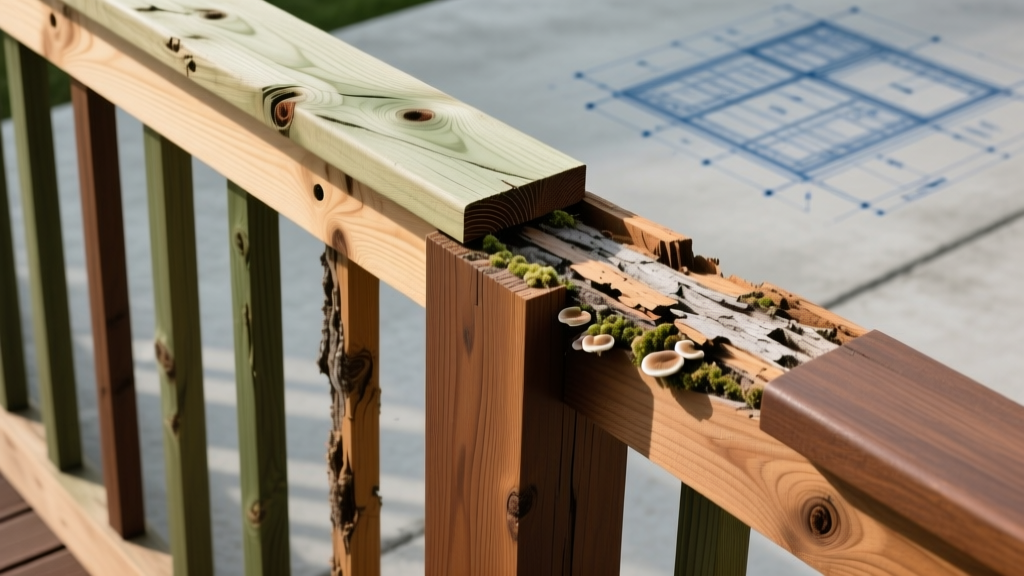
When calculating the lifespan of exterior timber, builders often conflate decking durability with railing durability. This is a critical error. While deck boards are installed horizontally with consistent gaps that promote rapid water shedding, a wood deck railing is a complex assembly of horizontal caps, vertical balusters, and exposed end-grains. This geometry creates multiple moisture traps. According to the USDA Forest Products Laboratory Wood Handbook, moisture content (MC) fluctuations above 20% trigger fungal decay. In railing systems, the bottom rail and post bases frequently sustain MC levels exceeding 25% due to capillary action and splash-back, accelerating rot long before the decking shows wear.
Furthermore, horizontal top rails suffer from severe lignin photodegradation. Ultraviolet (UV) radiation breaks down the wood's structural polymers, creating a micro-fissured surface that absorbs water like a sponge. Understanding these distinct mechanical and environmental stressors is mandatory for selecting the correct species and engineering a railing system that survives beyond its first decade.
Lifespan Matrix: Wood Species Ranked by Decay Resistance
The expected service life of a wood deck railing depends heavily on the species' natural extractives (tannins, oils, and resins) or chemical treatment levels. Below is a 2026 lifecycle analysis based on unmaintained versus properly maintained scenarios.
| Wood Species | Unmaintained Lifespan | Maintained Lifespan | Janka Hardness (lbf) | 2026 Material Cost (per linear ft) |
|---|---|---|---|---|
| Ipe (Tabebuia) | 25–30 years | 40+ years | 3,680 | $18.00 – $24.00 |
| Cumaru | 20–25 years | 35+ years | 3,540 | $14.00 – $19.00 |
| Clear All Heart Redwood | 15–20 years | 25–30 years | 420 | $12.00 – $16.00 |
| Western Red Cedar (STK) | 10–15 years | 20–25 years | 350 | $7.00 – $11.00 |
| PT Southern Yellow Pine (UC4A) | 10–12 years | 15–20 years | 870 | $3.50 – $5.50 |
Tier 1: Tropical Hardwoods (Ipe & Cumaru)
Tropical hardwoods offer unparalleled longevity due to their extreme density and high concentrations of natural lapachol and tannins, which act as potent fungicides. However, their density makes them prone to surface checking if exposed to rapid moisture cycling. Critical specification: Ipe and Cumaru railings must be fastened exclusively with 316-grade marine stainless steel. Using 304 stainless or galvanized fasteners will result in a severe iron-tannin reaction, causing permanent black streaking and accelerated fastener corrosion within 18 months.
Tier 2: Domestic Rot-Resistant Species (Redwood & Cedar)
The Western Red Cedar Lumber Association emphasizes that decay resistance in cedar and redwood is strictly confined to the heartwood. If you purchase Select Tight Knot (STK) or Construction grade lumber, the inclusion of sapwood margins creates vulnerable pathways for rot. For premium railings, specify Clear All Heart (CAH) Redwood or Clear Heart Cedar. These grades lack sapwood and provide uniform decay resistance, though they require UV-inhibiting penetrating oils to prevent the wood from graying and surface-checking.
Tier 3: Pressure-Treated Southern Yellow Pine (PT SYP)
Pressure-treated pine is the most economical option, but its lifespan hinges entirely on the American Wood Protection Association (AWPA) Use Category. Standard railing components are often treated to AWPA UC3B (Above Ground), which requires a minimum retention level of 0.25 pcf (pounds per cubic foot) of copper azole or ACQ. However, because bottom rails and posts trap moisture similarly to ground-level structures, expert builders mandate UC4A (Ground Contact, 0.40 pcf retention) for all posts and bottom rails to prevent premature fungal colonization.
⚠️ Warning: The Post-to-Deck Connection
Over 70% of structural railing failures occur at the post base. Never bury a wood post inside a concrete footing or allow it to sit directly on the deck membrane. Use hot-dipped galvanized or ZMAX-coated elevated post bases (e.g., Simpson Strong-Tie E-Z Base) that maintain a minimum 1-inch air gap between the wood end-grain and the decking surface to allow capillary evaporation.
Hidden Failure Points: Where Railings Actually Rot
Surface decay is easily spotted, but catastrophic wood deck railing failures originate in hidden micro-environments. Inspect and engineer against these three specific failure modes:
- End-Grain Wicking: Wood acts as a bundle of microscopic straws. When a baluster or post is cut, the exposed end-grain can wick water upward at a rate of several inches per day. Unsealed end-grains on top rails and baluster bottoms will rot from the inside out, often leaving the exterior surface looking intact until structural collapse occurs.
- Fastener Hole Micro-Fissures: Driving screws into dense hardwoods or dry cedar creates radial micro-cracks around the fastener shaft. Water infiltrates these cracks and freezes, expanding the wood and splitting the rail. Always pre-drill holes 1/32-inch oversized to allow for seasonal wood expansion and seal the hole with a penetrating epoxy before driving the screw.
- The Bottom Rail Trap: The top of the bottom rail is a horizontal shelf that collects wind-blown debris, pollen, and standing water. If balusters are mortised or routed into the bottom rail without a 1/8-inch drainage clearance, water pools in the joint, guaranteeing rot within 5 to 7 years.
2026 Maintenance Cost vs. Replacement Framework
Maintaining a wood deck railing requires a strict adherence to recoat intervals. Film-forming finishes (polyurethanes, solid-color stains) will peel on horizontal top rails within 24 months due to UV and moisture entrapment. You must use penetrating, non-film-forming oils.
| Finish Type | Recommended Product (2026) | Cost per Gallon | Recoat Interval | 10-Year Maint. Cost (per 50 LF) |
|---|---|---|---|---|
| Hardwood Penetrating Oil | Messmer's UV+ for Hardwoods | $75.00 | 18–24 months | $375 – $450 |
| Alkyd-Resin Cedar/Redwood Oil | Penofin Architectural Grade | $85.00 | 24–36 months | $250 – $320 |
| Semi-Transparent PT Pine Stain | Armstrong Clark (Semi-Transparent) | $65.00 | 24–30 months | $180 – $240 |
Advanced Preservation Protocols for Maximum Lifespan
To push a wood deck railing to the absolute upper limit of its lifespan matrix, implement these professional-grade preservation protocols during installation:
- End-Grain Sealing: Before assembly, coat every cut end-grain with a copper naphthenate solution (e.g., Copper-Green) or a two-part marine epoxy consolidant. This physically blocks the capillary tubes from wicking moisture.
- Drip Edge Engineering: Route a 1/4-inch drip kerf into the underside of all horizontal top caps and bottom rails, set back 1/2-inch from the edge. This forces water droplets to detach and fall before they can wick back under the rail via surface tension.
- Hidden Fastener Systems: For top caps, avoid top-down nailing entirely. Use blind fastening systems or pocket-hole joinery from the underside. Eliminating top-surface fastener holes removes the primary entry points for water infiltration on the most vulnerable horizontal surface.
- Sloped Top Caps: Do not install perfectly flat 5/4 top caps. Bevel the top surface at a minimum 5-degree pitch (approximately 1/8-inch drop over a 5.5-inch wide board) to force immediate gravitational water runoff.
'The longevity of a wood railing is rarely determined by the species you choose, but rather by the carpentry details that manage water. A perfectly detailed cedar railing will outlast a poorly detailed ipe railing every single time.' — Senior Structural Timber Inspector, Pacific Northwest Building Association
Frequently Asked Questions
Can I use ground-contact pressure-treated wood for the entire railing?
Yes, and it is highly recommended. While AWPA standards dictate UC3B for above-ground components, the micro-climates of bottom rails, post bases, and shaded top caps mimic ground-contact moisture levels. Specifying UC4A (Ground Contact) for the entire railing system adds roughly $0.75 per linear foot to material costs but extends the structural lifespan by 5 to 8 years.
Why is my cedar deck railing turning black around the screws?
This is an iron-tannin reaction. Western Red Cedar contains high levels of water-soluble tannic acid. If you use galvanized, zinc-coated, or uncoated steel fasteners, the tannins react with the iron to form iron tannate, a black, ink-like compound. To prevent this, you must use hot-dipped galvanized (HDG) or, preferably, 304/316 stainless steel fasteners.
How do I repair a rotting bottom rail without replacing the whole section?
If the rot is localized to the baluster mortises, use a two-part wood epoxy consolidant (such as Abatron WoodEpox). Dig out the soft, punky wood until you reach solid fibers, treat the area with a liquid borate fungicide to kill residual spores, and pack the void with the epoxy. Once cured, it can be sanded and stained, restoring structural integrity for an additional 5 to 10 years.