How to Tell Different Types of Wood: A Complete Species Guide
Learn how to tell different types of wood using end grain analysis, visual matrices, and sensory tests for accurate construction and millwork selection.

The Botanical Baseline: Hardwoods vs. Softwoods
Accurately identifying wood species is a critical prerequisite for any structural framing, finish carpentry, or flooring project. Misidentifying a species can lead to catastrophic structural failures, premature rot, or ruined millwork finishes. The first step in wood identification is understanding the botanical divide between angiosperms (hardwoods) and gymnosperms (softwoods).
Hardwoods, such as oak, maple, and walnut, possess broad leaves and produce enclosed seeds. Their cellular structure includes large vessels or pores for water transport, which manifest as visible grain patterns on the face of the board. Softwoods, like pine, fir, and spruce, are coniferous trees with needles and exposed seeds. They lack true pores, relying instead on tracheids for water transport, resulting in a generally smoother, less porous face grain. However, the terms "hard" and "soft" are not absolute indicators of density; balsa is botanically a hardwood but is exceptionally soft, while longleaf pine (a softwood) can be harder than many hardwoods.
Core Visual Identification Matrix
Face grain analysis relies on evaluating color, grain pattern, and figure. While stains and aging can alter color, the underlying pore structure remains a reliable identifier. Below is a diagnostic matrix for the most common North American construction and millwork species.
| Species | Category | Heartwood Color | Grain / Pore Pattern | Janka Hardness (lbf) | Primary Use |
|---|---|---|---|---|---|
| White Oak | Hardwood | Light to medium brown | Ring-porous; prominent ray fleck on quartersawn | 1,360 | Flooring, exterior millwork, structural timbers |
| Red Oak | Hardwood | Pinkish-red to light brown | Ring-porous; coarse texture, long rays | 1,290 | Interior flooring, cabinetry, furniture |
| Hard Maple | Hardwood | Creamy white to light reddish-brown | Diffuse-porous; fine, uniform, closed grain | 1,450 | Heavy-use flooring, butcher blocks, stair treads |
| Douglas Fir | Softwood | Orange-red to yellowish-brown | Pronounced contrast between earlywood and latewood | 660 | Structural framing, heavy timber beams |
| Eastern White Pine | Softwood | Light brown with a slight reddish hue | Straight grain, even texture, distinct resin canals | 380 | Interior trim, pattern stock, carved millwork |
| Black Walnut | Hardwood | Rich dark chocolate brown to purplish-black | Semi-ring-porous; medium texture, open pores | 1,010 | Premium furniture, accent paneling, gunstocks |
End Grain Analysis: The Professional Standard
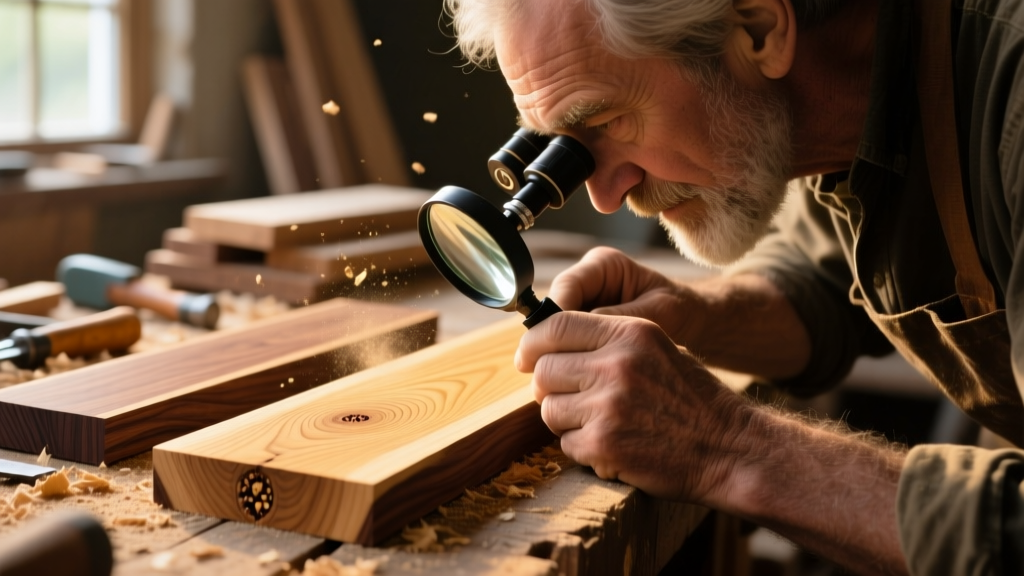
Relying solely on face grain color is a common amateur mistake, as environmental exposure, UV degradation, and chemical treatments drastically alter surface hues. Professional wood scientists and forensic carpenters rely on end grain analysis. According to The Wood Database, examining the end grain at 10x to 14x magnification reveals the cellular anatomy unique to each species.
Always carry a 10x or 14x triplet jeweler's loupe on site. A triplet lens uses three fused glass elements to eliminate edge distortion and chromatic aberration, providing a crystal-clear view of the wood's micro-anatomy. Sand the end grain progressively up to 320-grit, then apply a drop of mineral oil or water to hydrate the cells and make the pore structures pop before magnifying.
Ring-Porous vs. Diffuse-Porous
Under magnification, hardwoods are classified by their pore distribution. Ring-porous species (like Oak, Ash, and Elm) produce large earlywood pores in the spring for rapid sap flow, followed by tightly packed, smaller latewood pores in the summer. This creates a distinct, banded growth ring. Diffuse-porous species (like Maple, Cherry, and Poplar) produce uniformly sized pores throughout the growing season, resulting in a homogenous end grain appearance with less pronounced density shifts between early and late wood.
Sensory Identification: Specific Gravity and Odor
When visual and microscopic cues are inconclusive, physical properties provide the next layer of verification. Specific gravity (SG) and distinct odors are highly reliable identifiers, especially for softwoods and tropical imports.
- Specific Gravity (Density): A wood's SG dictates its weight relative to water. Lignum Vitae (SG ~1.28) will sink in water, while Balsa (SG ~0.15) floats effortlessly. In construction, weighing a standard 2x4x8 stud can help differentiate between dense Douglas Fir (approx. 11-12 lbs) and lighter Spruce-Pine-Fir (SPF) groupings (approx. 8-9 lbs).
- Odor Profiles: Many woods contain volatile organic compounds that serve as olfactory fingerprints. Eastern Red Cedar emits a sharp, closet-like scent due to thujopsene. Black Walnut smells faintly of chocolate and earth when machined. Cocobolo and other rosewoods possess a spicy, floral aroma. If a board is old and the scent has faded, sand a small patch or scrape the end grain to release trapped oils.
Critical Misidentifications in Construction and Millwork
Misidentifying wood in the field leads to expensive callbacks and material failures. Below are the most common traps and how to avoid them.
Red Oak and White Oak look nearly identical on the face grain when unfinished. However, White Oak contains tyloses—cellular outgrowths that plug the xylem vessels, making the wood impermeable to water. Red Oak lacks tyloses, acting like a bundle of open straws. Installing Red Oak in an exterior door threshold or boatbuilding application will result in rapid capillary water uptake and catastrophic rot. Always verify the end grain: White Oak pores are blocked; Red Oak pores are open and will draw water via capillary action.
Poplar vs. Pine
Tulip Poplar (a hardwood) is frequently confused with Eastern White Pine (a softwood) in painted trim applications. Poplar is diffuse-porous and lacks resin canals, while Pine has distinct resin canals visible as tiny dark dots on the end grain. Poplar machines much cleaner for complex routed profiles, whereas Pine tends to tear out and requires sharp, high-angle plane irons.
Tying Species ID to Structural Lumber Stamps
In structural framing, you rarely identify individual species; instead, you identify species groupings stamped by grading agencies. The USDA Forest Products Laboratory categorizes structural lumber based on composite mechanical properties rather than individual botanical traits. Understanding these stamps is crucial for verifying load-bearing capacities on site.
Decoding the SPF Grouping
Spruce-Pine-Fir (SPF) is the most common dimensional lumber grouping in North America. If you need to know exactly which species is in your SPF bundle, examine the end grain for resin canals. True firs (like Balsam Fir) lack resin canals entirely. Spruces have small, indistinct resin canals. Pines have large, prominent resin canals. While they share the same structural design values for basic framing, Pine holds fasteners slightly better, while Spruce is more prone to splintering during nailing.
Douglas Fir-Larch (DF-L) vs. Hem-Fir (HF)
DF-L is the premium structural softwood, prized for its high bending strength (Fb) and stiffness (E). It features a stark color contrast between the light orange earlywood and the dense, dark reddish-brown latewood. Hem-Fir, a grouping of Western Hemlock and True Firs, is lighter in color, lacks the stark earlywood/latewood contrast, and generally has lower design values for heavy timber applications. Always check the grade stamp to ensure the engineer's specified species grouping was delivered to the job site, as substituting HF for DF-L in a high-load beam application violates building codes outlined by the American Wood Council.
Mastering wood identification requires moving beyond surface-level color matching. By combining end-grain microscopy, sensory evaluation, and an understanding of structural grading stamps, builders and woodworkers can ensure material integrity, optimize finish performance, and maintain strict compliance with engineering specifications.
Written by
Sarah WhitfieldSarah Whitfield is a chartered quantity surveyor (MRICS) and construction cost analyst with 15 years of experience in material pricing, procurement strategy, and project budgeting. She earned her degree in Construction Management from the University of Reading (UK) and has worked on projects ranging from $2M custom homes to $180M mixed-use developments across North America and Europe. Sarah currently leads cost estimating for BuildMat Insight, maintaining a proprietary database of 4,000+ material price points updated quarterly. She is a frequent contributor to RSMeans cost data panels and has presented at the International Cost Engineering Council (ICEC) congress. Based in Denver, CO, Sarah is an avid trail runner and volunteer mentor for Women in Construction.
More from Sarah Whitfield
View all
Wood & Lumber
What Are the Different Types of Wood? A Builder's Guide
Compare structural softwoods, finish hardwoods, and engineered lumber. Analyze Janka ratings, MOE values, and 2026 pricing for construction.
Aug 4, 2026

Walls & Panels
Steel Framing vs Wood Framing: Corrosion and Moisture Defense
Compare steel framing vs wood framing for moisture resistance. Learn about galvanized coatings, condensation risks, and corrosion protection strategies.
Jul 21, 2026

Stone & Masonry
How to Cut Stone Veneer: Wet Saw vs Grinder Comparison
Compare the best tools for cutting stone veneer. We review wet saws, angle grinders, and chop saws to help you achieve clean, chip-free cuts.
Jul 21, 2026