Types of Wood Routers: Matching Power to Lumber Grades
Discover how to match types of wood routers, horsepower, and bit metallurgy to specific lumber grades and Janka hardness for tear-out-free milling.

The Intersection of Lumber Grade and Router Selection
Selecting the correct routing equipment is rarely just about the profile you want to cut; it is fundamentally dictated by the grade, density, and defect frequency of the lumber you are machining. The USDA Forest Products Laboratory emphasizes that wood machining quality is directly tied to grain orientation, moisture content, and the presence of structural anomalies. When a woodworker or mill operator evaluates the different types of wood routers available, the decision must be anchored in the National Hardwood Lumber Association (NHLA) grading rules they typically process.
Processing FAS (Firsts and Seconds) or Select grade lumber—characterized by long, clear cuttings and uniform grain—allows for aggressive feed rates and high-speed routing. Conversely, milling #2 Common or #3 Common grades, which contain frequent knots, wane, bark pockets, and grain reversals, demands variable-speed control, specialized bit geometries, and higher torque to prevent catastrophic tear-out. Understanding how to map router horsepower, collet size, and base type to your specific lumber inventory is the hallmark of professional-grade millwork.
Router Types Classified by Lumber Application
The market segments routers by motor size and base configuration, but professional shops categorize them by the lumber grades they can reliably process without inducing chatter or burn marks.
Trim and Palm Routers (1 to 1.25 HP)
Trim routers operate almost exclusively with 1/4-inch shank bits and are limited to light-duty edge profiling. They are ideal for softwoods (like SPF - Spruce-Pine-Fir) and clear, straight-grained Select grade hardwoods where the cutting resistance is minimal. Attempting to route a deep ogee profile into #1 Common Hard Maple with a 1 HP trim router will result in motor bogging, bit deflection, and severe burning. Use these tools strictly for edge-banding, light chamfers, and template flushing on high-grade, defect-free stock.
Mid-Size Variable-Speed Routers (1.75 to 2.25 HP)
The 2 to 2.25 HP class (such as the Bosch 1617EVSPK or Festool OF 1400) represents the critical threshold for professional hardwood milling. These routers feature 1/2-inch collets, which drastically reduce bit vibration when routing dense species like White Oak (Janka 1360) or Hickory (Janka 1820). The inclusion of variable-speed dials is non-negotiable when working with #1 Common lumber. When the router bit approaches a mineral streak or the swirling grain surrounding a small, sound knot, the operator must drop the RPM from 22,000 down to 16,000 to maintain torque and prevent the carbide from chipping.
Full-Size Production and CNC Routers (3 to 3.5 HP)
Production routers, like the Porter-Cable 7518 or heavy-duty CNC spindle motors, are engineered for deep stock removal and continuous operation. They are mandatory when processing thick, 8/4 or 12/4 stock, or when routing highly abrasive exotic species. These machines possess the rotational mass and thermal dissipation required to push large-diameter panel raisers or lock-miter bits through dense material without stalling.
Routing the edge of a #2 Common board that contains a marginal knot is a primary cause of carbide micro-chipping. The grain around a knot reverses direction, meaning the router bit will inevitably hit end-grain and cross-grain simultaneously. Always use a spiral compression bit for lower-grade lumber; the upward and downward shearing forces clamp the wood fibers together, preventing the knot from blowing out the back edge of the profile.
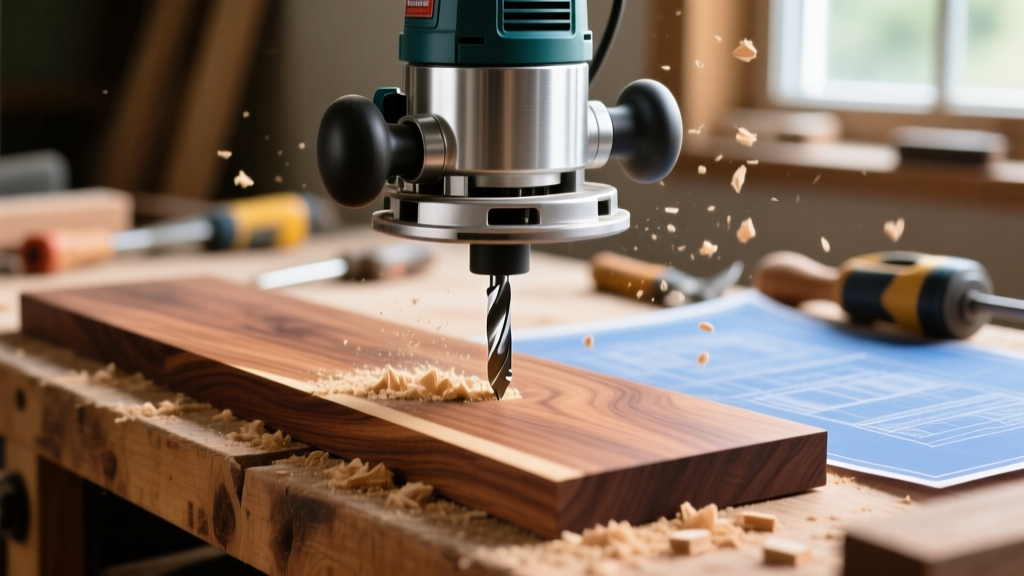
Matching Router RPM and Bit Metallurgy to Wood Density
Router speed must be inversely proportional to bit diameter and wood density. Furthermore, the metallurgy of the router bit must match the abrasiveness of the lumber grade. Reclaimed lumber and lower-grade outdoor timbers often contain embedded silica, dirt, or oxidized metal that will destroy standard carbide in minutes.
| Lumber Grade / Species Profile | Avg. Janka Hardness | Recommended Router RPM (1/2" Bit) | Required Bit Metallurgy & Geometry |
|---|---|---|---|
| Select Grade Softwoods (Pine, Cedar) | 380 - 900 | 20,000 - 24,000 RPM | Standard C2 Carbide; Straight or Roundover |
| FAS / Select Hardwoods (Walnut, Cherry) | 950 - 1010 | 18,000 - 22,000 RPM | C2 Carbide; Standard Profile Bits |
| #1 Common Dense Hardwoods (Maple, Oak) | 1290 - 1450 | 16,000 - 18,000 RPM | C4 Micro-grain Carbide; Shear-cut angles |
| #2 Common / Reclaimed / Exotics (Ipe, Teak) | 1800 - 3680+ | 12,000 - 16,000 RPM | Polidiamond (PCD) or Premium C4; Spiral Compression |
According to tooling experts at Woodweb's professional machining forums, upgrading from standard C2 tungsten carbide to C4 micro-grain carbide increases bit lifespan by up to 40% when routing #1 Common and #2 Common hardwoods. The tighter grain structure of C4 carbide allows for a sharper, more polished cutting edge that resists the microscopic abrasions caused by mineral deposits common in lower-grade domestic hardwoods.
Navigating Lumber Defects: Routing #2 and #3 Common Grades
Lumber graded as #2 Common (allowing for 50% clear face cuttings) and #3 Common is heavily utilized in rustic furniture, structural timber framing, and budget cabinetry. Routing these grades requires a departure from standard milling practices.
- Handling Wane and Bark Pockets: Never route a profile directly over a bark pocket. The structural integrity of the wood fibers in these areas is compromised, and the centrifugal force of a router bit spinning at 18,000 RPM will extract the bark and splinter the surrounding wood. Joint the edge straight and remove the wane before routing.
- Managing Pith and Heartwood: The pith (the center of the tree) often contains juvenile wood, which is highly unstable and prone to severe tear-out. When routing boards that include the pith, reduce your feed rate by 30% and take multiple shallow passes (no more than 1/16-inch per pass) rather than attempting a full-depth profile in a single run.
- Moisture Content Variance: Lower-grade lumber is often kiln-dried to different moisture tolerances than Select grades. Routing wood with a moisture content above 12% will cause the pitch and sap to gum up the router bit flutes, leading to friction burns. Always verify moisture content with a pin-type meter before machining structural or rustic grades.
Expert Framework: Selecting Your Router Kit Based on Mill Output
To build an efficient shop, align your router purchases with your primary lumber purchasing habits. Use this decision matrix to finalize your equipment investment:
The Millwork Purchasing Matrix:
If your shop processes >80% FAS/Select grade sheet goods and clear hardwoods: Invest in a high-RPM, 1.75 HP fixed-base router for table mounting, paired with a 1.25 HP trim router for edge work.
If your shop processes mixed #1 and #2 Common domestic hardwoods for custom furniture: A 2.25 HP variable-speed combo kit (plunge and fixed base) is mandatory. Allocate budget toward C4 micro-grain spiral upcut and compression bits.
If your shop mills reclaimed timber, live-edge slabs, or structural #3 Common beams: Bypass handheld routers entirely for primary profiling. Invest in a 3.5 HP production router for heavy jig work, or transition to a 3-axis CNC with a 3HP liquid-cooled spindle and PCD tooling to manage extreme density variations and hidden defects safely.
Ultimately, the types of wood routers you deploy should act as a mechanical response to the biological realities of the lumber grade on your bench. By matching horsepower, variable speed control, and bit metallurgy to the specific defect tolerances of NHLA grades, you eliminate tear-out, extend tooling life, and ensure a machined finish that requires minimal hand-sanding.
Written by
James ThorntonJames Thornton is a construction industry veteran with 25 years of hands-on experience in wood framing, lumber grading, and residential building codes. He started as a framing carpenter in rural Oregon, earned his ICC Residential Building Inspector certification, and eventually became a senior plan reviewer for the City of Portland Bureau of Development Services. James holds a B.S. in Wood Science & Technology from Oregon State University and is a certified lumber grader through the West Coast Lumber Inspection Bureau (WCLIB). He has inspected over 3,000 residential construction sites and authored the city's internal guide on advanced framing techniques (2x6 at 24" O.C.). James lives in Bend, OR, where he builds custom timber-frame cabins and competes in lumberjack sports.
More from James Thornton
View all
Insulation
Best Home Insulation Materials: Complete 2026 Guide
Compare top home insulation materials for 2026. Find R-values, installed costs per square foot, and best uses for fiberglass, spray foam, and mineral wool.
Aug 4, 2026

Sustainable Building
Certify Your Green Building Material for LEED and WELL
Step-by-step guide to certifying a green building material for LEED v5 and WELL v2. Master EPDs, HPDs, and VOC limits for 2026 project specifications.
Aug 4, 2026

Stone & Masonry
Veneer Stacked Stone Panels: Interior Design & Style Showcase
Discover how veneer stacked stone panels transform interiors. Explore modern design profiles, material pairings, and technical installation specs.
Aug 4, 2026