2026 Cost to Build House in Philippines: Wood Grade Guide
Discover how lumber grades and wood species impact the cost to build house in Philippines. Compare 2026 timber prices, structural grades, and budget tips.

The Hidden Variable in Philippine Construction Budgets
When calculating the total cost to build house in Philippines, contractors and homeowners often fixate on concrete, steel rebar, and roofing. However, wood and lumber procurement remains a highly volatile budget category. Depending on your lumber grade selections and species choices, timber can account for anywhere from 8% to 18% of your total material expenses. In 2026, supply chain shifts, stricter environmental logging bans, and the rising adoption of engineered wood alternatives have fundamentally altered how residential framing and finishing are priced.
Understanding the intersection of timber grading, moisture content, and local building codes is essential. Opting for lower-grade, undocumented lumber might reduce immediate out-of-pocket expenses, but it introduces severe long-term risks regarding structural integrity, termite vulnerability, and compliance fines from local authorities.
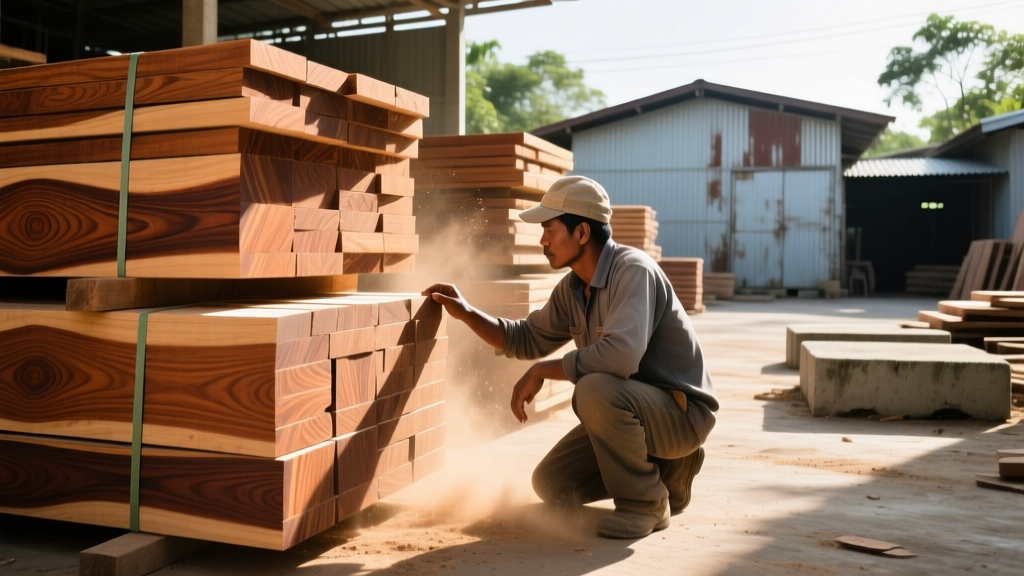
Decoding Philippine Lumber Grades: Structural vs. Finishing
The Philippine lumber market does not strictly adhere to the North American NHLA (National Hardwood Lumber Association) grading rules. Instead, local suppliers and the Forest Management Bureau (FMB) generally categorize timber by species strength classes and visual defect tolerances. Knowing these distinctions prevents overpaying for structural timber or under-specifying finishing woods.
Class A (Premium & Architectural Finishing)
Class A lumber is characterized by tight grain patterns, minimal knots (pin knots only), and high natural oil content. This grade is reserved for exposed architectural elements: main entry doors, window jambs, stair treads, and high-end cabinetry. Species in this category must be kiln-dried to a moisture content (MC) of 12% or lower to prevent warping in the tropical climate. Because these woods are often sourced from sustainable plantations or salvaged old-growth stock, they command premium pricing.
Class B & C (Framing, Trusses, & Hidden Structural)
Class B and C lumbers are utilized for roof trusses, wall studs, and concrete formwork. Visual defects like larger knots and slight bowing are acceptable, provided they do not compromise the load-bearing capacity. The critical metric here is not visual perfection but structural density and treatment. For roof trusses, lumber must meet the stress grading requirements outlined by the Department of Public Works and Highways (DPWH) under the National Building Code.
2026 Wood Species & Pricing Matrix
The table below outlines the most common wood species utilized in Philippine residential construction, their primary grade applications, and current 2026 market pricing. Prices are averages based on Metro Manila and Central Luzon lumber yards and fluctuate based on transport logistics and DENR permit availability.
| Wood Species | Grade / Class | Primary Application | 2026 Avg. Price (PHP / Board Foot) | Termite & Moisture Resistance |
|---|---|---|---|---|
| Yakal (Shorea astylosa) | Class A / Premium | Heavy structural, premium posts, marine | ₱180 - ₱280 | Exceptional (Class 1 Durability) |
| Tangile (Shorea polysperma) | Class A / Finishing | Doors, window jambs, interior trim | ₱90 - ₱130 | Moderate (Requires varnish/sealant) |
| Mahogany (Swietenia macrophylla) | Class A/B / Finishing | Cabinetry, furniture, decorative panels | ₱65 - ₱95 | Low-Moderate (Prone to powderpost beetles) |
| Gmelina (Gmelina arborea) | Class B / Framing | Wall studs, ceiling joists, trusses | ₱40 - ₱60 | Low (Must be borate-treated) |
| Coco Lumber (Cocos nucifera) | Class C / Temporary | Scaffolding, concrete formwork, light trusses | ₱25 - ₱45 | Very Low (High starch attracts termites) |
How Timber Selection Shifts Construction Costs
To understand how these material choices impact the broader cost to build house in Philippines, consider the two most common residential framing scenarios.
Scenario 1: The Engineered Truss & Plantation Framing Build
Modern Philippine contractors increasingly avoid traditional solid-sawn lumber for roof trusses, opting instead for pre-engineered steel or LVL (Laminated Veneer Lumber). However, for wall framing and ceiling joists, plantation-grown Gmelina or treated Mahogany is standard. Cost Impact: Using Gmelina for a 120sqm home's wall framing and ceiling joists will cost approximately PHP 140,000. The trade-off is that Gmelina is highly susceptible to moisture and fungal decay. It must be pressure-treated with copper azole or borate solutions, adding roughly PHP 15,000 to the budget but extending the lifespan from 5 years to over 40 years.
Scenario 2: The Heritage Hardwood Finishing Build
For homeowners prioritizing architectural longevity, specifying Yakal for structural posts and Tangile for all door jambs and window sills drastically alters the budget. Cost Impact: Outfitting the same 120sqm home with Class A Tangile jambs and solid Yakal structural accents can push the wood finishing budget past PHP 450,000. While expensive, Tangile holds screws exceptionally well and takes polyurethane finishes beautifully, reducing long-term maintenance costs associated with warping doors and cracked frames.
Many budget contractors suggest using Coco Lumber for permanent roof purlins or wall studs to lower the cost to build house in Philippines. Coco lumber has an extremely high starch content, making it a primary food source for Coptotermes (subterranean termites). Unless it undergoes rigorous industrial borate pressure treatment—not just surface brushing—it will compromise structurally within 3 to 5 years in humid provinces. Always verify the treatment certification before accepting Coco lumber for permanent framing.
Sourcing, Compliance, and the DENR Permit Factor
A frequently overlooked cost in Philippine construction is legal compliance. The transport of lumber across provincial and municipal lines requires a Certificate of Timber Origin (CTO) or a Wood Transport Permit issued by the Department of Environment and Natural Resources (DENR).
If your contractor sources 'cheap' lumber from undocumented mills in Mindanao or Palawan, and the delivery truck is intercepted at a DENR checkpoint, the entire shipment will be confiscated. This not only results in a total loss of material costs but also exposes the property owner to severe fines and project delays lasting months. When negotiating lumber contracts, always require the supplier to include CTO documentation and delivery insurance in their per-board-foot pricing.
Actionable Framework: Allocating Your Wood Budget
To optimize your budget without sacrificing structural safety, apply this decision matrix during the design phase:
- Roof Trusses & Purlins: Allocate budget to pre-engineered steel or LVL. Avoid solid-sawn Class B lumber for spans exceeding 4 meters to prevent sagging under heavy monsoon wind loads.
- Wall Studs & Ceiling Joists: Use plantation Gmelina or Mahogany, but mandate pressure-treatment. Do not compromise on the treatment certificate.
- Exterior Doors & Jambs: Invest heavily in Class A Tangile or Yakal. Exterior elements face direct UV and rain exposure; softwoods will rot and require replacement within a decade.
- Interior Cabinetry & Trim: Utilize engineered wood (MDF/Plywood core) with Mahogany veneers. Solid Mahogany is prone to cracking in air-conditioned environments due to rapid moisture loss.
Frequently Asked Questions
Is it legal to use Narra wood for residential construction?
Narra (Pterocarpus indicus) is heavily regulated in the Philippines. Cutting, selling, or transporting wild Narra is strictly prohibited. You can only use Narra if it is sourced from a DENR-accredited tree plantation with proper permits, or if it is salvaged/reclaimed from demolished ancestral homes with a valid Certificate of Timber Origin. Due to the legal complexities and extreme cost (often exceeding PHP 350 per board foot), it is rarely used in standard residential builds today.
How does moisture content affect lumber pricing and quality?
Kiln-dried (KD) lumber, which is dried to 12-14% moisture content, costs 20% to 30% more than air-dried (AD) lumber. However, using AD lumber (which can hold 20%+ moisture) for interior finishing guarantees that the wood will shrink, warp, and crack as it acclimates to the interior environment. Always specify KD lumber for doors, jambs, and cabinetry.
What is the most cost-effective termite treatment for framing lumber?
Surface spraying with Solignum or similar chemical barriers provides only temporary protection (1-2 years). For permanent structural framing, specify lumber that has been pressure-treated with Copper Azole (CA) or Alkaline Copper Quaternary (ACQ). This forces the preservative deep into the wood cellular structure, providing a 40+ year warranty against termite infestation and fungal decay.
Written by
Elena RodriguezElena Rodriguez is a civil engineer and technical writer specializing in concrete technology, masonry systems, and ASTM/ACI compliance. She earned her B.S. in Civil Engineering from Texas A&M University and spent a decade at a materials testing laboratory, performing over 2,000 concrete compressive strength tests and masonry prism evaluations. Elena is an ACI-certified Field Testing Technician (Grade I) and a member of ASTM Committee C12 on Natural Building Stone. She currently consults on forensic engineering cases involving concrete failures and moisture intrusion. Based in San Antonio, TX, Elena is a proud member of the Society of Women Engineers (SWE) and coaches her daughter's FIRST Robotics team.
More from Elena Rodriguez
View all
Walls & Panels
Cost Analysis: Light Gauge Steel Framing Advantages and Disadvantages
Evaluate light gauge steel framing advantages and disadvantages through a strict cost analysis lens, comparing material, labor, and lifecycle expenses.
Aug 4, 2026

Walls & Panels
Gypsum Board Types: Exact Specifications, Thickness & Dimensions
Compare standard, Type X, and moisture-resistant gypsum board types. Get exact specifications, thicknesses, dimensions, and ASTM standards for your project.
Aug 4, 2026

Fire Resistance
Best Fire-Resistant Outdoor Decking Materials: 2026 Buyer Guide
Discover the best fire-resistant outdoor decking materials for 2026. Compare Class A PVC, aluminum, and hardwood options for WUI compliance and safety.
Aug 4, 2026