Top Types of Finishes for Wood Treatment and Moisture Protection
Compare the best types of finishes for wood treatment. Expert guide on penetrating oils, film-forming varnishes, moisture limits, and 2026 VOC rules.

The Science of Wood Degradation and Finish Selection
Wood is a hygroscopic material composed of cellulose, hemicellulose, and lignin. The hydroxyl (-OH) groups within the cellulose molecular chains actively attract and bind with water molecules from the surrounding environment. When untreated wood absorbs moisture, it swells; when it dries, it shrinks. This continuous dimensional cycling leads to checking, splitting, and structural fatigue. Furthermore, moisture content (MC) exceeding 20% creates an ideal substrate for wood-decaying fungi and insect infestation.
Selecting the correct wood finish is not merely an aesthetic choice; it is a critical preservation strategy. The right treatment restricts moisture exchange, blocks ultraviolet (UV) radiation that degrades lignin (causing the wood to turn gray and friable), and prevents biological attack. According to the USDA Forest Products Laboratory, the service life of exterior wood can be extended by a factor of three to five simply by applying and maintaining an appropriate finish system.
End-grain absorbs moisture up to 50 times faster than face-grain due to the exposed capillary structure of the wood tracheids. When treating structural timber, decking, or exterior millwork, end-grain must be sealed with a penetrating epoxy or heavily loaded with your primary finish before installation. Failure to seal end-grain renders the rest of the finish system virtually useless against moisture intrusion.
Penetrating vs. Film-Forming: The Core Decision Matrix
The fundamental divide in wood preservation chemistry is whether the finish penetrates the cellular structure or forms a continuous barrier on the surface. Each approach has distinct mechanical properties, failure modes, and maintenance requirements.
| Finish Category | Mechanism of Action | Film Thickness | UV & Moisture Resistance | Maintenance Cycle |
|---|---|---|---|---|
| Penetrating Oils | Soaks into wood pores; polymerizes within cells. | 0 mils (sub-surface) | Moderate moisture barrier; requires UV pigments. | 1–2 years (exterior) |
| Penetrating Sealers | Water repellents (waxes/silicones) in solvent carriers. | 0 mils | High water repellency; low UV protection. | 1 year (exterior) |
| Film-Forming Varnish | Cures to a hard, continuous plastic-like shell on the surface. | 3–5 mils per coat | Excellent moisture/UV block (if loaded with UVAs). | 3–5 years (exterior) |
| Polyurethane | Forms a rigid, abrasion-resistant surface film. | 2–4 mils per coat | High abrasion/moisture resistance; poor exterior UV stability. | 5+ years (interior only) |
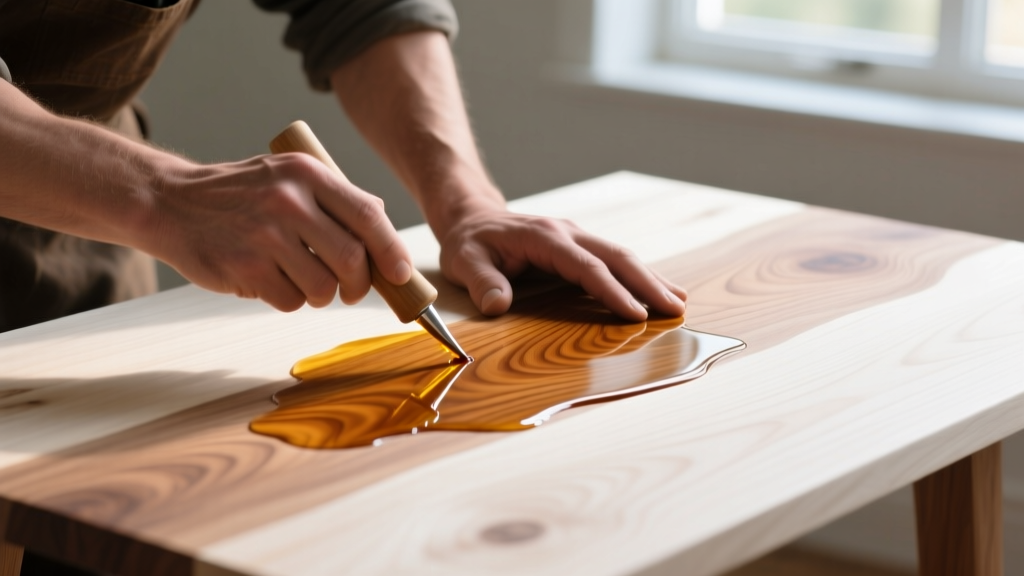
Deep Dive: Penetrating Finishes for Dimensional Stability
Penetrating finishes are the preferred choice for exterior decking, timber framing, and applications where wood movement is expected. Because they do not form a surface film, they cannot peel, blister, or flake. When the wood expands and contracts, the finish moves with it at the cellular level.
Modified Tung and Linseed Oils
Raw tung and linseed oils dry too slowly and remain tacky, attracting dirt. Modern preservation relies on polymerized or thermally modified oils. Products like Rubio Monocoat Oil Plus 2C utilize a molecular bonding mechanism where the oil reacts with the cellulose in the topmost microns of the wood. This creates a highly durable, zero-VOC surface that requires only a single coat. For exterior applications, these oils must be pigmented with iron oxide or titanium dioxide nanoparticles to scatter UV radiation; clear penetrating oils will fail to prevent lignin photodegradation outdoors.
Penetrating Epoxy Sealers
For structural timber exposed to ground contact or marine environments, a low-viscosity penetrating epoxy (such as TotalBoat Penetrating Epoxy) is mandatory. Thinned with denatured alcohol or specialized solvents, the epoxy wicks deep into the end-grain and checks, curing into a rigid, waterproof matrix. This treatment does not provide UV protection and must be overcoated with a UV-stable marine varnish, but it effectively stops osmotic moisture migration in its tracks.
Film-Forming Finishes: Maximum Barrier Protection
When absolute moisture exclusion is required—such as in marine brightwork, exterior doors, or high-humidity interior environments—film-forming finishes are necessary. These coatings build a measurable physical barrier measured in mils (thousandths of an inch).
Spar Urethane and Marine Varnishes
Standard interior polyurethanes are brittle and will crack when exterior wood moves. Spar varnishes (like Epifanes High Gloss Marine Varnish) are formulated with alkyd resins and high ratios of tung oil, creating a flexible film that accommodates wood swelling. Crucially, premium spar varnishes contain HALS (Hindered Amine Light Stabilizers) and UV absorbers. To achieve the necessary protection, a minimum of four to six coats must be applied, building a dry film thickness of at least 4 to 6 mils.
Moisture-Cure Urethanes (MCUs)
MCUs represent the pinnacle of industrial wood preservation. Unlike standard finishes that cure via solvent evaporation or oxidation, MCUs cure by reacting with ambient humidity. The resulting film is exceptionally dense, highly chemical-resistant, and virtually impermeable to liquid water. While difficult to apply (requiring strict humidity and temperature controls to prevent CO2 bubbling), MCUs are specified for heavy-duty commercial flooring and exterior architectural millwork where maintenance access is limited.
Applying a film-forming finish too thickly in a single coat traps solvents and prevents proper cross-linking. This results in a soft, gummy film that is highly susceptible to moisture vapor transmission. Always apply multiple thin coats (2-3 mils wet per coat) rather than one heavy flood coat. Use a wet mil thickness gauge during application to verify compliance with the manufacturer's technical data sheet (TDS).
Step-by-Step Application Protocol for Maximum Adhesion
The most expensive marine varnish will fail in months if applied over improperly prepared wood. Adhesion and preservation rely entirely on surface preparation and environmental controls.
- Verify Moisture Content (MC): Use a pinless moisture meter (e.g., Wagner Meters Orion 910). Interior wood must be below 12% MC; exterior wood must be below 15% MC. Applying a finish over damp wood traps moisture, guaranteeing fungal rot and film delamination.
- Progressive Sanding: Sand progressively through 80, 120, and 150 grits. Do not sand exterior wood above 150 grit. Burnishing the wood with 220 grit closes the cellular pores, preventing penetrating oils from absorbing and causing film-forming finishes to suffer mechanical adhesion failure.
- Solvent Wipe Down: Vacuum all dust, then wipe the surface with a lint-free cloth dampened with mineral spirits or denatured alcohol. This removes microscopic dust and extracts natural extractives (like tannins and resins) that can interfere with coating adhesion.
- Apply the First Coat (Wash Coat): For film-forming finishes, thin the first coat by 20-30% with the manufacturer-recommended solvent. This 'wash coat' penetrates the surface fibers, creating a mechanical anchor for subsequent full-strength coats.
- Intercoat Scuffing: Once cured, lightly scuff the surface with 320-grit silicon carbide paper or maroon non-woven abrasive pads. This creates the microscopic profile necessary for chemical and mechanical bonding between coats. Never skip this step.
Environmental and Regulatory Considerations
Wood treatment chemistry is heavily regulated due to the volatile organic compounds (VOCs) used as carriers and solvents. As of 2026, the EPA and regional authorities like the South Coast Air Quality Management District (SCAQMD) enforce strict VOC limits on architectural wood coatings. Under SCAQMD Rule 1113, the VOC limit for most clear wood sealers and varnishes is capped at 275 grams per liter (g/L), with even stricter limits for stains and lacquers.
For interior projects, specifiers must look for CARB2 (California Air Resources Board) compliant finishes, which limit VOCs to under 100 g/L. Waterborne acrylic-polyurethane hybrids (such as General Finishes High Performance Water Based Polyurethane) have largely replaced solvent-based lacquers in commercial interior millwork, offering comparable hardness (rated via ASTM D1474 Taber abrasion testing) with a fraction of the toxic emissions. For detailed guidance on indoor air quality and finishing emissions, refer to the EPA's Indoor Air Quality guidelines on VOCs.
Frequently Asked Questions
Can I apply a penetrating oil over an existing polyurethane finish?
No. Penetrating oils require direct contact with raw wood cellulose to absorb and polymerize. If applied over a film-forming finish like polyurethane, the oil will sit on the surface, remain permanently tacky, and attract dirt. You must completely strip the existing film finish using chemical strippers and mechanical sanding back to bare wood before applying any penetrating treatment.
How do I know when it is time to re-treat exterior wood?
Perform the 'water drop test.' Sprinkle a few drops of water on the wood surface in multiple locations. If the water beads up, the finish's hydrophobic properties are intact. If the water absorbs into the wood and darkens the grain within 3 to 5 minutes, the finish has degraded and the wood is vulnerable to moisture intrusion. Clean the surface and apply a maintenance coat immediately.
What is the best finish for a high-traffic commercial wood floor?
For commercial environments, a two-component (2K) waterborne polyurethane with an aluminum oxide additive is the industry standard. Products like Bona Traffic HD cure via a chemical cross-linking reaction rather than simple evaporation, achieving a commercial-grade wear layer capable of withstanding heavy foot traffic and rolling loads while maintaining low VOC emissions. Expect to pay between $1.50 and $2.50 per square foot for the materials alone for a premium 2K system.
Written by
Sarah WhitfieldSarah Whitfield is a chartered quantity surveyor (MRICS) and construction cost analyst with 15 years of experience in material pricing, procurement strategy, and project budgeting. She earned her degree in Construction Management from the University of Reading (UK) and has worked on projects ranging from $2M custom homes to $180M mixed-use developments across North America and Europe. Sarah currently leads cost estimating for BuildMat Insight, maintaining a proprietary database of 4,000+ material price points updated quarterly. She is a frequent contributor to RSMeans cost data panels and has presented at the International Cost Engineering Council (ICEC) congress. Based in Denver, CO, Sarah is an avid trail runner and volunteer mentor for Women in Construction.
More from Sarah Whitfield
View all
Wood & Lumber
What Are the Different Types of Wood? A Builder's Guide
Compare structural softwoods, finish hardwoods, and engineered lumber. Analyze Janka ratings, MOE values, and 2026 pricing for construction.
Aug 4, 2026

Walls & Panels
Steel Framing vs Wood Framing: Corrosion and Moisture Defense
Compare steel framing vs wood framing for moisture resistance. Learn about galvanized coatings, condensation risks, and corrosion protection strategies.
Jul 21, 2026

Stone & Masonry
How to Cut Stone Veneer: Wet Saw vs Grinder Comparison
Compare the best tools for cutting stone veneer. We review wet saws, angle grinders, and chop saws to help you achieve clean, chip-free cuts.
Jul 21, 2026