Asphalt vs Concrete: Oklahoma Climate Driveway Comparison
Compare asphalt vs concrete for Oklahoma climate. Learn how expansive clay soils, extreme heat, and freeze-thaw cycles impact driveway lifespan and costs.
The Oklahoma Climate and Soil Challenge
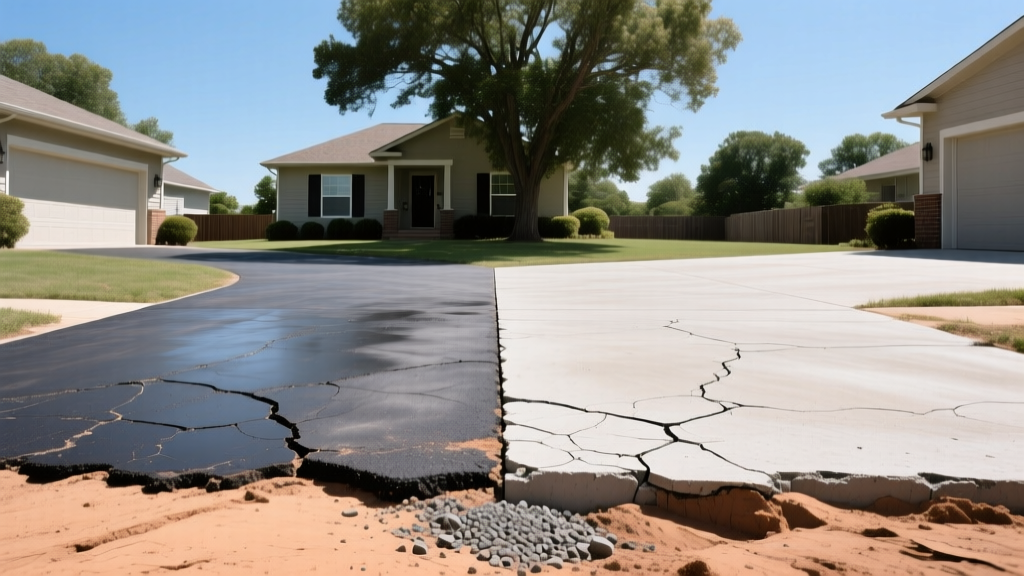
Paving a driveway in Oklahoma requires engineering for extremes. The state endures summer surface temperatures that routinely exceed 140°F, winter nights that plunge below freezing, and severe spring precipitation. However, the most destructive force is not the weather—it is the soil. Central and eastern Oklahoma sit atop highly expansive clay formations, including the Garber-Wellington shale and Pierre Shale. These soils swell dramatically when saturated and shrink during droughts, creating differential heave that tears apart improperly engineered pavement.
When evaluating asphalt vs concrete, Oklahoma climate conditions dictate that the winner is not determined by the surface material alone, but by the structural cross-section beneath it. Below is a technical breakdown of how each material performs against the state's specific environmental stressors.
Concrete in Oklahoma: Engineering for Extremes
Concrete offers a rigid, high-strength surface that excels in longevity, but its rigidity makes it unforgiving to shifting soils. To survive Oklahoma's environment, concrete must be treated as a structural slab rather than a simple surface covering.
Mix Design and Air Entrainment
Oklahoma experiences roughly 15 to 25 freeze-thaw cycles annually. When water penetrates concrete pores and freezes, it expands by 9%, causing surface scaling and spalling. According to guidelines from the American Concrete Institute (ACI), all exterior flatwork in this region must utilize air-entrained concrete. This process introduces microscopic, disconnected air bubbles (5% to 7% by volume) that give freezing water room to expand without rupturing the cement paste. Additionally, a minimum compressive strength of 4,000 PSI is required for residential driveways to withstand the point-loads of modern SUVs and trucks.
Thermal Expansion and Jointing
Summer heat causes concrete to expand. Without adequate control joints, the slab will crack randomly to relieve thermal stress. In Oklahoma, control joints must be saw-cut within 12 hours of pouring to a depth of one-quarter the slab thickness. For a standard 5-inch driveway, joints should be spaced every 10 feet to create square or near-square panels, preventing mid-panel thermal cracking.
Asphalt in Oklahoma: Beating the Summer Rutting
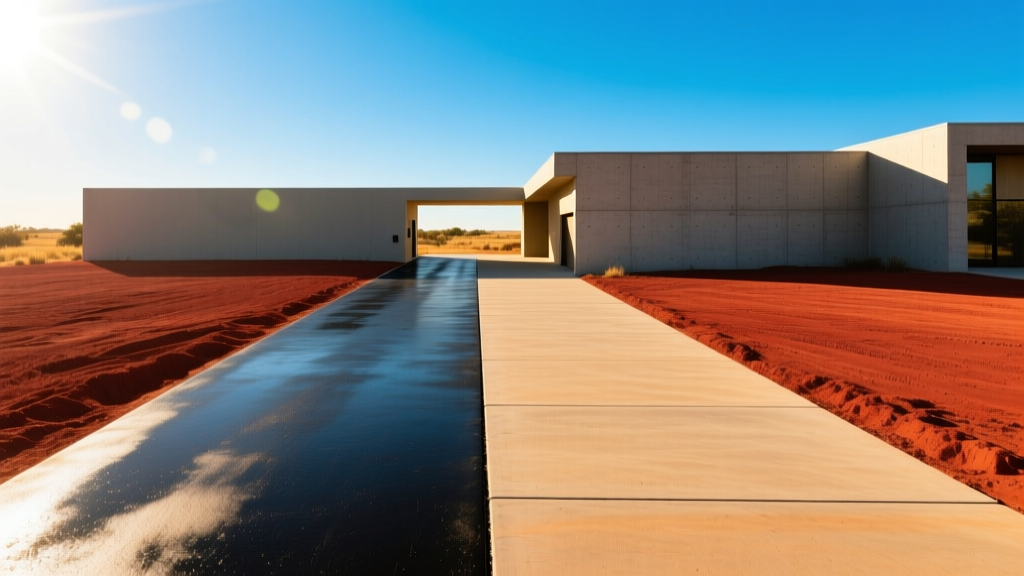
Asphalt is a flexible pavement that handles minor soil movements better than concrete, but it is highly susceptible to Oklahoma's intense summer UV radiation and extreme heat. The primary failure mode for asphalt in this state is rutting (permanent deformation) and oxidation.
Performance Graded (PG) Binders
The liquid asphalt cement (binder) used in the mix must be matched to local temperatures. Standard paving mixes often fail in Oklahoma summers because the binder softens under heavy vehicle loads on 100°F days. Current Oklahoma Department of Transportation (ODOT) specifications and best practices for high-stress residential applications recommend a Performance Graded (PG) 76-22 binder. This specific polymer-modified binder is engineered to resist rutting at high temperatures (up to 76°C / 168°F) while remaining flexible enough to resist thermal cracking at low temperatures (-22°C / -7°F).
Oxidation and Sealcoating
Oklahoma's high UV index accelerates asphalt oxidation, turning the surface gray and brittle. To prevent water infiltration into the base layer, asphalt driveways must be sealcoated every 2 to 3 years. Skipping this maintenance allows water to reach the expansive clay subgrade, triggering the exact heave issues that destroy concrete.
Head-to-Head Matrix: Asphalt vs Concrete
| Performance Metric | Concrete (Rigid) | Asphalt (Flexible) |
|---|---|---|
| Soil Heave Tolerance | Low (Requires thick base/rebar) | Moderate (Flexes slightly, but base failure still causes potholes) |
| Summer Heat Resistance | Excellent (Reflects UV, does not soften) | Poor to Fair (Requires PG 76-22 binder to prevent rutting) |
| Freeze-Thaw Durability | Excellent (If 5-7% air-entrained) | Good (Vulnerable if water penetrates unsealed cracks) |
| Expected Lifespan | 30 to 40 years | 15 to 20 years |
| Maintenance Cycle | Joint sealing every 5 years | Sealcoating every 2-3 years |
2026 Lifecycle Cost Analysis
While asphalt is traditionally viewed as the budget option, the long-term economics shift when factoring in Oklahoma's specific maintenance requirements and material costs.
Concrete Driveway (1,000 sq ft)
- Initial Install: $8,500 - $12,000
- Base Prep (Crucial): Included (6" limestone)
- 30-Year Maintenance: ~$1,200 (Joint sealing, power washing)
- Total 30-Year Cost: $9,700 - $13,200
Asphalt Driveway (1,000 sq ft)
- Initial Install: $4,500 - $7,000
- Base Prep: Included (6" crushed aggregate)
- 30-Year Maintenance: ~$4,500 (Biannual sealcoating, 1 overlay at year 15)
- Total 30-Year Cost: $9,000 - $11,500
Data aggregated from regional paving contractors and Oklahoma State University Extension agricultural engineering resources indicate that the 30-year cost gap between the two materials has narrowed significantly due to the rising cost of asphalt binders and the high frequency of required sealcoating in high-UV environments.
Decision Framework: Which Material Fits Your Property?
Use this diagnostic framework to select the optimal material for your specific site conditions:
- Choose Concrete IF: Your property has mature trees with aggressive root systems (roots push asphalt up from below but can be managed with thick concrete and root barriers), you park heavy RVs or dual-axle trailers (preventing asphalt rutting), or you want a low-maintenance surface that reflects summer heat.
- Choose Asphalt IF: Your lot features steep gradients (asphalt provides superior tire traction during rare but severe Oklahoma ice storms), your soil is exceptionally poor and you cannot afford the deep excavation required for a rigid concrete base, or your upfront capital is strictly limited.
- Choose Post-Tension Concrete IF: You are building in high-swell clay zones (like parts of Norman or Edmond) where standard rebar is insufficient to hold a slab together against expansive soil pressures.
Critical Installation Specs for Oklahoma Contractors
If you are soliciting bids, ensure your contractor's proposal explicitly includes the following specifications. Vague proposals that omit these details will lead to premature pavement failure.
Mandatory Concrete Specs:
- Slab Thickness: 5 inches minimum (4 inches is insufficient for OK clay).
- Base Material: 4 to 6 inches of compacted crushed limestone (not river rock, which shifts).
- Mix Design: 4,000 PSI with 5-7% air entrainment and a low water-cement ratio (0.45 max).
- Reinforcement: #4 rebar on 24-inch centers, or post-tension cables engineered for local soil swell potential.
Mandatory Asphalt Specs:
- Binder Grade: PG 76-22 (Verify the batch ticket from the plant).
- Base Thickness: 6 to 8 inches of compacted aggregate base course.
- Surface Thickness: 2.5 to 3 inches of hot mix asphalt (HMA) laid in two lifts (layers) for proper compaction.
- Edge Restraint: Concrete curb or buried edge beams to prevent lateral spreading under heavy summer heat.
Ultimately, the debate of asphalt vs concrete in the Oklahoma climate is won during the earthwork phase. A perfectly engineered 5-inch concrete slab or a 3-inch PG 76-22 asphalt mat will both fail if the underlying expansive clay is not properly isolated, drained, and stabilized. Demand rigorous subgrade preparation from your contractor to ensure your investment survives the state's punishing environmental cycles.
Written by
Marcus ChenMarcus Chen is a licensed structural engineer (PE) and building materials analyst with over 12 years of experience across residential, commercial, and industrial construction. He holds a Master of Science in Civil Engineering from UC Berkeley and spent six years at Thornton Tomasetti before transitioning to independent consulting and technical writing. Marcus specializes in material selection for seismic-prone regions, concrete reinforcement strategies, and lifecycle cost analysis. His work has been cited by the American Concrete Institute (ACI) and the Structural Engineers Association of California (SEAOC). When he is not on a job site or at his desk, you will find him hiking the Sierra Nevada or restoring a 1920s craftsman bungalow in Oakland, CA.
More from Marcus Chen
View all
Construction Cost
How Much Did the Eiffel Tower Cost to Build?
How much did the Eiffel Tower cost to build in 1889? We adjust for inflation and compare its budget to modern skyscraper construction.
Aug 4, 2026

Fire Resistance
What Is a Fire Resistant Material? Testing & Certification Guide
Discover what is a fire resistant material through ASTM and UL testing. Learn how fire ratings, certifications, and assemblies work in construction.
Aug 4, 2026

Construction Cost
How Much Did the Burj Khalifa Cost to Build?
How much did the Burj Khalifa cost to build? We break down the $1.5B project and extract 5 money-saving strategies for your next build.
Jul 30, 2026