Polished Concrete Garage Floor vs Epoxy: 2026 Cost Breakdown
Compare polished concrete garage floor vs epoxy with our 2026 cost breakdown. Analyze upfront pricing, 10-year lifecycle costs, and failure modes.

The Core Dilemma: Surface Coating vs. Mechanical Refinement
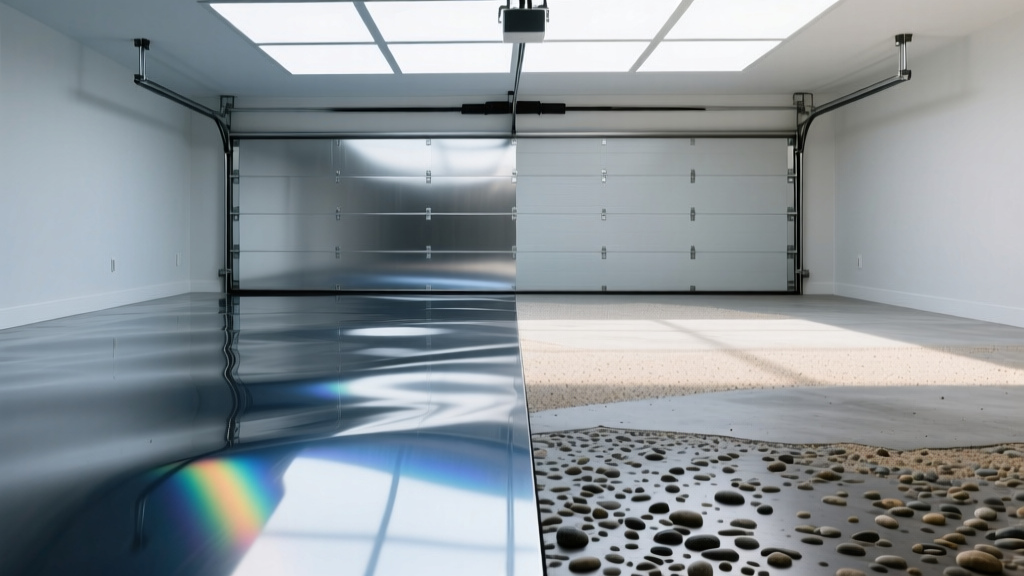
When evaluating a polished concrete garage floor vs epoxy, you are fundamentally choosing between two entirely different engineering philosophies. Epoxy is a film-forming surface coating that sits on top of the concrete substrate, acting as a sacrificial wear layer. Polished concrete, conversely, is a mechanical refinement process that alters the substrate itself, densifying the surface and exposing the aggregate matrix. This distinction dictates not only the upfront installation price but the 10-year lifecycle cost, maintenance requirements, and specific failure modes of your garage floor.
As of 2026, material science advancements—specifically in polyaspartic topcoats and lithium silicate densifiers—have shifted the cost-to-durability ratios of both systems. Below is a comprehensive cost breakdown analysis to help you allocate your budget accurately and avoid the hidden expenses that frequently derail garage floor projects.
2026 Upfront Cost Breakdown: Epoxy vs. Polished Concrete
Pricing for garage floors is highly dependent on the specific chemical formulation and the level of mechanical abrasion required. The following table outlines current national averages for a standard two-car garage (approximately 400 to 500 square feet).
| System Type | Material Cost (per sq ft) | Labor & Prep (per sq ft) | Total Installed Cost (per sq ft) | Expected Lifespan |
|---|---|---|---|---|
| Water-Based Epoxy (DIY/Light Duty) | $1.50 - $2.50 | $2.00 - $3.00 | $3.50 - $5.50 | 2 - 4 Years |
| 100% Solids Epoxy + Polyaspartic Topcoat | $3.50 - $5.50 | $5.00 - $8.00 | $8.50 - $13.50 | 10 - 15+ Years |
| Grind and Seal (Polished Alternative) | $1.00 - $2.00 | $2.50 - $4.00 | $3.50 - $6.00 | 3 - 5 Years |
| Mechanically Polished (800 - 1500 Grit) | $1.50 - $3.00 | $5.50 - $9.00 | $7.00 - $12.00 | 15 - 20+ Years |
Hidden Cost Factors That Inflate Bids
Contractor quotes often exclude critical preparatory steps. When comparing bids for a polished concrete garage floor vs epoxy, ensure the following line items are explicitly addressed:
- Surface Profiling: Epoxy requires a Concrete Surface Profile (CSP) of 2 to 3, achieved via shotblasting or scarifying. Diamond grinding alone often leaves a burnished surface that causes epoxy delamination. Shotblasting adds $0.75 to $1.50 per square foot.
- Joint and Crack Treatment: Epoxy systems require routing and filling control joints with polyurea or flexible epoxy to prevent telegraphing. Polished concrete leaves joints open or requires a semi-rigid filler, which costs $2 to $4 per linear foot.
- Edge Work: Planetary grinders cannot reach the final 2 to 4 inches near the garage walls. Hand-grinding edges for epoxy prep or polishing adds 15% to 20% to the total labor cost.
Lifecycle and Maintenance Cost Analysis (10-Year Projection)
Upfront costs only tell half the story. A true cost breakdown analysis must factor in maintenance, repairs, and recoating over a decade of vehicular traffic, chemical spills, and thermal cycling.
10-Year Epoxy Lifecycle:
A high-quality 100% solids epoxy with a polyaspartic topcoat will resist hot tire pickup and UV yellowing. However, in high-traffic zones (specifically the driveway threshold and the area directly behind the car's rear tires), the topcoat will degrade. Expect to pay $2.50 to $4.00 per square foot for a light scuff-sand and polyaspartic recoat around year 7 or 8. Over 10 years, the total cost of ownership for a 500 sq ft garage averages $5,500 to $8,000.
10-Year Polished Concrete Lifecycle:
Mechanically polished concrete does not have a film layer to peel or scratch off. The primary maintenance involves reapplying a penetrating fluorosilicate or siloxane guard coat every 3 to 5 years to maintain stain resistance against oil and antifreeze. This guard application costs roughly $1.00 to $1.50 per square foot and can often be done without professional equipment. Over 10 years, the total cost of ownership for a 500 sq ft garage averages $4,500 to $7,000.
Failure Modes and Edge Cases
Understanding how each system fails is critical for making an informed decision. According to the Concrete Network, the majority of epoxy failures are not due to the resin itself, but rather improper substrate preparation or moisture vapor transmission.
⚠️ Critical Warning: Moisture Vapor Transmission (MVT)
Garage slabs are typically poured without a vapor barrier beneath them. If your slab emits excessive moisture vapor, an epoxy coating will blister, turn white (amine blush), and delaminate within months. Before installing epoxy, contractors must perform ASTM F2170 relative humidity (RH) testing using in-situ probes. If RH levels exceed 75%, you must apply a moisture-mitigating epoxy primer, which adds $2.50 to $4.50 per square foot to the project. For detailed testing protocols, refer to the ASTM F2170 guidelines provided by Wagner Meters. Polished concrete, being a breathable system, is entirely immune to MVT blistering.
Polished Concrete Failure Modes:
While immune to peeling, polished concrete is inherently porous. If the densifier and guard coat are improperly applied, automotive fluids (brake fluid, oil, transmission fluid) will penetrate the capillary network of the concrete, causing permanent dark stains. Furthermore, highly polished floors (3000 grit) become exceptionally slippery when wet or covered in snow melt, requiring the broadcast of a micro-grit anti-slip additive into the final guard coat.
Epoxy Failure Modes:
The most common failure in standard epoxies is "hot tire pickup." When vehicle tires heat up during a drive and park on a standard epoxy floor, the thermal expansion softens the epoxy resin. As the tire cools and contracts, it pulls the epoxy off the concrete. This is entirely mitigated by using a 100% solids epoxy base and an aliphatic polyaspartic topcoat, which can withstand thermal shock up to 300°F.
Decision Matrix: Which System Fits Your Garage?
Use this framework to align your specific garage usage with the optimal flooring system.
| User Profile & Garage Condition | Recommended System | Why? |
|---|---|---|
| High MVT slab, older home, no vapor barrier | Mechanically Polished Concrete | Breathable system prevents moisture-related delamination and blistering. |
| Active mechanic, frequent oil/chemical spills | 100% Solids Epoxy + Polyaspartic | Provides an impermeable, chemical-resistant film that allows for easy wipe-up of harsh solvents. |
| Showroom garage, collector cars, aesthetic focus | Metallic Epoxy or High-Grit Polish | Both offer high reflectivity; epoxy allows for custom 3D metallic effects, while polish offers natural aggregate elegance. |
| Winter climate, heavy snow melt, salt tracking | Flake Epoxy with Polyaspartic | The vinyl flake texture provides vital slip resistance, while the polyaspartic resists salt pitting and deicing chemical degradation. |
Actionable Prep and Specification Requirements
If you are hiring a contractor, do not accept vague proposals. Demand that the following technical specifications are written into your contract to ensure the longevity of your investment. As outlined by the American Society of Concrete Contractors (ASCC) and industry standards, precise specifications prevent corner-cutting.
For Epoxy Installations:
- Preparation: Specify mechanical shotblasting or scarifying to achieve a minimum CSP-2 profile. Acid etching is unacceptable for garage environments.
- Base Coat: Require a 100% solids, high-build epoxy primer/base coat applied at a minimum of 10 to 12 mils thickness.
- Topcoat: Mandate an aliphatic polyaspartic topcoat (not polyurethane) applied at 4 to 6 mils. Polyaspartic offers 4x the abrasion resistance and zero UV yellowing.
For Polished Concrete Installations:
- Densification: Require a lithium silicate densifier (not sodium silicate, which leaves a white, powdery residue). Lithium penetrates deeper and reacts more completely with the calcium hydroxide in the concrete.
- Grit Progression: Specify a minimum 800-grit mechanical polish for a satin sheen, or 1500-grit for high reflectivity. Do not allow the contractor to stop at 400-grit and use a topical acrylic sealer to fake the shine.
- Guard Coat: Require the application of a penetrating fluorosilicate guard coat to provide oleophobic (oil-repelling) properties, ensuring automotive fluids do not stain the exposed aggregate.
By focusing on the specific chemical compositions, mechanical prep requirements, and long-term lifecycle costs rather than just the initial square-footage bid, you can confidently select the right system for your garage and avoid costly premature failures.
Written by
David NakamuraDavid Nakamura is a licensed architect (AIA) and construction technology writer focused on sustainable building methods, mass timber engineering, and high-performance building envelopes. He holds a Master of Architecture from the University of Washington and is a certified Passive House Consultant (CPHC). David spent eight years at the Seattle firm Mithun, where he led the design of three LEED Platinum projects, before founding his own practice specializing in net-zero residential design. He serves on the editorial advisory board of GreenBuilder Magazine and has authored peer-reviewed papers on cross-laminated timber (CLT) connections for the Journal of Structural Engineering. In his spare time, David teaches woodworking at Pratt Fine Arts Center and kayaks the Puget Sound.
More from David Nakamura
View all
Construction Cost
Labor Cost to Build a Deck Per Sq Ft: 2026 Installation Guide
Discover the exact labor cost to build a deck per sq ft in 2026. This installation guide breaks down contractor rates, complexity factors, and hidden fees.
Aug 4, 2026

Construction Cost
How Much Does It Cost to Build a 3 Bedroom House? Financing Guide
Learn exactly how much it costs to build a 3 bedroom house and explore 2026 financing options, construction loan types, and budget frameworks for your build.
Aug 4, 2026

Construction Cost
Cost to Build a Tennis Court: 2026 Guide
How much does it cost to build a tennis court in 2026? Breakdowns for asphalt, concrete, and synthetic surfaces plus fencing and lighting.
Jul 30, 2026