Concrete vs Fibreglass Pool Repair: Troubleshooting Cracks & Leaks
Compare concrete vs fibreglass pool repair costs and failure modes. Expert troubleshooting for structural cracks, osmotic blisters, and plaster leaks.

The True Cost of Ownership: Structural Failure vs. Surface Degradation
When evaluating concrete vs fibreglass pool ownership, the initial installation cost dominates the conversation. However, the true financial divergence occurs between years 5 and 15, when material-specific failure modes emerge. Concrete (gunite or shotcrete) pools rely on a thick, steel-reinforced structural shell covered by a sacrificial plaster finish. Fibreglass pools utilize a factory-molded, flexible shell composed of chopped strand mat, woven roving, and a protective gelcoat. Understanding how these distinct material sciences fail—and how to troubleshoot them—is critical for accurate long-term budgeting and structural preservation.
Concrete Pool Troubleshooting: Diagnosing Shell and Plaster Defects
Concrete pool issues generally fall into two categories: surface plaster degradation and structural shell failure. Misdiagnosing a structural crack as a surface defect leads to repeated, costly repair failures.
Spider Cracks vs. Structural Fissures
Surface crazing (a network of fine, shallow cracks) is common in new plaster applications and is typically caused by rapid moisture loss during the curing process or high wind conditions. These are cosmetic and do not compromise the pool's watertight integrity.
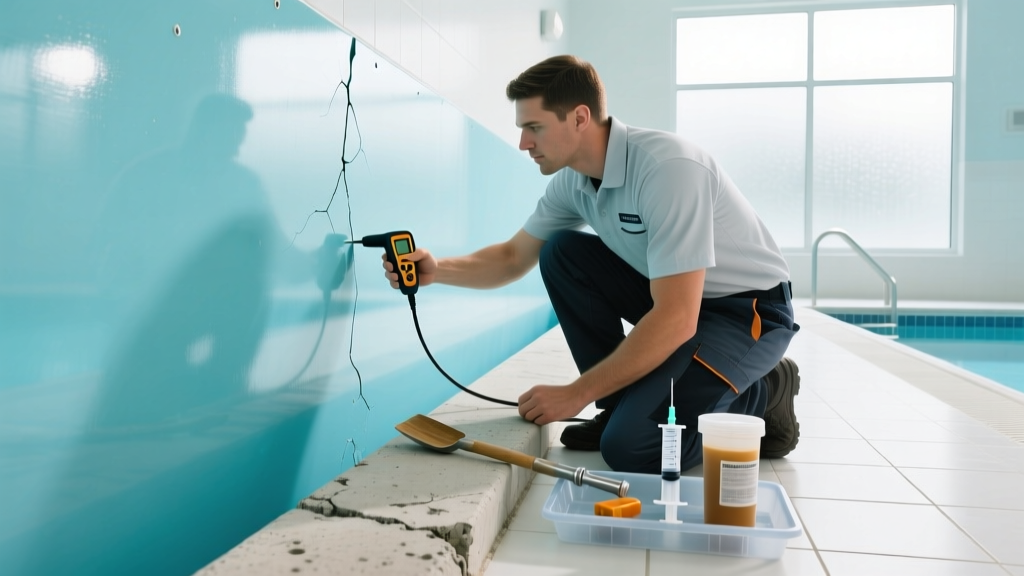
Conversely, structural fissures penetrate the gunite shell. To diagnose a structural crack, perform the feel-and-width test:
- Width: Cracks exceeding 1/8 inch in width are highly suspect for structural movement.
- Displacement: Run your fingernail across the crack. If one side is noticeably higher (shear displacement), the shell has shifted due to soil subsidence or hydrostatic pressure.
- Location: Cracks radiating from the corners of the deep end hopper or skimmer throats indicate stress concentration points.
If a crack exhibits brown or orange staining, moisture has reached the steel rebar matrix. The oxidizing steel expands up to seven times its original volume, spalling the concrete from the inside out. This requires chipping away the concrete, treating the rebar with a zinc-rich anti-corrosion primer, and patching with a polymer-modified hydraulic cement before re-plastering.
Delamination and Plaster Pop-Offs
Delamination occurs when the plaster finish loses its bond with the underlying concrete shell, creating hollow-sounding voids. Tap the pool surface with a hard rubber mallet; a sharp 'clack' indicates solid bonding, while a dull 'thud' reveals delamination. According to the National Plasterers Council (NPC), this is frequently caused by improper surface preparation (failing to chip or sandblast the old shell) or applying plaster to a frozen or excessively dry substrate. Repair requires draining, chipping out the hollow areas to a solid edge, and applying a bonding agent before patching.
Fibreglass Pool Troubleshooting: Gelcoat and Osmotic Blistering
Fibreglass shells are immune to the pH-driven chemical erosion that plagues concrete, but they are susceptible to manufacturing defects, installation errors, and osmotic degradation.
Identifying and Treating Osmotic Blisters
Osmotic blistering is the most complex fibreglass failure mode. It occurs when water molecules permeate the semi-permeable gelcoat and react with uncured resin, styrene, or water-soluble impurities trapped in the fibreglass laminate during manufacturing. This creates a concentrated solution that draws more water in, forming pressurized blisters.
- Inspection: Blisters typically appear as 1/4-inch to 1-inch raised domes, often concentrated below the waterline or in areas exposed to direct sunlight.
- Diagnosis: Puncture a blister. If a foul-smelling, acidic liquid (often containing acetic acid) seeps out, it is osmotic. If it is dry or contains only trapped air, it is a mechanical lamination void.
- Repair Protocol: Grind out the blister to healthy laminate using a 24-grit sanding disc. Clean the cavity with acetone, allow it to dry completely, and fill it with a vinylester-based structural filler. Once cured, sand flush and apply three coats of colour-matched marine-grade gelcoat, finishing with a PVA (polyvinyl alcohol) air-inhibitor layer for proper surface curing.
Shell Flexing and Plumbing Leaks
Unlike rigid concrete, fibreglass pools are designed to flex. However, improper backfilling (using native dirt instead of clean, washed gravel or crushed stone) creates uneven point-loading. This causes the shell to bulge or 'float' if the water table rises and the pool is drained. If you notice the pool walls bowing inward or the plumbing lines leaking at the rigid PVC connections, the backfill has likely failed. The Pool & Hot Tub Alliance (PHTA) strictly mandates clean, angular gravel backfill for fibreglass installations to ensure proper load distribution and drainage.
Head-to-Head Repair Matrix: Concrete vs Fibreglass
| Failure Mode | Material Affected | Diagnostic Method | Repair Protocol | 2026 Avg. Cost |
|---|---|---|---|---|
| Structural Cracking | Concrete (Gunite) | Width >1/8", shear displacement | Routing, epoxy injection, or hydraulic cement patching | $45 - $75 / linear ft |
| Surface Crazing | Concrete (Plaster) | Visual inspection, shallow depth | Acid wash or full drain-and-replaster | $250 (Wash) / $12k+ (Replaster) |
| Osmotic Blistering | Fibreglass | Puncture test, acidic fluid presence | Grinding, vinylester fill, gelcoat application | $150 - $250 / blister |
| Spider Cracks | Fibreglass | Visual, localized to stress points | Gelcoat patch kit, structural reinforcement behind shell | $800 - $1,500 (Professional) |
| Hydrostatic Floatation | Fibreglass | Shell lifting, plumbing separation | Drain, excavate perimeter, install gravel sump, reset | $8,000 - $15,000+ |
Chemical Imbalance Damage: Material Reactivity
Water chemistry affects both materials, but the failure mechanisms are entirely different. Concrete is highly alkaline; new plaster continuously leaches calcium hydroxide into the water, driving the pH up. Owners must frequently add muriatic acid to maintain a pH of 7.4 to 7.6. If the water becomes aggressively acidic (pH below 7.0) due to over-correction, the water will aggressively dissolve the calcium carbonate in the plaster, leading to severe etching, pitting, and premature failure of the aggregate finish.
Fibreglass, conversely, is chemically inert. It does not leach calcium or affect water pH. However, the gelcoat surface is vulnerable to prolonged exposure to highly acidic water, which can cause the surface to chalk, fade, and lose its glossy barrier properties. Furthermore, maintaining excessively high calcium hardness levels in a fibreglass pool will not damage the shell, but it will cause severe scaling on the waterline tile and plumbing, a problem that is much harder to remove from textured fibreglass waterlines than from smooth glass tile.
Expert Verdict: Long-Term Repair ROI
The decision between repairing a failing concrete pool versus addressing fibreglass defects hinges on the nature of the damage. Concrete pool repairs are frequent but modular; you can patch a localized leak or re-plaster the surface without replacing the entire structure. However, the cumulative cost of resurfacing every 12 to 15 years represents a massive, unavoidable capital expenditure.
Fibreglass pools require significantly less routine maintenance and chemical balancing, and the gelcoat can last 20 to 25 years before requiring a major restoration. However, when a fibreglass shell experiences catastrophic structural failure—such as severe hydrostatic floatation or massive delamination due to poor manufacturing—the repair costs can easily exceed the value of the pool, often necessitating a total teardown and replacement. For existing owners, investing in a professional sonar leak detection and structural assessment every five years is the most cost-effective strategy to catch material-specific degradation before it compromises the entire system.
Written by
Elena RodriguezElena Rodriguez is a civil engineer and technical writer specializing in concrete technology, masonry systems, and ASTM/ACI compliance. She earned her B.S. in Civil Engineering from Texas A&M University and spent a decade at a materials testing laboratory, performing over 2,000 concrete compressive strength tests and masonry prism evaluations. Elena is an ACI-certified Field Testing Technician (Grade I) and a member of ASTM Committee C12 on Natural Building Stone. She currently consults on forensic engineering cases involving concrete failures and moisture intrusion. Based in San Antonio, TX, Elena is a proud member of the Society of Women Engineers (SWE) and coaches her daughter's FIRST Robotics team.
More from Elena Rodriguez
View all
Walls & Panels
Cost Analysis: Light Gauge Steel Framing Advantages and Disadvantages
Evaluate light gauge steel framing advantages and disadvantages through a strict cost analysis lens, comparing material, labor, and lifecycle expenses.
Aug 4, 2026

Walls & Panels
Gypsum Board Types: Exact Specifications, Thickness & Dimensions
Compare standard, Type X, and moisture-resistant gypsum board types. Get exact specifications, thicknesses, dimensions, and ASTM standards for your project.
Aug 4, 2026

Fire Resistance
Best Fire-Resistant Outdoor Decking Materials: 2026 Buyer Guide
Discover the best fire-resistant outdoor decking materials for 2026. Compare Class A PVC, aluminum, and hardwood options for WUI compliance and safety.
Aug 4, 2026