Selecting Different Types of Concrete Mix for Structural Projects
Compare different types of concrete mix designs, including standard, high-strength, and SCC. Learn exact ratios, PSI ratings, and admixture specs.
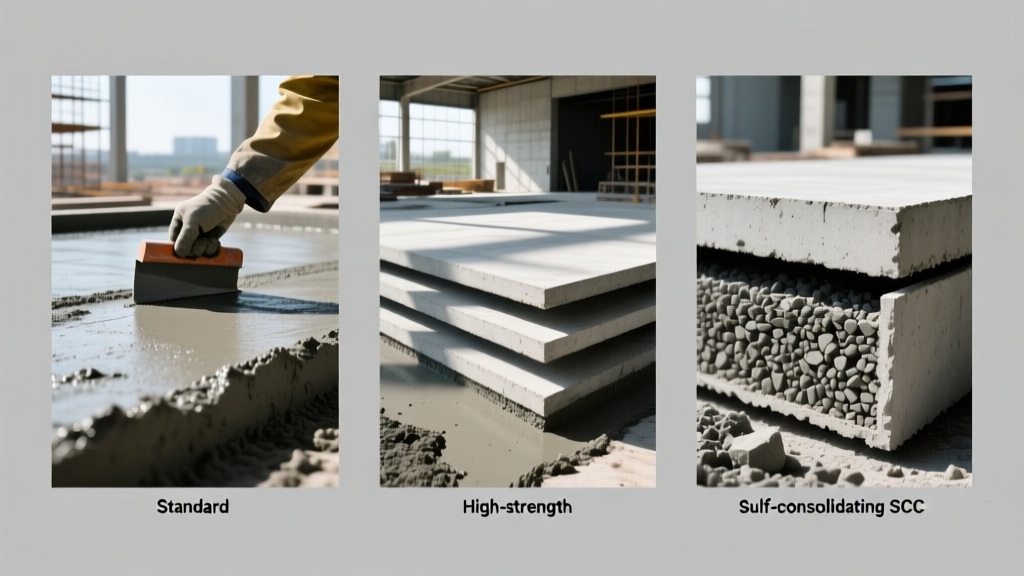
The Core Variables of Concrete Mix Design
Selecting the correct concrete formulation is the most critical decision in any structural or flatwork project. The performance, longevity, and ultimate cost of a pour are dictated long before the ready-mix truck arrives on site. When evaluating the different types of concrete mix available, contractors and engineers must balance compressive strength, workability, durability, and economics. A mismatch in mix design—such as using a standard 3,000 PSI slab mix for a heavily loaded industrial floor—will inevitably lead to premature cracking, spalling, or catastrophic structural failure.
According to the Portland Cement Association, modern mix design is not merely about combining cement, water, and aggregates. It requires precise proportioning based on the water-cement (w/c) ratio, which remains the single most influential factor governing concrete strength and permeability. Lowering the w/c ratio increases strength and durability but reduces workability, necessitating the use of chemical admixtures to maintain placement efficiency.
Matrix of Standard Mix Profiles
The table below outlines the primary specifications for the most commonly ordered ready-mix formulations in 2026. Pricing reflects national averages for delivered short-load and full-load ready-mix, excluding pumping or finishing labor.
| Mix Classification | Target PSI (28-Day) | w/c Ratio | Target Slump | Est. Cost per CY | Primary Application |
|---|---|---|---|---|---|
| Standard Structural | 3,000 - 4,000 | 0.45 - 0.50 | 4 - 5 inches | $135 - $155 | Residential flatwork, sidewalks, light foundations |
| High-Strength | 6,000 - 8,000 | 0.30 - 0.35 | 5 - 7 inches | $180 - $220 | High-rise columns, heavy industrial floors, post-tensioned decks |
| Self-Consolidating (SCC) | 4,000 - 6,000 | 0.35 - 0.40 | 18 - 24 inches (flow) | $165 - $195 | Densely reinforced walls, architectural precast, complex formwork |
| Lightweight Structural | 3,000 - 5,000 | 0.40 - 0.45 | 5 - 6 inches | $175 - $210 | Multi-story floor decks, bridge decks requiring dead-load reduction |
Deep Dive: Application-Specific Mix Designs
Standard Structural Mixes (3,000–4,000 PSI)
The baseline for most exterior flatwork and residential foundations is the 4,000 PSI mix. While 3,000 PSI was historically acceptable for interior slabs, modern building codes and best practices heavily favor 4,000 PSI for any surface exposed to freeze-thaw cycles. A standard 4,000 PSI mix typically utilizes a 1:2:3 volumetric ratio (one part Portland cement, two parts fine aggregate, three parts coarse aggregate). To meet ASTM C260 requirements for freeze-thaw durability, this mix must include an air-entraining admixture targeting 5% to 7% microscopic air content. These microscopic voids provide expansion chambers for freezing water, preventing internal hydraulic pressure from fracturing the paste.
High-Performance Concrete (HPC) (6,000+ PSI)
High-performance concrete goes beyond simple compressive strength; it is engineered for low permeability, high early strength, and long-term durability in aggressive environments. The Federal Highway Administration frequently mandates HPC for bridge decks and infrastructure exposed to de-icing salts. Achieving 8,000+ PSI requires dropping the w/c ratio below 0.30 and incorporating supplementary cementitious materials (SCMs). Silica fume (added at 5% to 10% by weight of cement) is critical in HPC. Its ultra-fine particles react with calcium hydroxide to form additional calcium silicate hydrate (C-S-H), densifying the matrix and drastically reducing chloride ion penetration.
Self-Consolidating Concrete (SCC)
SCC represents a major leap in placement technology. Designed to flow under its own weight and fill heavily congested rebar cages without mechanical vibration, SCC relies on a delicate balance of high-range water-reducing admixtures (HRWRA), typically polycarboxylate ethers (PCE), and viscosity-modifying admixtures (VMAs). The National Ready Mixed Concrete Association outlines that SCC is tested via slump flow rather than standard slump, with target spreads between 18 and 32 inches. The primary advantage of SCC is the elimination of vibration, which reduces labor costs, prevents honeycombing, and yields a superior architectural finish on formed surfaces.
Modifying Mix Behavior with Chemical Admixtures
Chemical admixtures (governed by ASTM C494) allow batch plants to customize the different types of concrete mix to specific site conditions, weather, and scheduling demands.
- Accelerators (Type C/E): Calcium chloride or non-chloride alternatives (like calcium nitrate) speed up the hydration process. Crucial for cold-weather pours to achieve finishing strength before temperatures drop below freezing. Non-chloride versions are mandatory for reinforced concrete to prevent rebar corrosion.
- Retarders (Type B/D): Lignosulfonates or synthetic polymers delay the initial set. Essential for hot-weather concreting or long-haul transit times to prevent cold joints and plastic shrinkage cracking.
- Superplasticizers (Type F/G): Also known as HRWRAs, these disperse cement floccules, allowing for a massive reduction in mixing water while maintaining high workability. They are the enabling technology for high-strength and SCC mixes.
Adding water to the ready-mix truck chute on-site to improve workability is the most common and destructive error in concrete placement. Every additional gallon of water per cubic yard increases the w/c ratio, potentially reducing the 28-day compressive strength by 200 to 300 PSI and increasing shrinkage cracking. If the mix is too stiff upon arrival, the only acceptable remedy is the addition of a dosed superplasticizer, not water.
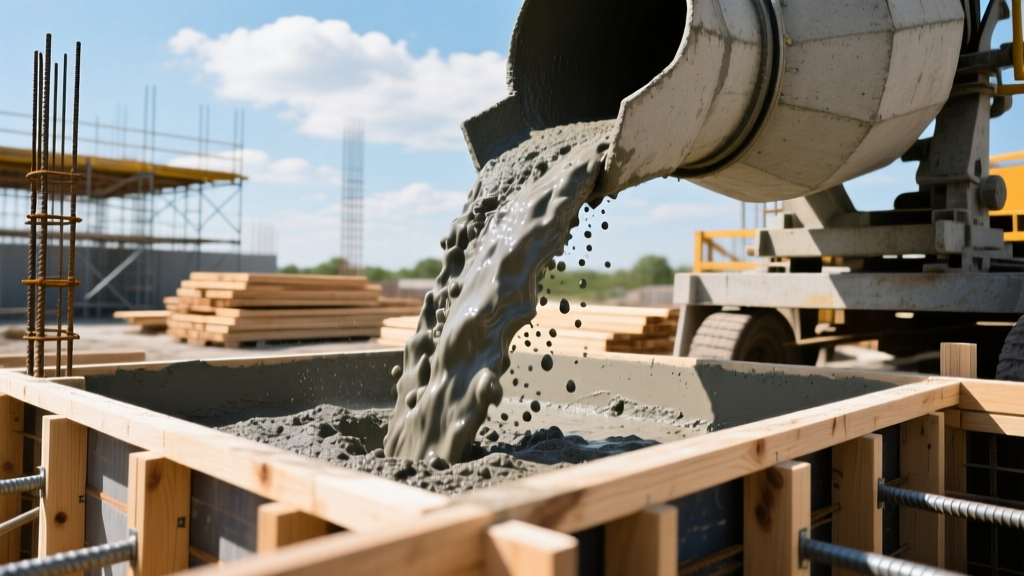
Field Verification: The Slump Cone Test
Regardless of the mix design specified by the structural engineer, field verification is mandatory to ensure the batch plant delivered the correct product. The slump test (ASTM C143) measures the consistency and workability of the fresh concrete.
During a standard test, a 12-inch truncated cone is filled in three equal rodded layers. When the cone is lifted, the distance the concrete subsides is the 'slump'. A 4-inch slump is standard for flatwork, while 6 to 7 inches is typical for pumped wall forms. If the measured slump deviates from the ticket specifications by more than 1 inch, the load should be rejected or modified with admixtures under the direct supervision of the batch plant representative. Relying on visual estimation rather than empirical field testing frequently results in undocumented w/c ratio deviations that compromise the structural integrity of the final pour.
Written by
Marcus ChenMarcus Chen is a licensed structural engineer (PE) and building materials analyst with over 12 years of experience across residential, commercial, and industrial construction. He holds a Master of Science in Civil Engineering from UC Berkeley and spent six years at Thornton Tomasetti before transitioning to independent consulting and technical writing. Marcus specializes in material selection for seismic-prone regions, concrete reinforcement strategies, and lifecycle cost analysis. His work has been cited by the American Concrete Institute (ACI) and the Structural Engineers Association of California (SEAOC). When he is not on a job site or at his desk, you will find him hiking the Sierra Nevada or restoring a 1920s craftsman bungalow in Oakland, CA.
More from Marcus Chen
View all
Construction Cost
How Much Did the Eiffel Tower Cost to Build?
How much did the Eiffel Tower cost to build in 1889? We adjust for inflation and compare its budget to modern skyscraper construction.
Aug 4, 2026

Fire Resistance
What Is a Fire Resistant Material? Testing & Certification Guide
Discover what is a fire resistant material through ASTM and UL testing. Learn how fire ratings, certifications, and assemblies work in construction.
Aug 4, 2026

Construction Cost
How Much Did the Burj Khalifa Cost to Build?
How much did the Burj Khalifa cost to build? We break down the $1.5B project and extract 5 money-saving strategies for your next build.
Jul 30, 2026