Guide to Different Types of Concrete Floor Finishes and Costs
Compare different types of concrete floor finishes including polished, stained, and epoxy. Explore costs, durability, and installation steps for your project.
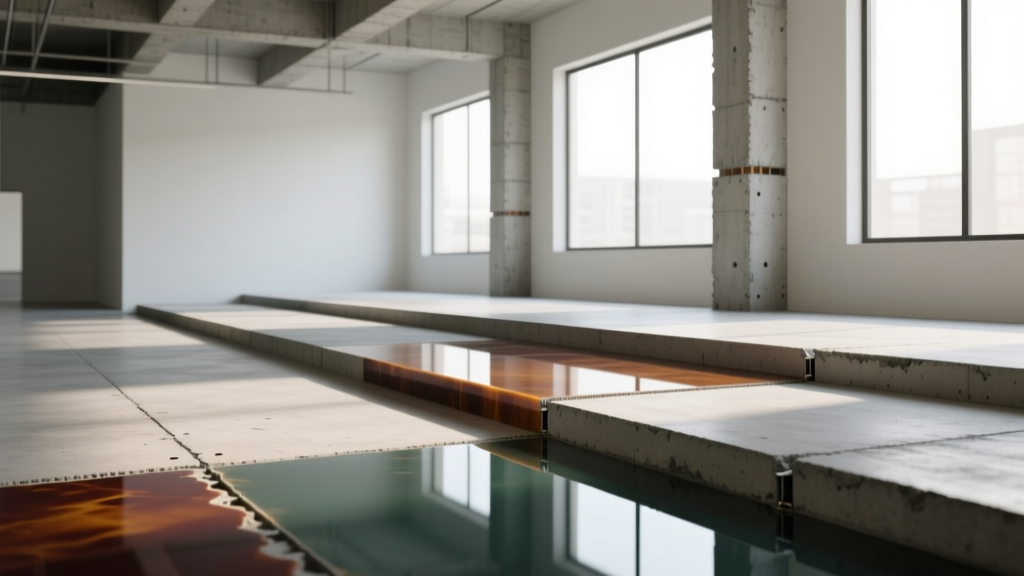
The Concrete Floor Finish Decision Matrix
Concrete slabs are no longer just structural subfloors hidden beneath carpet or tile. With the right treatment, they become the primary wearing surface, offering exceptional durability and thermal mass. Selecting among the different types of concrete floor finishes requires understanding the slab's current condition, moisture vapor transmission (MVT) rates, and expected traffic loads. The wrong choice leads to delamination, peeling, or rapid wear.
Use the decision matrix below to map your project requirements to the appropriate finish category before specifying materials.
| Finish Category | Mechanism | Added Thickness | Avg. Cost (per sq.ft.) | Best Application |
|---|---|---|---|---|
| Mechanical (Polished) | Abrasive grinding & densification | 0 inches (removes ~1/16') | $4.50 - $9.00 | Retail, showrooms, heavy foot traffic |
| Chemical (Stained) | Chemical reaction with lime | 0 inches (penetrates 1-2mm) | $2.50 - $5.00 | Residential, patios, low-impact areas |
| Coated (Epoxy/Urethane) | Surface adhesion & cross-linking | 10 to 60 mils | $5.00 - $12.00 | Garages, labs, industrial facilities |
| Overlaid (Micro-topping) | Polymer-modified cementitious bond | 1/16' to 1/8' | $7.00 - $15.00 | Renovations over damaged slabs |
Mechanical and Abrasive Finishes
Polished Concrete: The Grit Progression
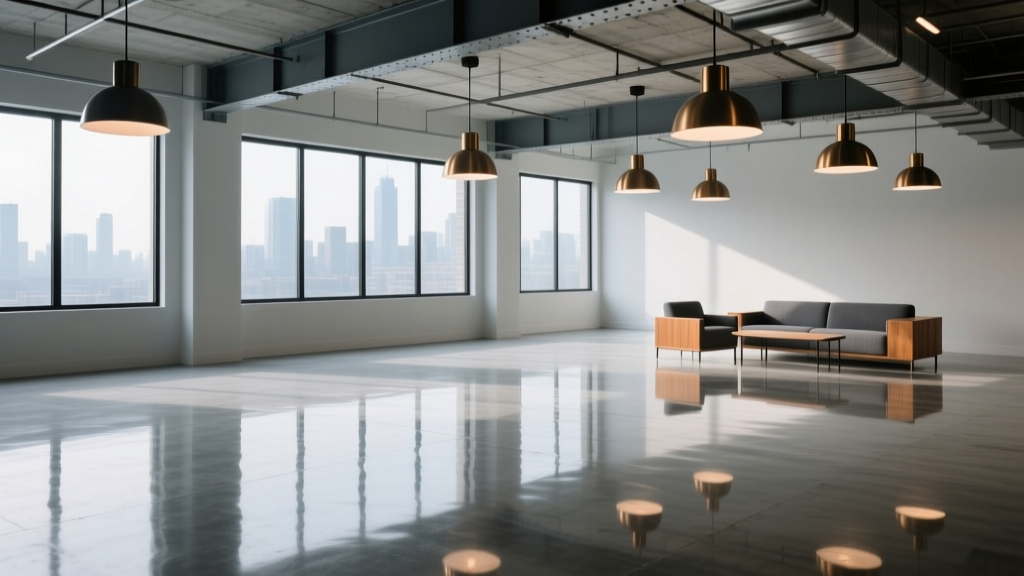
Polished concrete is not a coating; it is the physical refinement of the concrete matrix itself. The process relies on heavy planetary grinders equipped with diamond-impregnated segments. The critical differentiator between a true polish and a simple 'grind-and-seal' is the use of a chemical densifier and a multi-step grit progression.
After the initial 50-grit and 100-grit metal-bond diamonds cut the surface, a lithium silicate densifier is applied. This chemical reacts with the free calcium hydroxide in the concrete to form additional calcium silicate hydrate (C-S-H), permanently hardening the surface. The grinding then transitions to resin-bond diamonds (200, 400, 800, 1500, and up to 3000 grit) to burnish the surface to a high-gloss, glass-like finish.
Grind and Seal: The Budget Alternative
For projects where the budget cannot accommodate a 7-step mechanical polish, a grind-and-seal finish offers a similar aesthetic at roughly 40% less cost. The slab is ground to a 120-grit or 200-grit finish to expose the fine sand aggregate, cleaned, and then sealed with a high-solids polyurethane or polyaspartic topcoat. While it provides excellent UV stability and stain resistance, the sheen comes from the topical sealer rather than the concrete itself, meaning it will require recoating every 3 to 5 years in commercial settings.
Chemical and Penetrating Finishes
Acid Staining: Metallic Salt Reactions
Acid stains do not contain pigment. Instead, they are aqueous solutions of water, hydrochloric acid, and metallic salts. When applied, the acid etches the surface and opens the pores, allowing the metallic salts to react with the calcium hydroxide. The result is a permanent, translucent, variegated color that mimics natural stone or aged leather.
- Iron Chloride / Iron Sulfate: Produces earthy browns, rusts, and terracotta tones.
- Copper Sulfate: Yields blues, greens, and turquoise hues (highly dependent on the slab's age and lime content).
- Zinc Sulfate: Creates yellowish-brown and ochre variations.
Critical Step: Acid staining leaves active hydrochloric acid in the pores. The slab must be neutralized with a baking soda and water solution, followed by a thorough wet-vacuuming, before any sealer is applied. Failure to neutralize will cause topical sealers to delaminate within weeks.
Water-Based and Solvent-Based Dyes
Unlike acid stains, concrete dyes are non-reactive. They consist of microscopic colorants suspended in a water or solvent carrier. Solvent-based dyes penetrate deeply and dry in minutes, making them ideal for tight construction schedules, while water-based dyes offer more working time and richer, more uniform color saturation. Dyes are highly susceptible to UV fading and must be locked in with a UV-stable urethane sealer if exposed to direct sunlight.
Coated and Overlaid Systems
100% Solids Epoxy vs. Water-Based Epoxy
When specifying epoxy for garages, laboratories, or industrial facilities, understanding the solids content is non-negotiable. 'Water-based' or 'solvent-based' epoxies sold in big-box stores contain 40% to 60% solids; the rest evaporates, leaving a thin film (2-4 mils) that quickly chips under vehicular traffic.
Professional-grade 100% solids epoxy contains no volatile organic compounds (VOCs) that evaporate. What you apply is what you get, resulting in a 10 to 20-mil thick, high-build coating with a compressive strength exceeding 10,000 PSI. For heavy industrial use, a 100% solids epoxy mortar system can be troweled down to 1/8-inch thickness, incorporating quartz sand for extreme impact resistance.
Micro-Toppings and Skim Coats
When an existing slab is heavily spalled, riddled with patch marks, or features an ugly exposed aggregate that the owner wants to hide, micro-toppings provide a clean slate. These polymer-modified cementitious overlays can be applied as thin as 1/16-inch. The acrylic polymers provide the flexural strength needed to prevent cracking at such low thicknesses, while the Portland cement base accepts acid stains and dyes just like traditional concrete.
Critical Failure Modes and Surface Preparation
The most expensive finish will fail catastrophically if surface preparation and environmental conditions are ignored. According to the Portland Cement Association, the vast majority of coating failures are traced back to inadequate surface profiling or moisture issues.
Moisture Vapor Transmission (MVT): Before applying any topical finish (epoxy, urethane, or micro-topping), you must perform in-situ relative humidity testing per ASTM F2170. If the relative humidity at 40% depth of the slab exceeds 75%, standard epoxies will blister and peel as hydrostatic pressure pushes moisture vapor through the coating. High-moisture slabs require a specialized moisture-mitigating epoxy primer before the finish coat is applied.
Silica Dust and Safety Compliance
Mechanical grinding and scarifying generate massive amounts of respirable crystalline silica. Under OSHA's respirable crystalline silica standard, the permissible exposure limit (PEL) is strictly capped at 50 micrograms per cubic meter of air over an 8-hour shift. Contractors must use HEPA-filtered dust extraction shrouds attached directly to planetary grinders, and operators must wear N95 or P100 respirators when engineering controls cannot fully eliminate exposure.
Project Cost Breakdown and ROI
Budgeting for concrete finishes requires looking beyond the initial square-foot price. Consider the lifecycle maintenance and expected lifespan of the system.
- Polished Concrete ($4.50 - $9.00/sq.ft.): Highest upfront cost for mechanical finishes, but lowest lifecycle cost. Requires only daily dust mopping and occasional burnishing with a diamond pad. Lifespan: 20+ years.
- Acid Stain & Seal ($2.50 - $5.00/sq.ft.): Low initial cost, but the topical acrylic or urethane sealer must be stripped and reapplied every 3-5 years in commercial environments, increasing long-term OPEX.
- 100% Solids Epoxy Flake System ($7.00 - $12.00/sq.ft.): Includes diamond grinding, moisture testing, epoxy base coat, vinyl flake broadcast, and polyaspartic topcoat. Highly resistant to chemicals and impacts. Lifespan: 10-15 years.
- Micro-topping ($7.00 - $15.00/sq.ft.): Labor-intensive due to the hand-troweled application and multiple sealing steps. Best reserved for high-end residential or boutique retail where aesthetic perfection is required over damaged substrates.
By matching the specific chemical and mechanical properties of these finishes to your slab's condition and traffic demands, you can ensure a durable, high-performance floor that eliminates the need for secondary floor coverings.
Written by
David NakamuraDavid Nakamura is a licensed architect (AIA) and construction technology writer focused on sustainable building methods, mass timber engineering, and high-performance building envelopes. He holds a Master of Architecture from the University of Washington and is a certified Passive House Consultant (CPHC). David spent eight years at the Seattle firm Mithun, where he led the design of three LEED Platinum projects, before founding his own practice specializing in net-zero residential design. He serves on the editorial advisory board of GreenBuilder Magazine and has authored peer-reviewed papers on cross-laminated timber (CLT) connections for the Journal of Structural Engineering. In his spare time, David teaches woodworking at Pratt Fine Arts Center and kayaks the Puget Sound.
More from David Nakamura
View all
Construction Cost
Labor Cost to Build a Deck Per Sq Ft: 2026 Installation Guide
Discover the exact labor cost to build a deck per sq ft in 2026. This installation guide breaks down contractor rates, complexity factors, and hidden fees.
Aug 4, 2026

Construction Cost
How Much Does It Cost to Build a 3 Bedroom House? Financing Guide
Learn exactly how much it costs to build a 3 bedroom house and explore 2026 financing options, construction loan types, and budget frameworks for your build.
Aug 4, 2026

Construction Cost
Cost to Build a Tennis Court: 2026 Guide
How much does it cost to build a tennis court in 2026? Breakdowns for asphalt, concrete, and synthetic surfaces plus fencing and lighting.
Jul 30, 2026