Concrete Pavers vs Brick Paver: Driveway & Patio Guide
Compare concrete pavers vs brick paver materials for driveways and patios. Explore costs, durability, installation, and maintenance to choose the right option.

Material Composition: The Chemistry of Paving
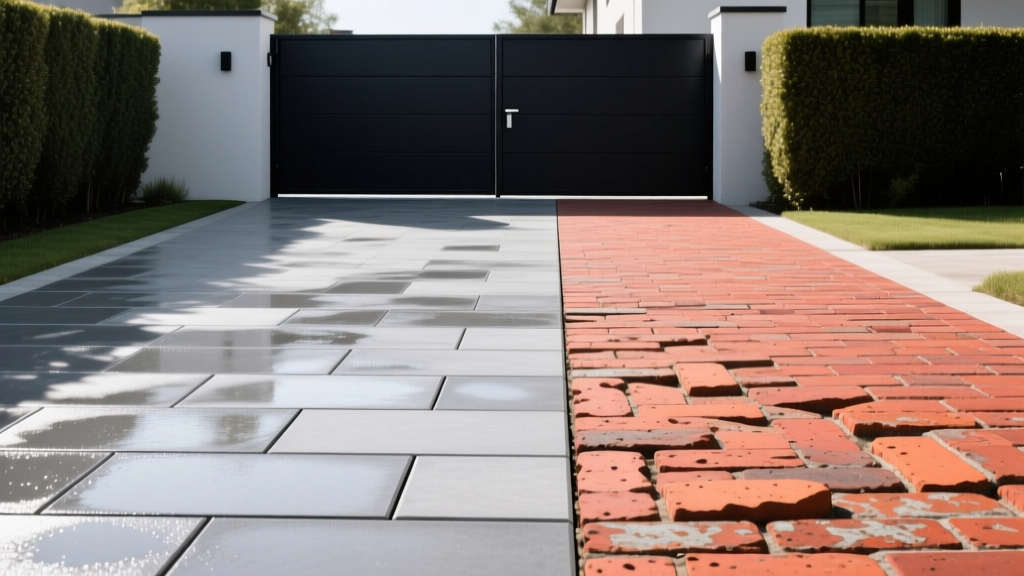
The choice between concrete and brick pavers is fundamentally a choice between manufactured composite materials and kiln-fired natural clay. Understanding the chemical and physical differences between these two materials is the first step in selecting the right surface for high-load driveways, pool decks, or pedestrian patios.
Concrete pavers are manufactured using a zero-slump concrete mixture (Portland cement, fine and coarse aggregates, and water) combined with iron oxide pigments. They are formed using high-pressure vibro-compaction machines, which compress the mixture into steel molds before being cured in a controlled environment. This process yields a dense, uniform product with highly customizable shapes and colors.
Brick pavers, conversely, are extruded or molded from natural clay and shale, then fired in kilns at temperatures exceeding 2,000°F (1,093°C). This vitrification process fuses the clay particles into a ceramic-like matrix. The color of a brick paver is derived entirely from the mineral composition of the clay and the firing atmosphere, meaning the color is permanent and runs through the entire unit.
Concrete Pavers vs Brick Paver: Head-to-Head Matrix
| Specification | Concrete Pavers | Clay Brick Pavers |
|---|---|---|
| Governing Standard | ASTM C936 | ASTM C902 |
| Minimum Compressive Strength | 8,000 psi | 10,000 psi |
| Max Water Absorption | 5% (by weight) | 7% (Type SX for severe weathering) |
| Color Longevity | 15-25 years (surface pigments fade) | Permanent (mineral-based vitrification) |
| Dimensional Tolerance | Extremely high (machine-molded) | Moderate (kiln-shrinkage variations) |
| Sealing Requirement | Recommended every 3-5 years | Rarely required; sealing can trap moisture |
Concrete Pavers: Performance, Pricing, and Pitfalls
Concrete pavers dominate the modern landscaping market due to their design versatility and lower initial cost. Brands like Belgard and Pavestone offer dozens of profiles, from tumbled cobblestone replicas to sleek, large-format architectural slabs. For vehicular driveways, the Interlocking Concrete Pavement Institute (ICPI) mandates a minimum thickness of 80mm (3.15 inches) to withstand dynamic vehicular loads without cracking.
The UV and Wear Factor
The most significant vulnerability of concrete pavers is color degradation. Standard concrete pavers utilize a 'face-mix' design, where a 3/8-inch layer of pigmented concrete is applied over a gray structural base. Over 10 to 15 years, UV exposure and foot traffic will wear away this pigmented layer, revealing the dull gray aggregate beneath. To mitigate this, specify 'full-body' or 'through-mix' concrete pavers, which are colored all the way through. While full-body pavers cost 20% to 30% more upfront, they eliminate the risk of color loss.
Because Portland cement contains soluble calcium salts, concrete pavers are highly susceptible to efflorescence—a white, powdery residue that blooms on the surface when moisture evaporates. While it does not compromise structural integrity, it requires chemical efflorescence removers and specialized cleaning to resolve. Using polymeric jointing sand and a breathable, penetrating sealer immediately after installation significantly reduces this occurrence.
Brick Pavers: Heritage Durability and Kiln-Fired Strength
Clay brick pavers, such as those manufactured by Pine Hall Brick or General Shale, offer unmatched compressive strength and color permanence. Fired to vitrification, brick pavers routinely exceed 12,000 psi, making them exceptionally resistant to heavy point-loads, such as the jacks of motorhomes or commercial delivery trucks. The Brick Industry Association (BIA) classifies brick pavers by weathering index; for any driveway or patio in a climate that experiences freeze-thaw cycles, you must specify Type SX (Severe Weathering) brick.
Sizing Tolerances and Jointing
Unlike the machine-perfect dimensions of concrete, clay bricks experience slight shrinkage and warping during the kiln-firing process. A nominal 4x8 inch brick paver typically measures 3.625 x 7.625 inches, but variances of up to 1/16 inch between individual units are common. This requires wider jointing gaps (typically 3/16 to 1/4 inch) filled with coarse, angular jointing sand. Attempting to butt clay bricks tightly together will result in edge-spalling and an uneven surface.
Subgrade and Base Preparation: The Make-or-Break Step
The most common cause of paver failure—regardless of whether you choose concrete or brick—is inadequate base preparation. Both materials are flexible pavement systems; they rely entirely on the underlying aggregate base for structural support. According to ICPI technical specifications, a standard residential driveway base must include:
- Subgrade Compaction: Native soil must be compacted to 95% Standard Proctor density.
- Geotextile Fabric: A non-woven separation fabric placed over the subgrade to prevent clay migration into the aggregate base.
- Aggregate Base: 6 to 8 inches of crushed, angular aggregate (ASTM D2940) compacted in 2-inch lifts. Rounded river gravel must never be used, as it will not interlock.
- Bedding Sand: Exactly 1 inch of coarse, washed concrete sand (ASTM C33). Never use masonry sand, stone dust, or limestone screenings, as these materials retain water and cause frost heave.
Installed Cost Breakdown (Current Market Rates)
Pricing fluctuates based on regional labor rates, site accessibility, and material selection. The following matrix reflects current national averages for a standard 500-square-foot residential driveway, including excavation, base preparation, materials, and installation.
| Cost Component | Concrete Pavers | Clay Brick Pavers |
|---|---|---|
| Material Cost (per sq. ft.) | $3.50 - $7.00 | $8.00 - $14.00 |
| Base Materials (per sq. ft.) | $1.50 - $2.50 | $1.50 - $2.50 |
| Labor & Installation (per sq. ft.) | $7.00 - $12.00 | $10.00 - $15.00 |
| Total Installed Cost (per sq. ft.) | $12.00 - $21.50 | $19.50 - $31.50 |
Note: Complex patterns (like herringbone or basketweave) increase labor costs by 15% to 20% due to the high volume of cuts required at the perimeter.
The Decision Matrix: Which Material Fits Your Project?
Use the following framework to determine the optimal material for your specific application:
Scenario A: High-Load Driveway in a Freeze-Thaw Climate
Recommendation: 80mm Concrete Pavers (Full-Body) or Type SX Clay Brick.
Why: Both meet the structural requirements, but concrete offers wider format options that speed up installation. Ensure a minimum 8-inch aggregate base.
Scenario B: Pool Deck in a High-Sun Environment
Recommendation: Light-colored Concrete Pavers with a textured, non-slip finish.
Why: Dark clay bricks absorb massive amounts of solar radiation and can become dangerously hot on bare feet. Light-colored concrete reflects UV rays, keeping the surface temperature up to 30°F cooler.
Scenario C: Historic Home Renovation or Formal Courtyard
Recommendation: Reclaimed or Tumbled Clay Brick Pavers.
Why: Brick provides authentic, timeless character that concrete cannot replicate. The natural color variations and slight imperfections of clay complement traditional architecture perfectly.
Scenario D: Budget-Conscious Patio with Complex Curves
Recommendation: Concrete Pavers.
Why: Concrete pavers are available in specialized wedge shapes and smaller modular units designed specifically for radial patterns, whereas cutting brittle clay brick to fit tight curves results in high material waste and labor costs.
Maintenance and Long-Term Care
The maintenance profiles of these two materials diverge significantly after installation. Concrete pavers require periodic re-sanding of joints and the application of a breathable, water-based sealant every three to five years to protect the surface pigments from oil stains and UV fading. If a concrete paver cracks, it can be easily pried up and replaced with an identical unit.
Clay brick pavers, on the other hand, are virtually maintenance-free regarding surface protection. Sealing clay brick is generally discouraged; because brick is highly porous, surface sealants can trap internal moisture, leading to catastrophic spalling when that moisture freezes. Maintenance for brick is limited to occasional weed control in the joints and power washing to remove organic growth. While the initial investment for brick is substantially higher, its zero-maintenance surface and permanent color often result in a lower total cost of ownership over a 40-year lifespan.
Written by
James ThorntonJames Thornton is a construction industry veteran with 25 years of hands-on experience in wood framing, lumber grading, and residential building codes. He started as a framing carpenter in rural Oregon, earned his ICC Residential Building Inspector certification, and eventually became a senior plan reviewer for the City of Portland Bureau of Development Services. James holds a B.S. in Wood Science & Technology from Oregon State University and is a certified lumber grader through the West Coast Lumber Inspection Bureau (WCLIB). He has inspected over 3,000 residential construction sites and authored the city's internal guide on advanced framing techniques (2x6 at 24" O.C.). James lives in Bend, OR, where he builds custom timber-frame cabins and competes in lumberjack sports.
More from James Thornton
View all
Insulation
Best Home Insulation Materials: Complete 2026 Guide
Compare top home insulation materials for 2026. Find R-values, installed costs per square foot, and best uses for fiberglass, spray foam, and mineral wool.
Aug 4, 2026

Sustainable Building
Certify Your Green Building Material for LEED and WELL
Step-by-step guide to certifying a green building material for LEED v5 and WELL v2. Master EPDs, HPDs, and VOC limits for 2026 project specifications.
Aug 4, 2026

Stone & Masonry
Veneer Stacked Stone Panels: Interior Design & Style Showcase
Discover how veneer stacked stone panels transform interiors. Explore modern design profiles, material pairings, and technical installation specs.
Aug 4, 2026