Concrete Roads vs Asphalt Roads: Paving Cost, Lifespan, and Durability
Compare concrete roads vs asphalt roads with current paving costs, lifespan data, load-bearing metrics, and maintenance frameworks for municipal projects.
Structural Mechanics: Rigid Slabs vs. Flexible Layers
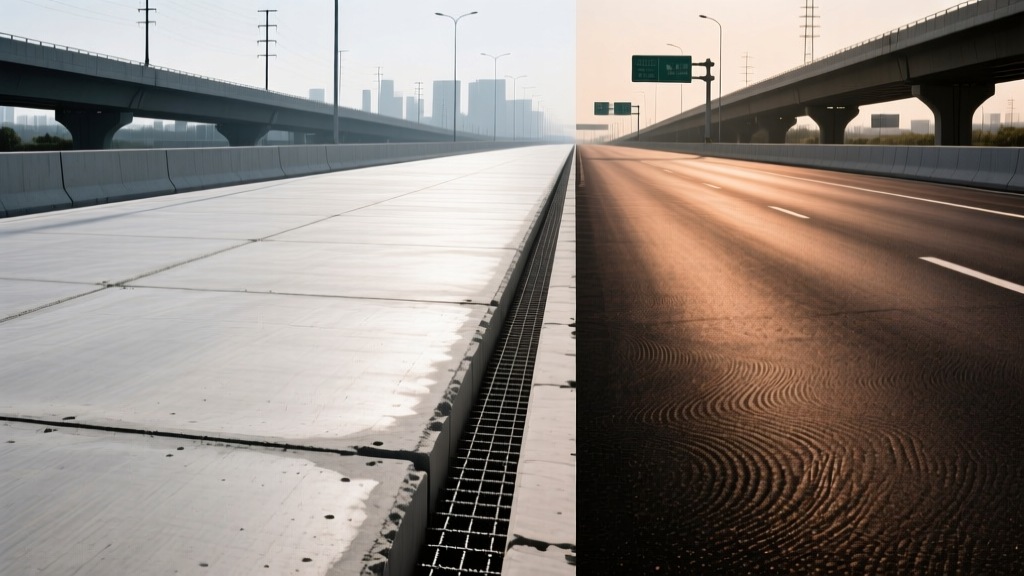
The fundamental difference between concrete roads and asphalt roads lies in how they distribute vehicular loads to the underlying subgrade. Understanding this mechanical divergence is critical for specifying the correct pavement type based on traffic volume and soil conditions.
Portland Cement Concrete (PCC): Rigid Pavement
Concrete operates as a rigid pavement. Its high modulus of elasticity allows the slab to bridge over minor subgrade irregularities, distributing heavy wheel loads across a wide area through slab action. A typical 2026 municipal arterial specification calls for an 8- to 10-inch thick dowel-bar reinforced concrete slab placed over a 4-inch lean concrete or asphalt-treated base. This non-erodible base is mandatory to prevent 'pumping'—the ejection of subgrade fines through joints caused by heavy traffic deflection and water intrusion.
Hot Mix Asphalt (HMA): Flexible Pavement
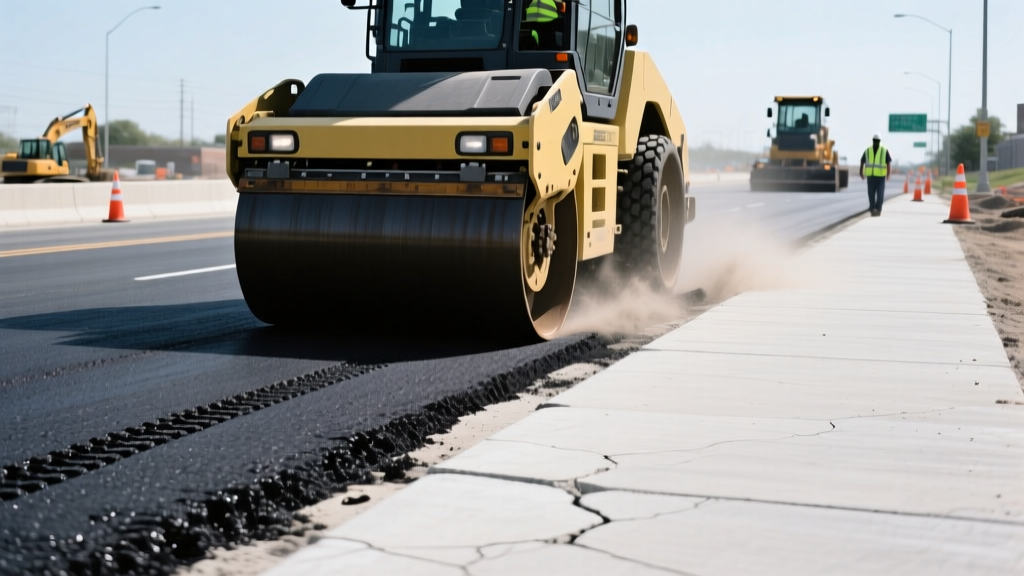
Asphalt is a flexible pavement system that relies on grain-to-grain load transfer through its layered structure. The load is dissipated at a roughly 45-degree angle downward through the surface course, base course, and subbase. Because asphalt lacks the structural rigidity of concrete, it requires a significantly thicker aggregate base course (often 12 to 24 inches) to prevent the subgrade from failing under heavy Equivalent Single Axle Loads (ESALs). Modern highway designs frequently utilize Stone Matrix Asphalt (SMA) or polymer-modified binders (like PG 76-22) in the surface course to resist rutting in high-stress braking zones.
The Cost Matrix: Initial vs. Lifecycle Paving Expenses
While asphalt consistently wins the initial bid due to lower material and placement costs, concrete frequently achieves a lower Life Cycle Cost Analysis (LCCA) over a 40-year period on high-traffic corridors. The following table outlines current 2026 pricing benchmarks for standard two-lane municipal road construction.
| Metric | Concrete (PCC) | Asphalt (HMA) |
|---|---|---|
| Initial Cost (per sq. yard) | $110 - $150 | $55 - $85 |
| Design Life Expectancy | 30 - 50 years | 15 - 20 years |
| Primary Rehabilitation Method | Diamond Grinding ($3 - $6/sq yd) | Mill & Overlay ($25 - $40/sq yd) |
| Rehabilitation Interval | Every 15 - 25 years | Every 8 - 12 years |
| 40-Year Annualized Lifecycle Cost | Lower (for ESALs > 10M) | Lower (for ESALs < 3M) |
According to data tracked by the Federal Highway Administration's Long-Term Pavement Performance program, the crossover point where concrete becomes more economically viable than asphalt typically occurs when traffic volumes exceed 10 million ESALs over the design period. For rural collectors and residential streets, asphalt remains the undisputed economic choice.
Durability, Load-Bearing, and Failure Modes
Both materials degrade, but their failure mechanisms require entirely different maintenance strategies. Recognizing these edge cases prevents catastrophic pavement failures.
Concrete Failure Modes
- Joint Faulting: Occurs when dowel bars misalign or subgrade support washes away, causing one slab edge to sit higher than the adjacent one. This creates a 'thump-thump' ride quality issue.
- Corner Breaks: Heavy axle loads applied near slab corners induce high tensile stresses at the top of the slab, leading to diagonal cracking. Proper load transfer efficiency (LTE) via dowel baskets mitigates this.
- D-Cracking: A freeze-thaw durability issue originating in the coarse aggregate rather than the cement paste. Specifying low-permeability aggregates and limiting maximum aggregate size to 1 inch eliminates this risk in northern climates.
Asphalt Failure Modes
- Rutting (Plastic Deformation):strong> Permanent longitudinal depressions in the wheel path, typically caused by inadequate compaction during placement or a binder grade that is too soft for local high-temperature extremes.
- Top-Down Fatigue Cracking: Initiated at the surface due to tire-pavement interaction and binder oxidation, eventually propagating downward. Timely application of polymer-modified chip seals or thin asphalt overlays halts progression.
- Thermal Cracking: Transverse cracks caused by the asphalt binder contracting in extreme cold. Utilizing a high-quality PG binder with a low-temperature grade (e.g., the '-22' in PG 64-22) is the primary defense.
Environmental Impact and the Urban Heat Island Effect
The environmental calculus of concrete roads vs asphalt roads extends beyond embodied carbon. Surface albedo and end-of-life recyclability play massive roles in modern municipal sustainability mandates.
Albedo and Heat Retention: Fresh concrete has a high solar reflectance (albedo of 0.35 to 0.45), meaning it reflects a significant portion of solar radiation. Asphalt, conversely, has a very low albedo (0.05 to 0.10), absorbing heat and contributing heavily to the Urban Heat Island (UHI) effect. In dense metropolitan areas, specifying concrete can reduce localized ambient nighttime temperatures by up to 3°F, lowering municipal cooling energy demands. The American Concrete Pavement Association provides extensive modeling tools for engineers calculating UHI mitigation credits for LEED-certified infrastructure projects.
Recyclability: Asphalt is the most recycled material in the United States. According to the National Asphalt Pavement Association, modern plants routinely incorporate 20% to 30% Recycled Asphalt Pavement (RAP) into new surface courses, and up to 100% in base layers, without sacrificing performance. Concrete is also highly recyclable, but it is almost exclusively downcycled into Recycled Concrete Aggregate (RCA) for use as a subbase material, rather than being reintegrated into new structural concrete paving slabs.
Decision Framework: When to Specify Concrete vs. Asphalt
Use this practical framework during the preliminary design phase to select the optimal paving material for your specific project constraints.
Specify Concrete (PCC) When:
- High Traffic Volume: The route is an interstate, primary arterial, or heavy truck corridor exceeding 10 million ESALs.
- Utility Stability: The corridor has minimal underground utility conflicts. (Trenching through concrete and patching it to match the original ride quality is notoriously difficult and expensive).
- High-Stress Zones: The project includes bus stops, weigh stations, or signalized intersections where static loads and shear forces would destroy flexible pavement.
- Nighttime Visibility: The road lacks overhead lighting, and the high albedo of concrete is required to reflect headlight illumination, reducing municipal lighting infrastructure costs.
Specify Asphalt (HMA) When:
- Capital Constraints: The project operates on a strict initial capital budget, and lifecycle maintenance funds are secured separately.
- Utility-Heavy Corridors: The road runs through older urban grids with frequent water, gas, and fiber-optic maintenance requirements. Asphalt is easily milled, trenched, and patched.
- Fast-Track Timelines: The road must be opened to traffic immediately. Asphalt can be driven on as soon as it cools to ambient temperature (usually within hours), whereas concrete requires 7 to 14 days of curing to achieve sufficient compressive strength for heavy loads.
- Ride Quality Priorities: The project demands a perfectly smooth initial ride quality for high-speed passenger traffic, as asphalt pavers lay a continuous mat without the transverse joints inherent to concrete slip-form paving.
Ultimately, the choice between concrete roads and asphalt roads is not a matter of one material being universally superior. It is an exercise in aligning material physics with traffic data, budget structures, and long-term maintenance capabilities. By applying rigorous LCCA and understanding the specific failure mechanisms of both PCC and HMA, engineers can deliver infrastructure that performs reliably for decades.
Written by
David NakamuraDavid Nakamura is a licensed architect (AIA) and construction technology writer focused on sustainable building methods, mass timber engineering, and high-performance building envelopes. He holds a Master of Architecture from the University of Washington and is a certified Passive House Consultant (CPHC). David spent eight years at the Seattle firm Mithun, where he led the design of three LEED Platinum projects, before founding his own practice specializing in net-zero residential design. He serves on the editorial advisory board of GreenBuilder Magazine and has authored peer-reviewed papers on cross-laminated timber (CLT) connections for the Journal of Structural Engineering. In his spare time, David teaches woodworking at Pratt Fine Arts Center and kayaks the Puget Sound.
More from David Nakamura
View all
Construction Cost
Labor Cost to Build a Deck Per Sq Ft: 2026 Installation Guide
Discover the exact labor cost to build a deck per sq ft in 2026. This installation guide breaks down contractor rates, complexity factors, and hidden fees.
Aug 4, 2026

Construction Cost
How Much Does It Cost to Build a 3 Bedroom House? Financing Guide
Learn exactly how much it costs to build a 3 bedroom house and explore 2026 financing options, construction loan types, and budget frameworks for your build.
Aug 4, 2026

Construction Cost
Cost to Build a Tennis Court: 2026 Guide
How much does it cost to build a tennis court in 2026? Breakdowns for asphalt, concrete, and synthetic surfaces plus fencing and lighting.
Jul 30, 2026