Sealed Concrete vs Polished Concrete: Cost & Durability Compared
Compare sealed concrete vs polished concrete for your 2026 project. Analyze costs, durability, maintenance, and ideal applications for each finish.

The Core Distinction: Topical vs. Mechanical Finishes
When specifying a finished concrete floor, the debate between sealed concrete vs polished concrete fundamentally comes down to the difference between a topical coating and a mechanical refinement. While both methods enhance the appearance and performance of a raw concrete slab, their chemical and physical interactions with the substrate are entirely different.
Polished concrete is an integral finish. It relies on heavy planetary grinders equipped with diamond abrasives to physically cut, hone, and refine the surface of the concrete itself. A chemical densifier is then introduced to harden the matrix from the inside out. Sealed concrete, conversely, is a topical finish. It relies on a film-forming chemical layer—such as acrylic, polyurethane, or epoxy—that sits on top of the concrete pores to provide protection and sheen.
Quick Decision Matrix
- Choose Polished Concrete if: You need a 20+ year lifecycle, high light reflectivity for retail spaces, and have a structurally sound slab with minimal moisture vapor transmission (MVT).
- Choose Sealed Concrete if: You are working with a tight upfront budget, need to hide surface imperfections or previous patch jobs, or require heavy chemical/acid resistance in an industrial setting.
Deep Dive: Polished Concrete Mechanics and Costs
The polished concrete process is labor-intensive and requires specialized heavy equipment. According to the Concrete Polishing Council (CPC), achieving a true polished finish requires a minimum of three distinct grinding steps with progressively finer resin-bonded diamonds, following the initial metal-bonded prep work.
The Grinding and Densifying Process
The process begins with coarse metal-bonded diamonds (typically 30 or 40 grit) to remove the weak surface laitance and expose the desired aggregate profile. Once the floor is flattened and the aggregate is exposed, a chemical densifier is applied. Lithium silicate densifiers, such as PROSOCO Consolideck LS, react with the free lime and calcium hydroxide in the concrete to form calcium silicate hydrate (C-S-H). This permanently hardens the surface, preventing dusting and allowing the subsequent resin-bonded polishing steps (ranging from 100-grit up to 3000-grit) to achieve a high-gloss reflection.
2026 Pricing Breakdown
Polished concrete pricing is directly tied to the desired Grit Level and Aggregate Exposure. As of 2026, national averages for commercial projects are:
- Level 1 (400-Grit Honed): $3.50 – $5.00 per sq. ft. (Matte finish, no aggregate exposure).
- Level 2 (800-Grit Semi-Polished): $5.50 – $8.00 per sq. ft. (Satin finish, fine sand exposure).
- Level 3 (1500 to 3000-Grit Highly Polished): $8.50 – $14.00+ per sq. ft. (Mirror-like reflectivity, full aggregate exposure).
Deep Dive: Sealed Concrete Applications and Limits
Sealed concrete bypasses the mechanical grinding process, relying instead on surface preparation and chemical adhesion. The longevity of a sealed floor is entirely dependent on the chemistry of the sealer and the quality of the surface prep.
Sealer Chemistries: Acrylic vs. Polyurethane vs. Epoxy
Not all sealers perform equally. Selecting the right chemistry is critical for the environment:
- Acrylic Sealers: The most economical option ($1.50 – $3.00 per sq. ft.). They provide a basic wet-look and UV stability but wear away quickly under foot traffic. Expect to reapply every 1 to 2 years in commercial settings.
- Aliphatic Polyurethanes: Mid-range cost ($3.50 – $6.50 per sq. ft.). These offer excellent UV resistance, high abrasion tolerance, and do not yellow over time. They are the standard for exterior sealed concrete and interior retail spaces.
- Epoxy and Polyaspartic Topcoats: High-end cost ($6.00 – $10.00+ per sq. ft.). Epoxies provide massive build thickness and chemical resistance but will amber under UV light. Polyaspartics offer similar durability with rapid cure times and UV stability.
Lifecycle Costs and Reapplication
While sealed concrete is cheaper to install initially, the lifecycle cost often surpasses polished concrete within 7 to 10 years. Film-forming sealers act as a sacrificial wear layer. In high-traffic corridors, forklift lanes, or retail entrances, the physical friction will eventually degrade the polymer matrix, requiring a full mechanical scarification and recoat.
Head-to-Head Comparison Matrix
| Feature | Polished Concrete (Integral) | Sealed Concrete (Topical Film) |
|---|---|---|
| Upfront Cost | High ($5.50 - $14.00/sq ft) | Low to Moderate ($1.50 - $6.50/sq ft) |
| Lifecycle (Years) | 15 - 30+ years | 2 - 7 years (before recoat) |
| Maintenance | Daily dust mopping, neutral pH cleaner | Standard cleaning, avoid harsh solvents |
| Slip Resistance (Wet) | Low (DCOF often < 0.42 unless treated) | High (can be broadcast with aluminum oxide) |
| Hides Flaws? | No (exposes cracks and patching) | Yes (pigmented epoxies hide substrate) |
Failure Modes: What Actually Goes Wrong?
Understanding how these floors fail is the hallmark of expert specification. Both systems have distinct vulnerabilities that must be mitigated during the design phase.
Moisture Vapor Transmission (MVT) in Sealed Floors
The most catastrophic failure mode for sealed concrete is osmotic blistering caused by MVT. If a concrete slab was poured without a proper sub-slab vapor barrier, hydrostatic pressure will push moisture vapor upward. When this vapor hits the impermeable film of an epoxy or urethane sealer, it creates blisters and delamination. Always mandate ASTM F2170 relative humidity testing before specifying a topical sealer. If RH levels exceed 75%, you must use a moisture-mitigating epoxy primer or pivot to a breathable polished finish.
Acid Etching and Micro-Scratching in Polished Floors
While polished concrete is incredibly hard, it is fundamentally alkaline. It is highly susceptible to acidic spills. Citrus juices, vinegar, carbonated beverages, and acidic commercial cleaning agents will chemically etch the surface, leaving permanent dull spots. Furthermore, 3000-grit highly polished floors will show micro-scratches from abrasive dirt and sand tracked in from outdoors. To mitigate this, specify a high-quality stain guard (like a fluoropolymer or silicone-based penetrating guard) and mandate walk-off matting at all exterior entries.
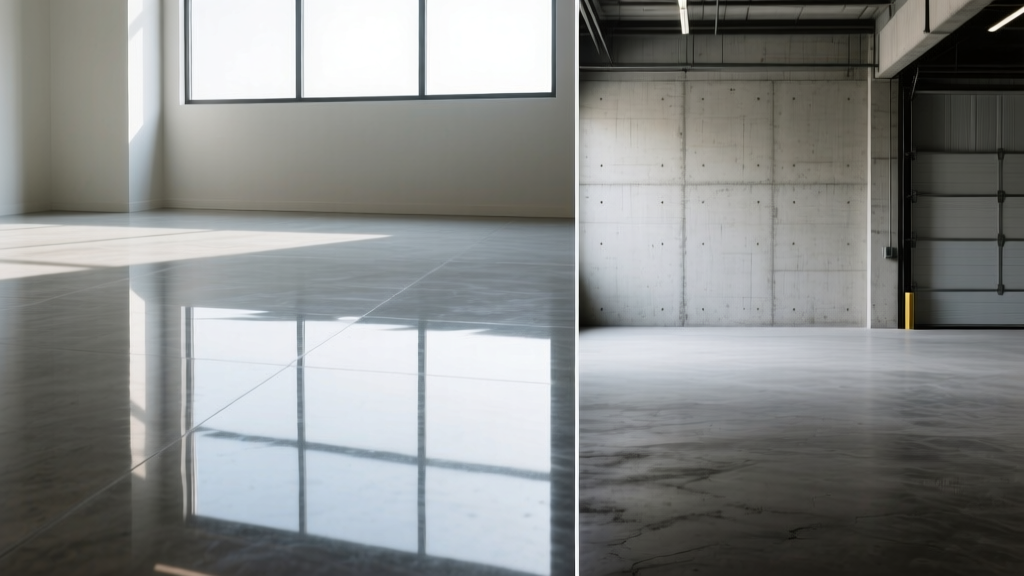
The Verdict: Matching the Finish to the Environment
The choice between sealed concrete vs polished concrete should never be made on upfront cost alone. For big-box retail, automotive showrooms, and modern office lobbies where light reflectivity and long-term lifecycle costs are paramount, polished concrete is the undisputed champion. The mechanical densification ensures the floor will outlast the lease.
Conversely, for industrial warehouses requiring heavy chemical spill resistance, exterior pool decks needing aggressive slip resistance, or renovation projects where the existing slab is heavily scarred and visually compromised, a high-performance sealed system (such as a polyaspartic topcoat over an epoxy base) provides the necessary functional protection and aesthetic uniformity that polishing simply cannot achieve.
Written by
Marcus ChenMarcus Chen is a licensed structural engineer (PE) and building materials analyst with over 12 years of experience across residential, commercial, and industrial construction. He holds a Master of Science in Civil Engineering from UC Berkeley and spent six years at Thornton Tomasetti before transitioning to independent consulting and technical writing. Marcus specializes in material selection for seismic-prone regions, concrete reinforcement strategies, and lifecycle cost analysis. His work has been cited by the American Concrete Institute (ACI) and the Structural Engineers Association of California (SEAOC). When he is not on a job site or at his desk, you will find him hiking the Sierra Nevada or restoring a 1920s craftsman bungalow in Oakland, CA.
More from Marcus Chen
View all
Construction Cost
How Much Did the Eiffel Tower Cost to Build?
How much did the Eiffel Tower cost to build in 1889? We adjust for inflation and compare its budget to modern skyscraper construction.
Aug 4, 2026

Fire Resistance
What Is a Fire Resistant Material? Testing & Certification Guide
Discover what is a fire resistant material through ASTM and UL testing. Learn how fire ratings, certifications, and assemblies work in construction.
Aug 4, 2026

Construction Cost
How Much Did the Burj Khalifa Cost to Build?
How much did the Burj Khalifa cost to build? We break down the $1.5B project and extract 5 money-saving strategies for your next build.
Jul 30, 2026