Concrete vs Asphalt Driveway: Cost, Lifespan, and Climate Guide
Compare concrete vs asphalt driveway options. Explore installation costs, structural lifespan, climate suitability, and long-term maintenance needs.

The Core Showdown: Quick Decision Matrix
Choosing between a concrete vs asphalt driveway is rarely just about the initial price tag. It is a structural decision that impacts your property's drainage, curb appeal, and maintenance schedule for the next three decades. While asphalt offers a lower barrier to entry and faster curing times, concrete delivers superior longevity and load-bearing capacity. Below is a high-level decision framework to help you align your material choice with your specific property constraints.
The 30-Second Decision Framework
- Choose Concrete If: You live in a hot climate, plan to stay in the home for 15+ years, park heavy RVs/boats, or want decorative stamped finishes.
- Choose Asphalt If: You are in a region with severe freeze-thaw cycles, have a strict upfront budget, need the driveway usable within 48 hours, or prefer easy DIY crack patching.
Upfront Installation Costs & Material Breakdown
The financial divergence between the two materials is most pronounced on day one. In 2026, the national average for a standard 600-square-foot residential driveway installation reveals a significant premium for concrete. However, analyzing the cost per year of expected lifespan tells a different story.
| Cost Factor | Concrete Driveway | Asphalt Driveway |
|---|---|---|
| Material & Labor (per sq. ft.) | $8.00 – $14.00 | $4.00 – $8.00 |
| Base Preparation (per sq. ft.) | $1.50 – $2.50 | $1.00 – $2.00 |
| Old Driveway Demolition/Removal | $2.00 – $5.00 | $1.50 – $3.50 |
| Total Average (600 sq. ft.) | $6,900 – $12,900 | $3,900 – $8,100 |
The Hidden Cost: Subgrade Engineering
Both materials will fail catastrophically if the subgrade is ignored, but their specific requirements differ. Concrete relies on a uniform, rigid support system. A standard specification requires 4 to 6 inches of compacted crushed aggregate base (meeting ASTM D2940 standards) to prevent differential settling, which leads to slab cracking. Asphalt, being a flexible pavement, requires a thicker aggregate base—typically 6 to 8 inches of compacted crushed stone—to distribute dynamic vehicular loads and prevent rutting.
Lifespan, Durability, and Structural Failure Modes
When evaluating a concrete vs asphalt driveway, understanding how each material fails is critical for long-term planning. According to data from the Federal Highway Administration, flexible pavements (asphalt) and rigid pavements (concrete) exhibit entirely different degradation curves.
Concrete: Rigid Pavement Failure Modes
A properly poured 4-inch thick concrete slab using a 4,000 PSI air-entrained mix will last 30 to 50 years. However, it is susceptible to specific structural failures:
- D-Cracking: Occurs when the coarse aggregate used in the mix is porous and absorbs water. During freeze-thaw cycles, the aggregate expands and cracks the surrounding mortar matrix. Always specify low-porosity aggregate in northern climates.
- Frost Heave & Differential Settlement: Because concrete is rigid, if the subgrade washes out or heaves, the slab will snap rather than bend. This is why control joints must be cut every 10 feet to force cracking along predetermined, straight lines.
- Surface Spalling: Often caused by finishing the concrete while bleed water is still on the surface, trapping water under the crust, which later flakes off during winter freezing.
Asphalt: Flexible Pavement Failure Modes
Hot Mix Asphalt (HMA) driveways typically last 15 to 25 years. Its failures are largely surface-level and progressive:
- Alligator (Fatigue) Cracking: Interconnected cracks resembling reptile skin, indicating the asphalt layer is too thin for the loads applied, or the base has become saturated with water.
- Oxidation and Raveling: UV rays and oxygen cause the bitumen binder to become brittle. The surface aggregates then loosen and ravel away, creating a rough, pitted texture.
- Thermal Cracking: In extreme cold, asphalt contracts. If it cannot contract freely, it tears, creating deep, transverse cracks across the driveway width.
Climate & Environmental Performance
Your geographic location should heavily dictate your material choice. The thermal properties of concrete and asphalt react inversely to extreme weather.
Hot & Sunny Climates
Winner: Concrete. Asphalt softens in temperatures exceeding 90°F, making it susceptible to rutting from heavy vehicle tires or jack stands. Furthermore, the EPA Heat Island Effect data highlights that dark asphalt absorbs up to 95% of solar radiation, significantly raising ambient temperatures around your home. Concrete's high albedo reflects sunlight, keeping the surrounding microclimate cooler.
Freeze-Thaw & Snow Climates
Winner: Asphalt. Asphalt's flexibility allows it to expand and contract with deep freezes without snapping. Additionally, the black surface absorbs winter sunlight, accelerating snow and ice melt. Concrete requires expensive de-icing chemicals; using rock salt (sodium chloride) on concrete causes severe surface scaling and accelerates the corrosion of embedded steel rebar.
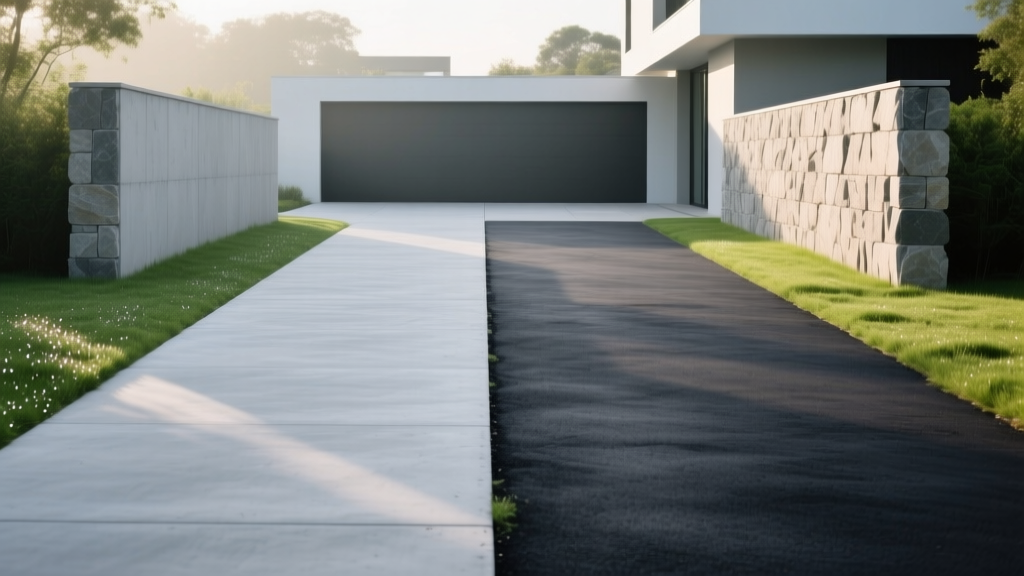
Maintenance Realities: Sealing, Patching, and Resurfacing
The maintenance profiles of the two materials require completely different chemical approaches and time commitments.
Asphalt Maintenance Protocol
Asphalt requires proactive, frequent maintenance to prevent binder degradation.
- Initial Cure: Wait 6 to 12 months before the first sealcoat to allow the asphalt oils to fully off-gas and cure.
- Sealcoating: Apply a coal tar or asphalt emulsion sealer every 2 to 3 years. Cost: $0.15 to $0.25 per square foot.
- Crack Filling: Annually inspect and fill transverse cracks with hot-pour rubberized crack filler before water infiltrates the base.
Concrete Maintenance Protocol
Concrete is largely 'install and forget,' but chemical protection extends its life dramatically.
- Sealing: Avoid film-forming acrylics which peel and yellow. Instead, apply a penetrating silane/siloxane sealer every 3 to 5 years. These chemicals react with the free lime in the concrete to form a hydrophobic barrier deep within the pores, preventing water and chloride intrusion. Cost: $0.20 to $0.40 per square foot.
- Joint Maintenance: Every 5 years, clear out debris from control joints and refill with a self-leveling polyurethane joint sealant to prevent incompressible stones from causing spalling when the slab expands in summer.
- Resurfacing: If the surface becomes heavily spalled but the structural base is sound, a polymer-modified concrete overlay (1/4 to 1/2 inch thick) can restore the surface for roughly $3.00 to $5.00 per square foot, avoiding full demolition.
Aesthetic and Property Value Impacts
From a real estate perspective, the visual impact of the driveway apron heavily influences curb appeal. The National Ready Mixed Concrete Association notes that decorative concrete applications consistently yield higher property value appraisals compared to standard gray slabs or asphalt.
"While asphalt is strictly utilitarian, concrete offers architectural versatility. A stamped and stained concrete driveway mimicking natural cobblestone or slate can increase overall property value by up to 10%, effectively paying for the material premium at the time of resale."
If you choose concrete but are on a budget, a simple 'broom finish' with scored control joints provides excellent slip resistance and a clean, modern geometric look. For asphalt, aesthetic options are limited to the initial deep black finish, which inevitably fades to a mottled gray within three years unless meticulously sealcoated.
Final Verdict: Which Should You Pour or Pave?
There is no universally superior material in the concrete vs asphalt driveway debate; there is only the right material for your specific site conditions and financial timeline.
Specify Concrete (4,000 PSI, 4-inch slab, #3 rebar at 24" O.C.) if: You are building your forever home, reside in the Sunbelt or areas with high summer temperatures, park heavy dual-axle trailers, and want to maximize resale curb appeal with minimal annual maintenance.
Specify Asphalt (2.5-inch compacted HMA over 6-inch aggregate base) if: You are flipping a property, live in the Upper Midwest or Northeast with brutal freeze-thaw cycles, need to minimize immediate capital expenditure, and do not mind dedicating a weekend every three years to apply sealcoat.
Ultimately, the success of either driveway relies 80% on the quality of the subgrade preparation and drainage engineering, and only 20% on the surface material itself. Ensure your contractor provides a detailed specification sheet outlining base depth, compaction testing, and mix designs before breaking ground.
Written by
Priya KapoorPriya Kapoor is a real estate market analyst and construction economics researcher with expertise in housing affordability, development feasibility, and infrastructure investment. She holds a Master of Regional Planning from Cornell University and previously worked as a senior analyst at CBRE's Investment Properties group, where she modeled returns for $4B in mixed-use development pipelines. Priya now runs an independent research practice advising developers, municipalities, and REITs on construction cost forecasting and market timing. She publishes the quarterly "BuildMat Market Pulse" report tracking material price indices across 12 commodity categories. Based in Austin, TX, Priya serves on the board of Habitat for Humanity Austin and is a marathon runner.
More from Priya Kapoor
View all
Construction Cost
Cost to Build a 1600 Sq Ft Home in 2026: Full Breakdown
Accurate 2026 cost to build a 1600 sq ft home—material, labor, and regional pricing breakdowns included. Plan your budget with real-time estimates.
Aug 11, 2026

Wood & Lumber
Name the Types of Wood for Pressure Treatment and Preservation
Learn how to name the types of wood best suited for pressure treatment. Compare species treatability, chemical retention levels, and 2026 preservation costs.
Aug 4, 2026

Stone & Masonry
Stone Veneer Suppliers Lindenhurst: 2026 Cost Analysis
Analyze 2026 stone veneer costs in Lindenhurst, NY. Compare local supplier pricing, delivery fees, and Suffolk County installation labor rates.
Aug 4, 2026