Concrete vs Asphalt Driveway Price: 2026 Mix Design Cost Guide
Compare the concrete vs asphalt driveway price in 2026. We break down mix designs, material costs, and 30-year lifecycle expenses to help you choose.

The True Cost of Pavement: Beyond the Surface Quote
Evaluating the concrete vs asphalt driveway price requires looking past the per-square-foot installation quote. The final cost is fundamentally driven by material science—specifically, the mix design, aggregate structure, and chemical additives required to ensure longevity in your specific climate. A cheap initial bid often reflects a diluted concrete mix or an undersized asphalt binder course, leading to premature rutting, scaling, or frost heave. In 2026, with fluctuating bitumen and cement prices, understanding the exact composition of your pavement is the only way to accurately forecast both immediate expenses and long-term lifecycle costs.
- Standard Concrete (4000 PSI): $8.50 – $12.00
- Premium Concrete (5000 PSI + Fiber): $12.50 – $16.00
- Standard Asphalt (PG 64-22): $5.50 – $8.50
- Polymer-Modified Asphalt (PG 76-22): $8.00 – $11.50
Deconstructing the Concrete Driveway Mix Design
Concrete pricing is dictated by the compressive strength (measured in PSI), the water-cement ratio, and the inclusion of admixtures. For residential driveways, the American Concrete Institute (ACI) recommends a minimum compressive strength of 4,000 PSI. However, the Portland Cement Association emphasizes that in regions experiencing freeze-thaw cycles, the mix design must include 5% to 7% air entrainment. These microscopic air bubbles provide expansion chambers for freezing water, preventing catastrophic surface scaling.
Standard vs. Premium Concrete Mixes
The price gap between a standard and premium concrete mix typically ranges from $15 to $35 per cubic yard, which translates to roughly $0.75 to $1.50 per square foot of finished driveway.
| Mix Design Parameter | Standard Driveway Mix | Premium / Heavy-Duty Mix | Cost Impact (2026) |
|---|---|---|---|
| Compressive Strength | 4,000 PSI at 28 days | 5,000+ PSI at 28 days | +$10 - $15 per cubic yard |
| Aggregate Size | 3/4-inch crushed stone | 3/4-inch with optimized gradation | Base price inclusion |
| Water-Cement Ratio | 0.50 (Standard workability) | 0.40 - 0.45 (Requires plasticizers) | +$8 - $12 per cubic yard |
| Secondary Reinforcement | Welded wire mesh (6x6 W2.9) | Macro-synthetic or steel fibers | +$12 - $20 per cubic yard |
| Air Entrainment | 5% - 7% (Cold climates) | 5% - 7% (Cold climates) | +$3 - $5 per cubic yard |
The Hidden Cost of Subgrade Preparation
Concrete is a rigid pavement; it relies entirely on uniform subgrade support. If the soil beneath the slab settles unevenly, the concrete will crack regardless of its PSI rating. Proper installation requires excavating 8 to 10 inches of topsoil and replacing it with a compacted Aggregate Base Course (ABC). Expect to pay $1.50 to $2.50 per square foot just for site preparation and base compaction. Skipping this step is the primary cause of structural failure in budget concrete installations.
Asphalt Binder and Aggregate Economics
Asphalt is a flexible pavement composed of roughly 95% mineral aggregate and 5% bitumen binder. The price of an asphalt driveway is heavily influenced by the Performance Grade (PG) of the binder and the thickness of the paving lifts. According to the Asphalt Institute, the binder must be engineered to withstand the specific high and low temperatures of your geographic region.
Understanding Performance Grades (PG)
A standard PG 64-22 binder is designed to resist rutting at pavement temperatures up to 64°C (147°F) and thermal cracking down to -22°C (-8°F). In regions with extreme summer heat or heavy static loads (like parked RVs or dump trucks), contractors should use a polymer-modified binder, such as PG 76-22. The addition of Styrene-Butadiene-Styrene (SBS) polymers increases the binder's elasticity, preventing the asphalt from softening and deforming under heavy tires in July heat. Polymer modification adds approximately 10% to 15% to the total material cost but significantly extends the pavement's structural life.
Structural Layering: Binder vs. Surface Course
A durable asphalt driveway requires a two-lift system over a 6-to-8-inch compacted aggregate base:
- Binder Course (Base Lift): 2 inches of Hot Mix Asphalt (HMA) utilizing larger aggregate (typically 3/4-inch) to provide structural load distribution.
- Surface Course (Top Lift): 1 to 1.5 inches of fine-graded HMA utilizing smaller aggregate (3/8-inch or 1/2-inch) to create a smooth, impermeable, and aesthetically pleasing driving surface.
Head-to-Head Price Matrix: Concrete vs Asphalt Driveway Price
The following matrix breaks down the average 2026 installed costs for a standard 1,000-square-foot residential driveway, assuming moderate site conditions and standard regional labor rates.
| Cost Category | 4,000 PSI Concrete (Broom Finish) | 3.5-Inch Two-Lift Asphalt (PG 64-22) |
|---|---|---|
| Demolition & Haul-Away (Existing) | $1,500 - $2,200 | $1,200 - $1,800 |
| Subgrade Excavation & Base Prep | $1,800 - $2,500 (8" ABC base) | $1,500 - $2,200 (6" ABC base) |
| Material Costs (Ready-Mix / HMA) | $2,800 - $3,400 | $1,600 - $2,100 |
| Labor & Equipment (Pump/Paver) | $2,500 - $3,500 | $1,800 - $2,500 |
| Finishing, Jointing, & Curing | $1,200 - $1,800 | $400 - $600 (Rolling & sealing edges) |
| Total Estimated Project Cost | $9,800 - $13,400 | $6,500 - $9,200 |
The Hidden Cost Multipliers
Both materials are subject to site-specific variables that can inflate the final invoice:
- Pump Truck Fees (Concrete): If the ready-mix truck cannot back directly up to the forms, a concrete pump truck is required. Expect a flat mobilization fee of $800 to $1,200, plus $100 to $150 per hour.
- Tree Root Excavation: Removing large root systems near the driveway perimeter can add $500 to $1,500 in manual labor and disposal fees.
- Tack Coat (Asphalt): When overlaying existing asphalt or applying the surface course over the binder course, a liquid asphalt emulsion tack coat is mandatory for layer adhesion. This adds $0.15 to $0.25 per square foot.
Lifecycle Cost Analysis: 30-Year Projection
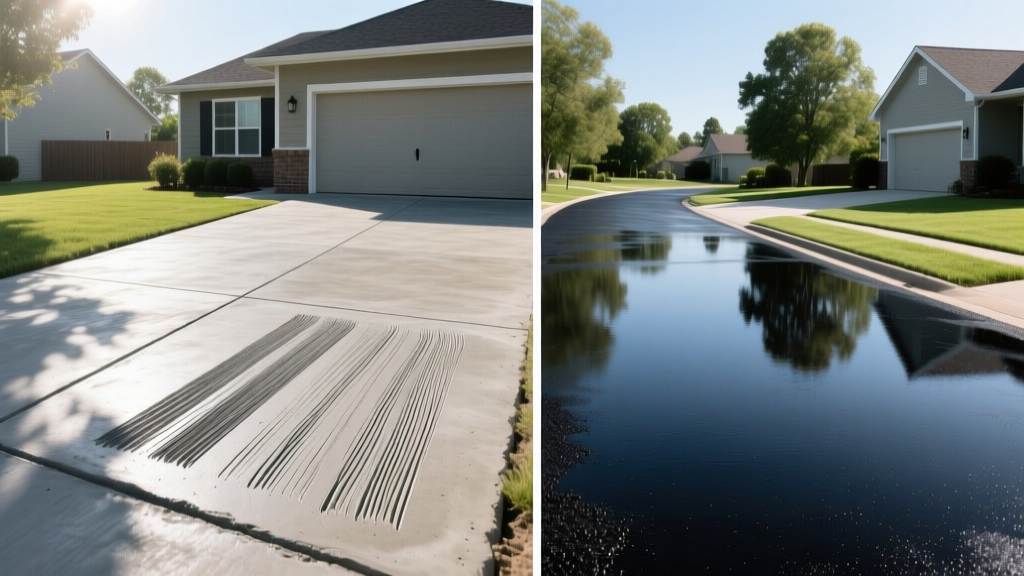
The initial installation is only half the financial equation. Asphalt requires frequent, low-cost maintenance, while concrete requires infrequent, moderate-cost maintenance. Over a 30-year horizon, the price gap narrows significantly.
"When calculating the true cost of pavement, facility managers and homeowners must factor in the Net Present Value (NPV) of maintenance. Asphalt's lower initial capital expenditure is frequently offset by the compounding costs of sealcoating, crack filling, and eventual mill-and-overlay procedures within the first two decades."
Maintenance Schedule & Costs (1,000 Sq. Ft. Driveway)
Concrete Maintenance:
- Penetrating Silane/Siloxane Sealer: Apply every 5 years to prevent chloride and water ingress. Cost: $250 - $400 per application. (Total over 30 years: ~$1,500)
- Joint Caulking: Replace polyurethane joint sealant at year 15. Cost: $300 - $500.
- Expected Lifespan: 35 to 50 years before structural replacement is needed.
Asphalt Maintenance:
- Crack Sealing: Required annually or bi-annually using hot-pour rubberized sealant. Cost: $100 - $200 per year. (Total over 30 years: ~$3,000)
- Sealcoating: Required every 3 to 4 years to protect the bitumen binder from UV oxidation. Cost: $250 - $400 per application. (Total over 30 years: ~$2,800)
- Mill and Overlay: Required at year 15-20 when the surface course deteriorates. Cost: $3,500 - $5,000.
- Expected Lifespan: 20 to 25 years before full-depth reconstruction is required.
Decision Framework: Which Mix Wins for Your Site?
Use the following parameters to determine which material aligns with your structural needs and financial strategy.
- You park heavy vehicles (RVs, boat trailers, or dump trucks) that exert high static point loads, which cause asphalt to rut in high heat.
- You plan to stay in the home for 20+ years and want to minimize annual maintenance chores.
- Your driveway features a steep gradient (over 12%); concrete provides superior traction and does not soften or bleed tar in direct summer sunlight.
- You prefer the aesthetic versatility of stamped, exposed aggregate, or integral color finishes.
- Your budget is strictly capped at the initial installation phase, and you cannot absorb the $10,000+ upfront cost of concrete.
- Your property features significant tree cover; asphalt's flexibility allows it to bridge minor subgrade shifts caused by root growth better than rigid concrete.
- You live in a region with extreme winter cold and heavy municipal snowplow traffic; asphalt is less prone to catastrophic shattering from plow blades compared to concrete edges.
- The driveway features complex curves or tight turning radii, which are faster and cheaper to pave with an asphalt paver than to form and pour with concrete.
Ultimately, the concrete vs asphalt driveway price decision hinges on your timeline. If you view the driveway as a 10-year functional surface, asphalt's lower initial capital requirement makes it the superior choice. If you view it as a 40-year structural asset integrated into your property's hardscaping, investing in a premium, fiber-reinforced concrete mix yields a lower total cost of ownership and significantly higher property value retention.
Written by
Priya KapoorPriya Kapoor is a real estate market analyst and construction economics researcher with expertise in housing affordability, development feasibility, and infrastructure investment. She holds a Master of Regional Planning from Cornell University and previously worked as a senior analyst at CBRE's Investment Properties group, where she modeled returns for $4B in mixed-use development pipelines. Priya now runs an independent research practice advising developers, municipalities, and REITs on construction cost forecasting and market timing. She publishes the quarterly "BuildMat Market Pulse" report tracking material price indices across 12 commodity categories. Based in Austin, TX, Priya serves on the board of Habitat for Humanity Austin and is a marathon runner.
More from Priya Kapoor
View all
Construction Cost
Cost to Build a 1600 Sq Ft Home in 2026: Full Breakdown
Accurate 2026 cost to build a 1600 sq ft home—material, labor, and regional pricing breakdowns included. Plan your budget with real-time estimates.
Aug 11, 2026

Wood & Lumber
Name the Types of Wood for Pressure Treatment and Preservation
Learn how to name the types of wood best suited for pressure treatment. Compare species treatability, chemical retention levels, and 2026 preservation costs.
Aug 4, 2026

Stone & Masonry
Stone Veneer Suppliers Lindenhurst: 2026 Cost Analysis
Analyze 2026 stone veneer costs in Lindenhurst, NY. Compare local supplier pricing, delivery fees, and Suffolk County installation labor rates.
Aug 4, 2026